

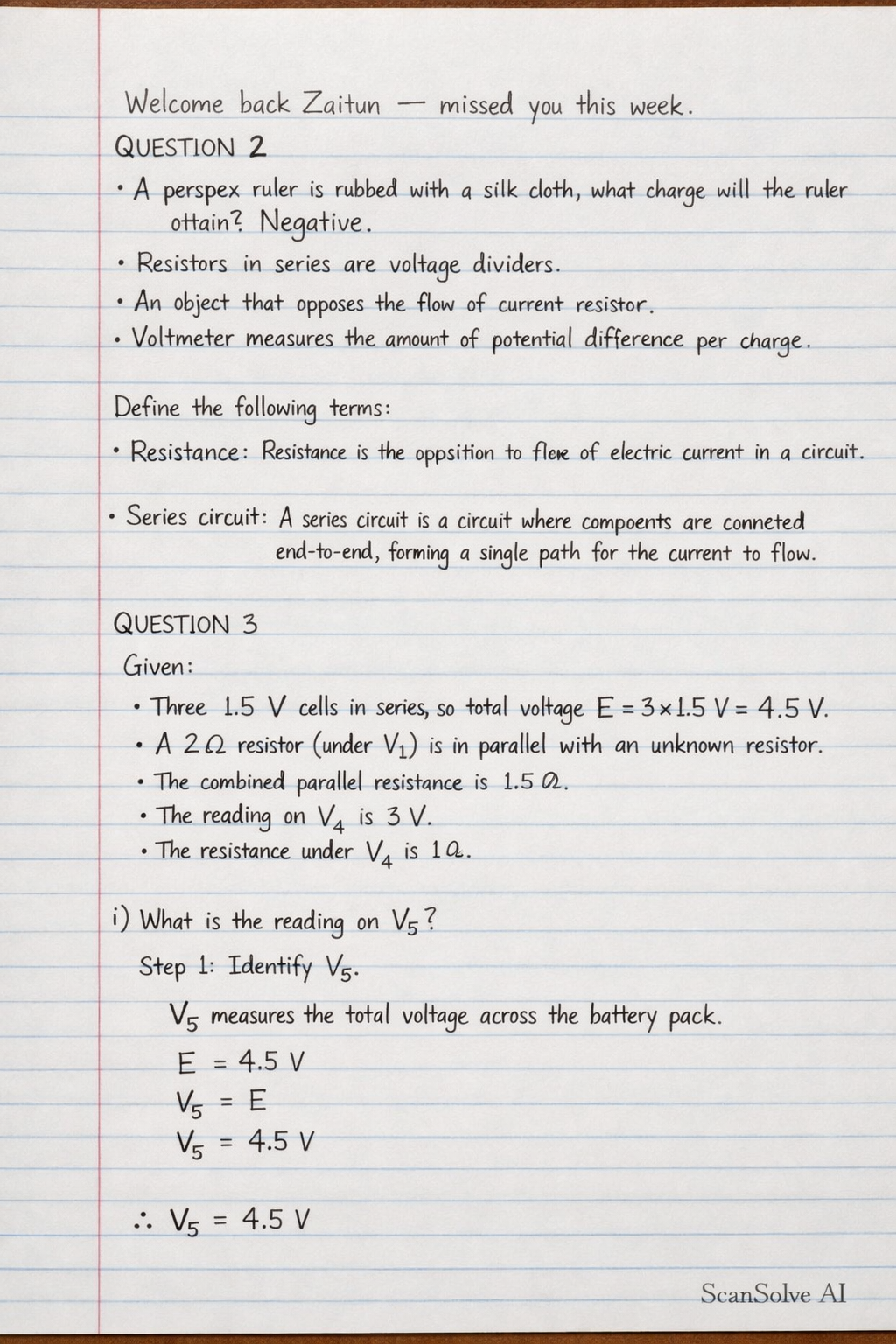
This physics problem tests your understanding of fundamental physical laws and their applications. The step-by-step solution below breaks down the problem using relevant equations and physical reasoning.
ScanSolve AI Answer
Welcome back Zaitun — missed you this week. QUESTION 2 A perspex ruler is rubbed with a silk cloth, what charge will the ruler obtain? Negative* Resistors in series are voltage* dividers. An object that opposes the flow of current resistor*. Voltmeter measures the amount of potential difference* per charge. Define the following terms: Resistance: Resistance is the opposition to the flow of electric current in a circuit.* Series circuit: A series circuit is a circuit where components are connected end-to-end, forming a single path for the current to flow.* QUESTION 3 Given: Three 1.5 V cells in series, so total voltage E = 3 × 1.5 V = 4.5 V. A 2 resistor (under V_1) is in parallel with an unknown resistor. The combined parallel resistance is 1.5 . The reading on V_4 is 3 V. The resistance under V_4 is 1 . i) What is the reading on V_5? Step 1: Identify V_5. V_5 measures the total voltage across the battery pack. Step 2: Calculate the total voltage. There are three 1.5 V cells connected in series. V_5 = 3 × 1.5 V = 4.5 V The reading on V_5 is 4.5 V. ii) What is the reading on V_1? Step 1: Understand the circuit. The 2 resistor and the unknown resistor are in parallel. This parallel combination is in series with the 1 resistor (under V_4). The ammeter A is in the main circuit. V_1 measures the voltage across the 2 resistor. Step 2: Calculate the current through the 1 resistor. The reading on V_4 is 3 V and the resistance under V_4 is 1 . Using Ohm's Law V = IR: I = (V_4)/(R_4) = 3 V1 = 3 A This is the total current flowing through the series part of the circuit. Step 3: Calculate the voltage across the parallel combination. The total voltage supplied by the cells is 4.5 V. The voltage drop across the 1 resistor is V_4 = 3 V. The voltage across the parallel combination (V_1 and V_2) is the total voltage minus the voltage drop across R_4. V_parallel = V_5 - V_4 = 4.5 V - 3 V = 1.5 V Since V_1 measures the voltage across the 2 resistor, which is part of the parallel combination, and voltage across parallel components is the same: V_1 = V_parallel = 1.5 V The reading on V_1 is 1.5 V. iii) Calculate the reading on A? Step 1: Identify ammeter A. Ammeter A is in the main circuit, measuring the total current. Step 2: Use the current calculated in part (ii). The current flowing through the 1 resistor (under V_4) is the total current in the circuit because it is in series with the parallel combination. I_total = (V_4)/(R_4) = 3 V1 = 3 A The reading on A is 3 A. iv) Calculate the resistance of the unknown resistor? Step 1: Use the given combined parallel resistance. The combined parallel resistance is 1.5 . Let the unknown resistor be R_x. The 2 resistor is in parallel with R_x. The formula for two parallel resistors is: (1)/(R_parallel) = (1)/(R_1) + (1)/(R_x) Step 2: Substitute known values and solve for R_x. (1)/(1.5 ) = (1)/(2 ) + (1)/(R_x) (1)/(R_x) = (1)/(1.5 ) - (1)/(2 ) (1)/(R_x) = (2)/(3 ) - (1)/(2 ) (1)/(R_x) = (4)/(6 ) - (3)/(6 ) (1)/(R_x) = (1)/(6 ) R_x = 6 The resistance of the unknown resistor is 6 . v) Calculate the amount of charge that flows through the ammeter in 2 seconds. Step 1: Recall the relationship between current, charge, and time. Current I is the rate of flow of charge Q over time t: I = (Q)/(t) Step 2: Use the total current from part (iii) and the given time. The current through the ammeter is I = 3 A. The time is t = 2 s. Q = I × t Q = 3 A × 2 s Q = 6 C The amount of charge that flows through the ammeter in 2 seconds is 6 C. vi) The resistor under V_4 becomes hot. This is due to energy transferred in the resistor. Calculate the amount of energy transferred in the resistor? Step 1: Identify the resistor and relevant values. The resistor under V_4 has a resistance R_4 = 1 . The voltage across it is V_4 = 3 V. The current through it is I = 3 A (from part ii). The time is not specified for this part, but typically for energy transfer questions related to heating, a time duration is needed. Assuming the question refers to the same time duration as part (v), which is t = 2 s. Step 2: Calculate the energy transferred. The energy transferred (heat) E can be calculated using the formula: E = VIt or E = I^2Rt or E = (V^2)/(R)t Using V_4 = 3 V, I = 3 A, and t = 2 s: E = 3 V × 3 A × 2 s E = 18 J The amount of energy transferred in the resistor is 18 J. Send me the next one 📸