
We read your photo as:
A rectangular object has a length of (250 ± 1) mm and a width of (200 ± 1) mm. Calculate the fractional uncertainty in length and width, and the percentage error in length.
ScanSolve AI Answer
Answers
5 partsStep-by-step solution
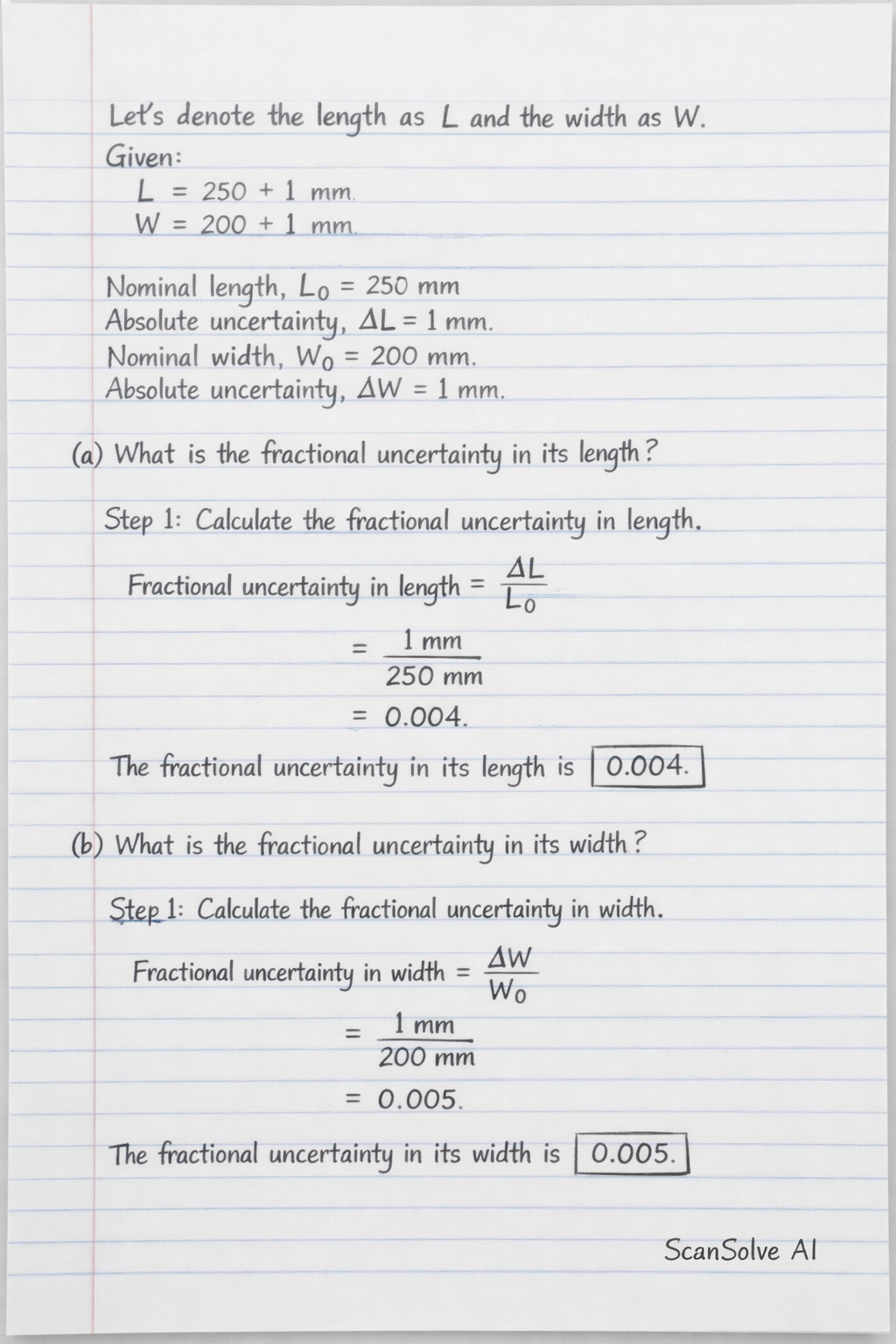
8 stepsLet's denote the length as and the width as .
Given:
Length
Width
From these values:
Nominal length
Absolute uncertainty in length
Nominal width
Absolute uncertainty in width
Part a· 1 step
What is the fractional uncertainty in its length?
Calculate the fractional uncertainty in length.
The fractional uncertainty is given by .
The fractional uncertainty in its length is .
Part b0.005
What is the fractional uncertainty in its width?
Calculate the fractional uncertainty in width.
The fractional uncertainty is given by .
The fractional uncertainty in its width is .
Part c
What is the percentage error on its length?
Calculate the percentage error in length.
The percentage error is the fractional uncertainty multiplied by .
The percentage error on its length is .
Part d
What is the percentage error on its width?
Calculate the percentage error in width.
The percentage error on its width is .
Part e
What is the area of one side of the book? State your answer with its uncertainty.
Calculate the nominal area ().
The area of one side of the book is .
Calculate the fractional uncertainty in the area ().
For multiplication, the fractional uncertainties add up:
Calculate the absolute uncertainty in the area ().
State the area with its uncertainty.
The area of one side of the book is .
Try one yourself
A new problem that tests the same skill.
Still stuck on this one?
Ask a follow-up, and the answer starts from this question.
More Physics Questions
Handwritten Step-by-Step Solution
Get this as a handwritten image on WhatsApp — like a tutor wrote it for you.
Try on WhatsApp