A regular hexagon ABCDEF has forces acting from vertex A. If the forces are 2N along AB, 4 extsqrt(3)N along AC, 8N along AD, 2 extsqrt(3)N along AE, and 4N along AF, find the resultant force.
|Physics
A regular hexagon ABCDEF has forces acting from vertex A. If the forces are 2N along AB, 4 extsqrt(3)N along AC, 8N along AD, 2 extsqrt(3)N along AE, and 4N along AF, find the resultant force.
ScanSolve AI Answer
Answer
2NactsalongAB.Angle\theta_1 = 0^\circ$.
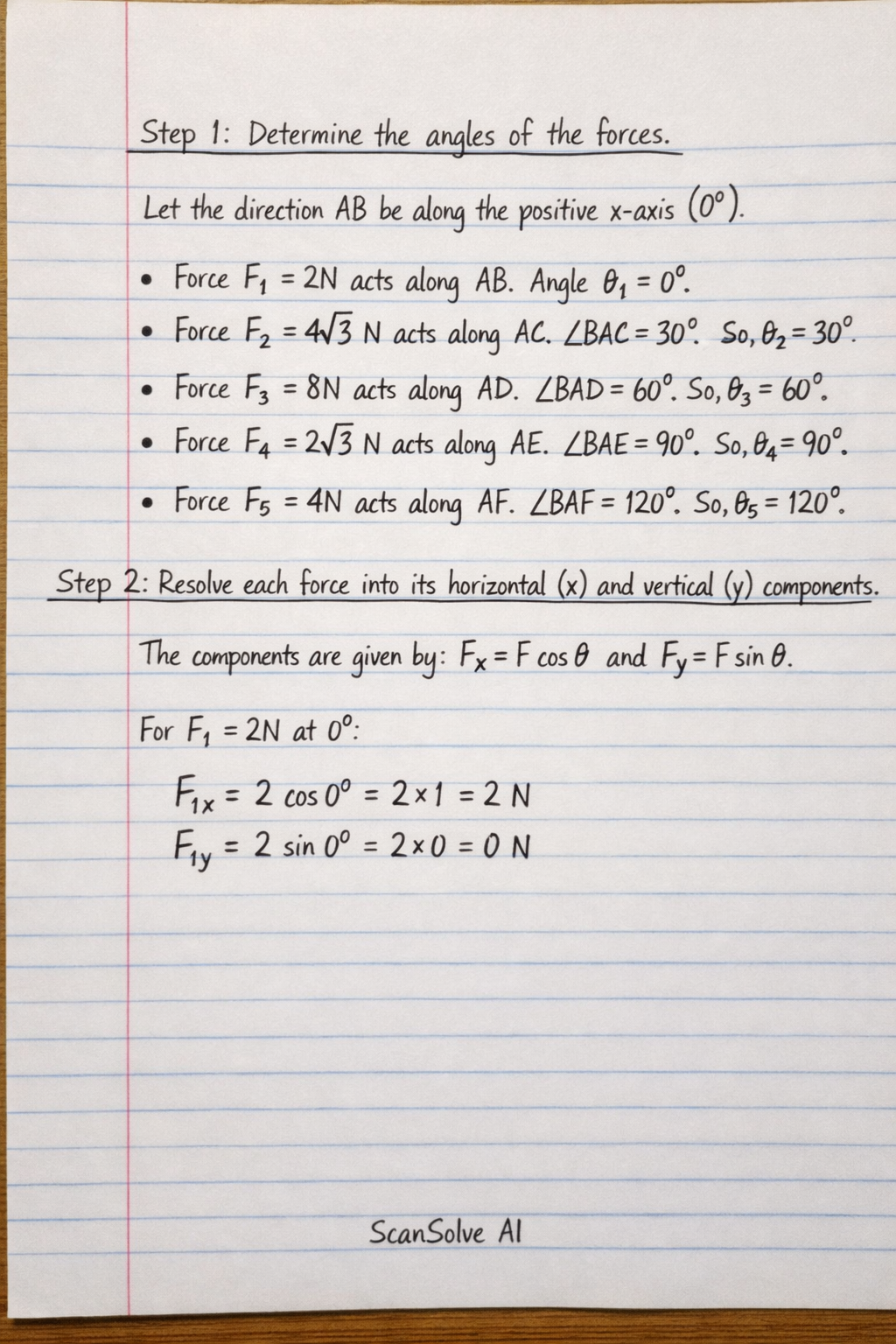
Step 1: Determine the angles of the forces.
Let the direction AB be along the positive x-axis (0∘). For a regular hexagon ABCDEF, with forces acting from vertex A:
• Force F1=2N acts along AB. Angle θ1=0∘.
• Force F2=43N acts along AC. The angle ∠BAC=30∘. So, θ2=30∘.
• Force F3=8N acts along AD. The angle ∠BAD=60∘. So, θ3=60∘.
• Force F4=23N acts along AE. The angle ∠BAE=90∘. So, θ4=90∘.
• Force F5=4N acts along AF. The angle ∠BAF=120∘. So, θ5=120∘.
Step 2: Resolve each force into its horizontal (x) and vertical (y) components.
The components are given by Fx=Fcosθ and Fy=Fsinθ.
For F1=2N at 0∘:
F1x=2cos0∘=2×1=2NF1y=2sin0∘=2×0=0N
For F2=43N at 30∘:
F2x=43cos30∘=43×23=4×23=6NF2y=43sin30∘=43×21=23N
For F3=8N at 60∘:
F3x=8cos60∘=8×21=4NF3y=8sin60∘=8×23=43N
For F4=23N at 90∘:
F4x=23cos90∘=23×0=0NF4y=23sin90∘=23×1=23N
For F5=4N at 120∘:
F5x=4cos120∘=4×(−21)=−2NF5y=4sin120∘=4×23=23N
Step 3: Sum the horizontal and vertical components to find the resultant components (Rx,Ry).
Rx=F1x+F2x+F3x+F4x+F5xRx=2N+6N+4N+0N+(−2N)=10N
Determine the angles of the forces. Let the direction AB be along the positive x-axis (0^).
A regular hexagon ABCDEF has forces acting from vertex A. If the forces are 2N along AB, 4 extsqrt(3)N along AC, 8N along AD, 2 extsqrt(3)N along AE, and 4N along AF, find the resultant force.
This physics problem tests your understanding of fundamental physical laws and their applications. The step-by-step solution below breaks down the problem using relevant equations and physical reasoning.
ScanSolve AI Answer
Step 1: Determine the angles of the forces. Let the direction AB be along the positive x-axis (0^). For a regular hexagon ABCDEF, with forces acting from vertex A: • Force F_1 = 2N acts along AB. Angle _1 = 0^. • Force F_2 = 4sqrt(3)N acts along AC. The angle BAC = 30^. So, _2 = 30^. • Force F_3 = 8N acts along AD. The angle BAD = 60^. So, _3 = 60^. • Force F_4 = 2sqrt(3)N acts along AE. The angle BAE = 90^. So, _4 = 90^. • Force F_5 = 4N acts along AF. The angle BAF = 120^. So, _5 = 120^. Step 2: Resolve each force into its horizontal (x) and vertical (y) components. The components are given by F_x = F and F_y = F . For F_1 = 2N at 0^: F_1x = 2 0^ = 2 × 1 = 2N F_1y = 2 0^ = 2 × 0 = 0N For F_2 = 4sqrt(3)N at 30^: F_2x = 4sqrt(3) 30^ = 4sqrt(3) × sqrt(3)2 = 4 × (3)/(2) = 6N F_2y = 4sqrt(3) 30^ = 4sqrt(3) × (1)/(2) = 2sqrt(3)N For F_3 = 8N at 60^: F_3x = 8 60^ = 8 × (1)/(2) = 4N F_3y = 8 60^ = 8 × sqrt(3)2 = 4sqrt(3)N For F_4 = 2sqrt(3)N at 90^: F_4x = 2sqrt(3) 90^ = 2sqrt(3) × 0 = 0N F_4y = 2sqrt(3) 90^ = 2sqrt(3) × 1 = 2sqrt(3)N For F_5 = 4N at 120^: F_5x = 4 120^ = 4 × (-(1)/(2)) = -2N F_5y = 4 120^ = 4 × sqrt(3)2 = 2sqrt(3)N Step 3: Sum the horizontal and vertical components to find the resultant components (R_x, R_y). R_x = F_1x + F_2x + F_3x + F_4x + F_5x R_x = 2N + 6N + 4N + 0N + (-2N) = 10N R_y = F_1y + F_2y + F_3y + F_4y + F_5y R_y = 0N + 2sqrt(3)N + 4sqrt(3)N + 2sqrt(3)N + 2sqrt(3)N = (2+4+2+2)sqrt(3)N = 10sqrt(3)N Step 4: Calculate the magnitude of the resultant force (R). R = sqrt(R_x^2 + R_y^2) R = sqrt((10N)^2 + (103)N)^2 R = sqrt(100N^2 + (100 × 3)N^2) R =