
We read your photo as:
A spring-mass system, resting on an inclined plane, is subjected to a harmonic force as shown in Fig. 3.38. Find the response of the system by assuming zero initial conditions.
ScanSolve AI Answer
This answer stops before the end.
It was cut off when it was first written. Ask ScanSolve this question again for the full working.
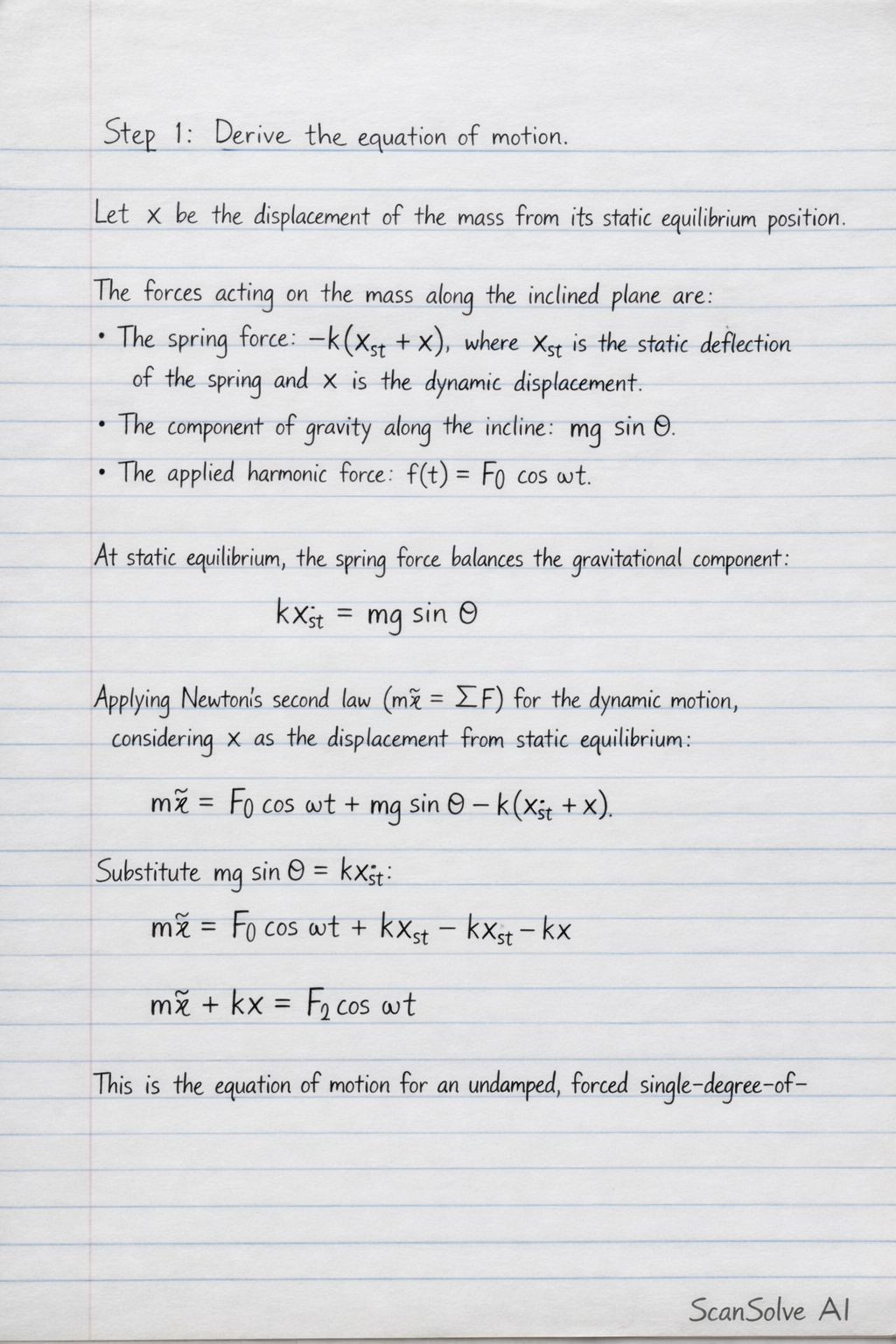
Step 1: Derive the equation of motion.
Let be the displacement of the mass from its static equilibrium position.
The forces acting on the mass along the inclined plane are:
- The spring force: , where is the static deflection of the spring and is the dynamic displacement.
- The component of gravity along the incline: .
- The applied harmonic force: .
At static equilibrium, the spring force balances the gravitational component:
Applying Newton's second law () for the dynamic motion, considering as the displacement from static equilibrium:
Substitute :
This is the equation of motion for an undamped, forced single-degree-of-
Still stuck on this one?
Ask a follow-up, and the answer starts from this question.
More Physics Questions
Handwritten Step-by-Step Solution
Get this as a handwritten image on WhatsApp — like a tutor wrote it for you.
Try on WhatsApp