
We read your photo as:
A spring with an unknown natural length and spring constant extends by 1.225 m when a 1 kg mass is attached to it. If the total length of the spring is then 2.49 m, what is its natural length and spri
Physics
ScanSolve AI Answer
Answer
Step-by-step solution
3 stepsCalculate the force exerted by the mass.
Given:
Mass
Acceleration due to gravityThe force () acting on the spring is the weight of the mass:
Calculate the extension of the spring () when supporting the mass.
Using Hooke's Law () and the spring constant from Step 1:
Calculate the natural length () of the spring.
The total length of the spring when supporting the mass is given as . This total length is the sum of the natural length and the extension.
Total lengthThe natural length of the spring is and the spring constant is .
Was this helpful?
Try one yourself
A new problem that tests the same skill.
Still stuck on this one?
Ask a follow-up, and the answer starts from this question.
Got a different question?Ask your own question
More Physics Questions
QA spring has natural length 2 cm. When a mass of 5 g is attached, its length is 3.5 cm. What is the…QCalculate the spring constant of a spring given a force and extension, and set up the equation for a…QA student hangs different loads on a spring as shown. a) Determine the spring constant of the…QA spring stretches 0.05 m under a force of 40 N. Find the energy stored in it. A spring has a Force…QSolve the modulus of elasticity for the previous question. 2.Two springs AB and BC are joined…
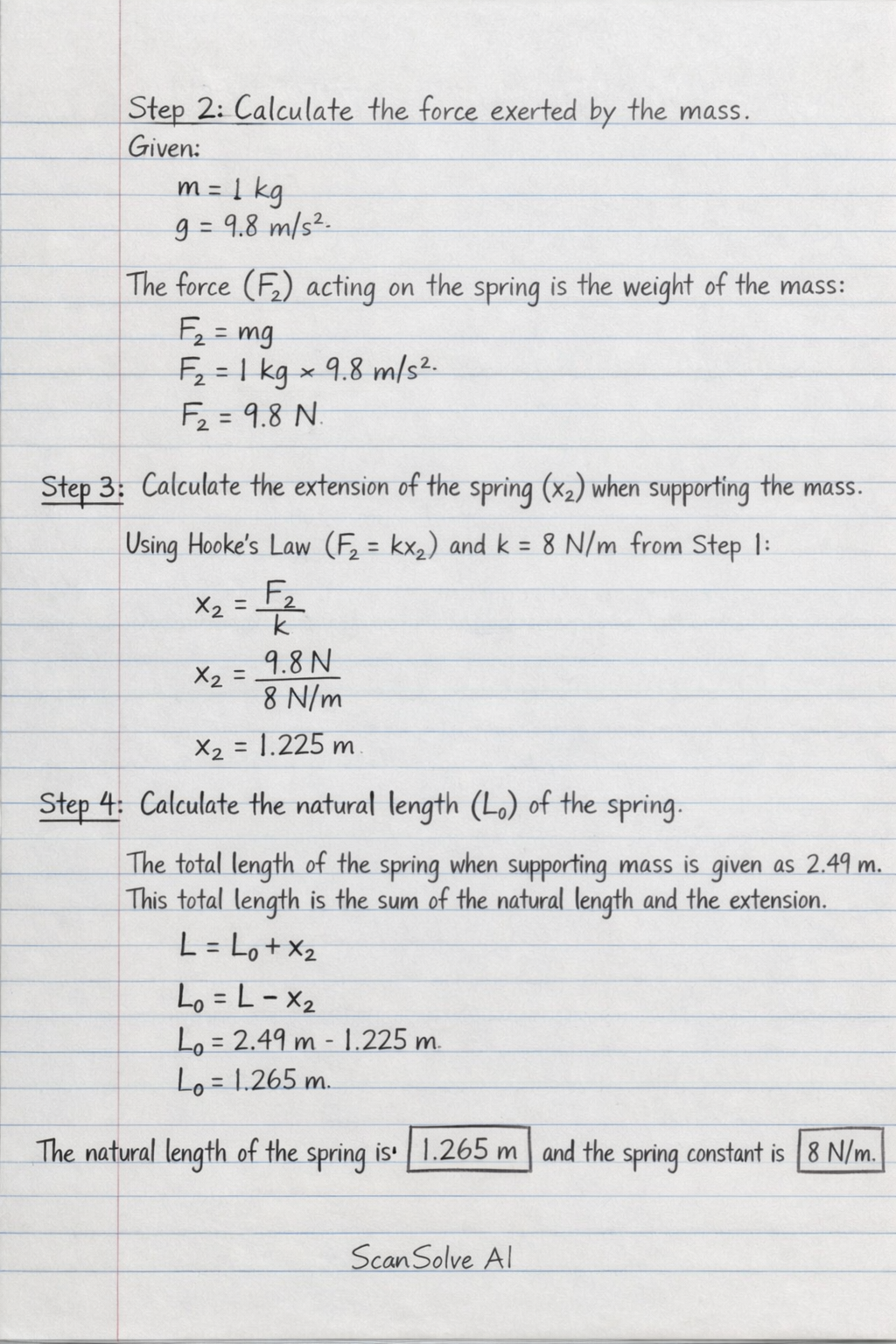
Handwritten Step-by-Step Solution
Get this as a handwritten image on WhatsApp — like a tutor wrote it for you.
Try on WhatsApp