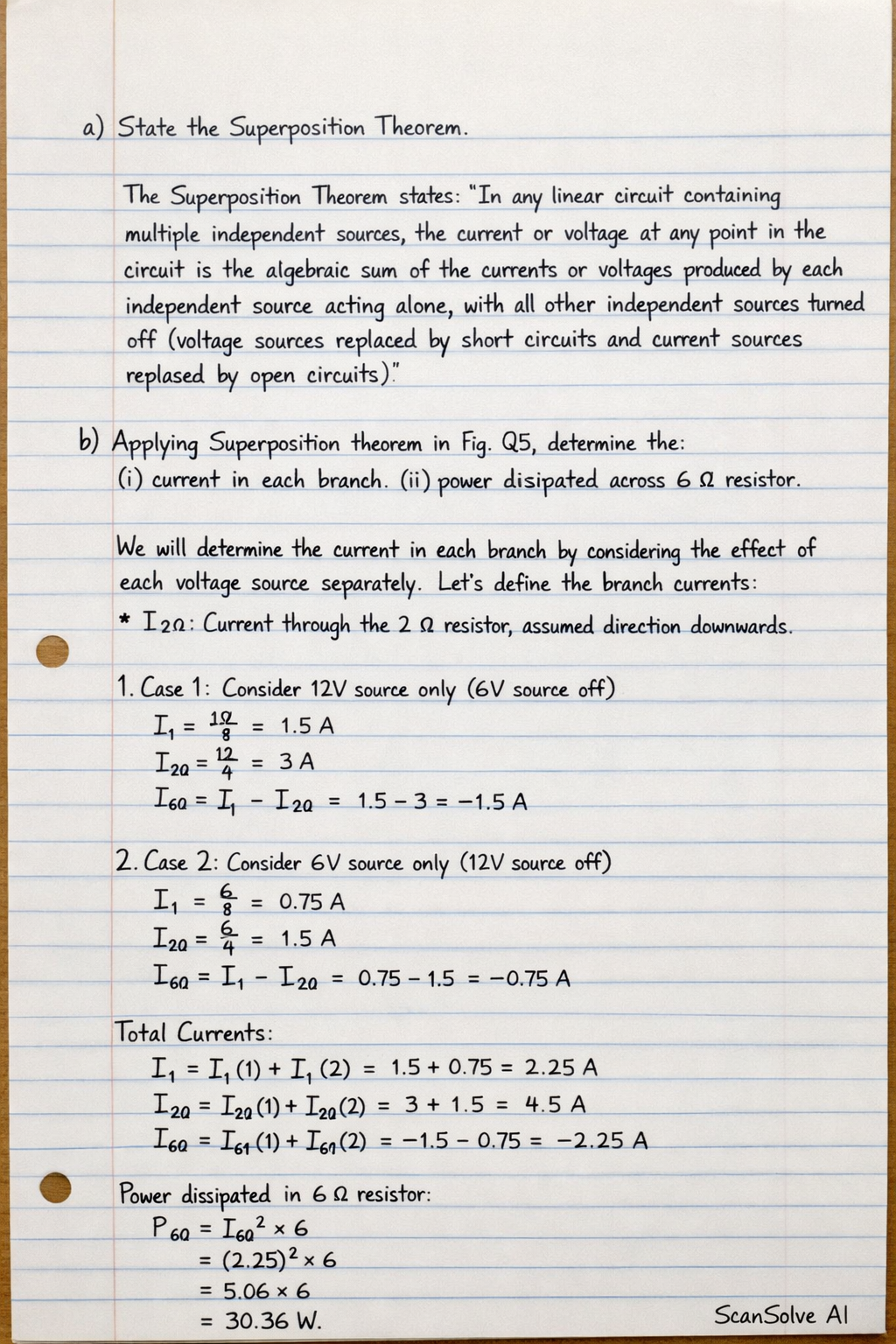
State the Superposition theorem. Applying Superposition theorem in Fig. Q5, determine the (i) current in each branch and (ii) power dissipated across 6 Ω resistor.

Physics
State the Superposition theorem. Applying Superposition theorem in Fig. Q5, determine the (i) current in each branch and (ii) power dissipated across 6 Ω resistor.

ScanSolve AI Answer

a) State the Superposition's theorem.

The Superposition Theorem states that in any linear circuit containing multiple independent sources, the current or voltage at any point in the circuit is the algebraic sum of the currents or voltages produced by each independent source acting alone, with all other independent sources turned off (voltage sources replaced by short circuits and current sources replaced by open circuits).

b) Applying Superposition theorem in Fig. Q5, determine the (i) current in each branch (ii) power dissipated across 6 Ω\Omega resistor.

We will determine the current in each branch by considering the effect of each voltage source separately. Let's define the branch currents:

  • I2ΩI_{2\Omega}: Current through the 2 Ω\Omega resistor, assumed direction downwards.
Was this helpful?

Need help with your own homework?

Get instant step-by-step solutions to any question. Free to start.

Ask Your Question
Handwritten step-by-step solution preview

Handwritten Step-by-Step Solution

Get this as a handwritten image on WhatsApp — like a tutor wrote it for you.

Try on WhatsApp

Still have questions?

State the Superposition theorem. Applying Superposition theorem in Fig. Q5, determine the (i) current in each branch and (ii) power dissipated across 6 Ω resistor.
Physics

This physics problem tests your understanding of fundamental physical laws and their applications. The step-by-step solution below breaks down the problem using relevant equations and physical reasoning.

ScanSolve AI Answer
a) State the Superposition's theorem. The Superposition Theorem states that in any linear circuit containing multiple independent sources, the current or voltage at any point in the circuit is the algebraic sum of the currents or voltages produced by each independent source acting alone, with all other independent sources turned off (voltage sources replaced by short circuits and current sources replaced by open circuits). b) Applying Superposition theorem in Fig. Q5, determine the (i) current in each branch (ii) power dissipated across 6 resistor. We will determine the current in each branch by considering the effect of each voltage source separately. Let's define the branch currents: I_2: Current through the 2 resistor, assumed direction downwards.