
We read your photo as:
A student set up a circuit to measure the potential difference across a bulb using a voltmeter. Identify and correct any defects in the circuit diagram and explain the reasons.
ScanSolve AI Answer
Here are the solutions to the exercises:
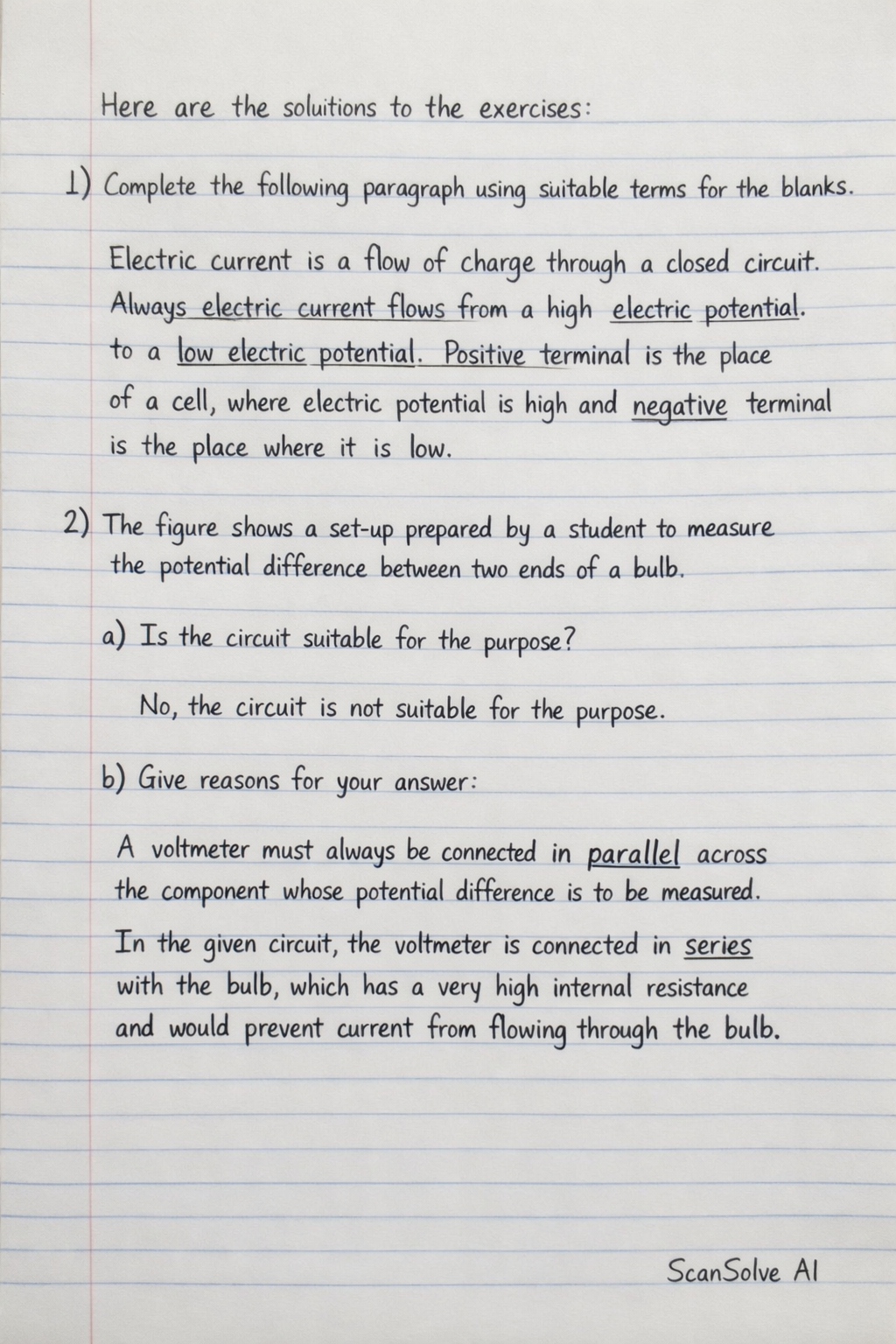
1) Complete the following paragraph using suitable terms for the blanks.
Electric current is a flow of charge through a closed circuit. Always electric current flows from a high electric potential to a low electric potential. Positive terminal is the place of a cell, where electric potential is high and negative terminal is the place where it is low.
2) The figure shows a set-up prepared by a student to measure the potential difference between two ends of a bulb.
a) Is the circuit suitable for the purpose?
No, the circuit is not suitable for the purpose.
b) Give reasons for your answer.
A voltmeter must always be connected in parallel across the component whose potential difference is to be measured. In the given circuit, the voltmeter is connected in series with the bulb, which has a very high internal resistance and would prevent current from flowing through the bulb.
3) If there is any defect, correct it and draw the circuit again.
The defect is the series connection of the voltmeter. It should be connected in parallel across the bulb.
Here is the corrected circuit diagram:
\begin{circuitikz} \draw
(0,0) to[battery] (0,2)
to[switch] (2,2)
to[bulb, l_=$R$] (4,2)
(4,2) -- (4,0)
(0,0) -- (4,0)
(4,2) to[voltmeter, v_=$V$] (4,0);
\end{circuitikz}
Note: The voltmeter is now connected across the bulb, in parallel.
4) Mention two facts that should be considered when connecting a voltmeter to a circuit.
- A voltmeter must always be connected in parallel across the component whose potential difference is to be measured.
- A voltmeter has a very high internal resistance to ensure it draws negligible current from the circuit and does not alter the potential difference being measured.
Still stuck on this one?
Ask a follow-up, and the answer starts from this question.
More Physics Questions
Handwritten Step-by-Step Solution
Get this as a handwritten image on WhatsApp — like a tutor wrote it for you.
Try on WhatsApp