Elucidate the history of The Last and present of the Universe.

Physics
Elucidate the history of The Last and present of the Universe.

ScanSolve AI Answer

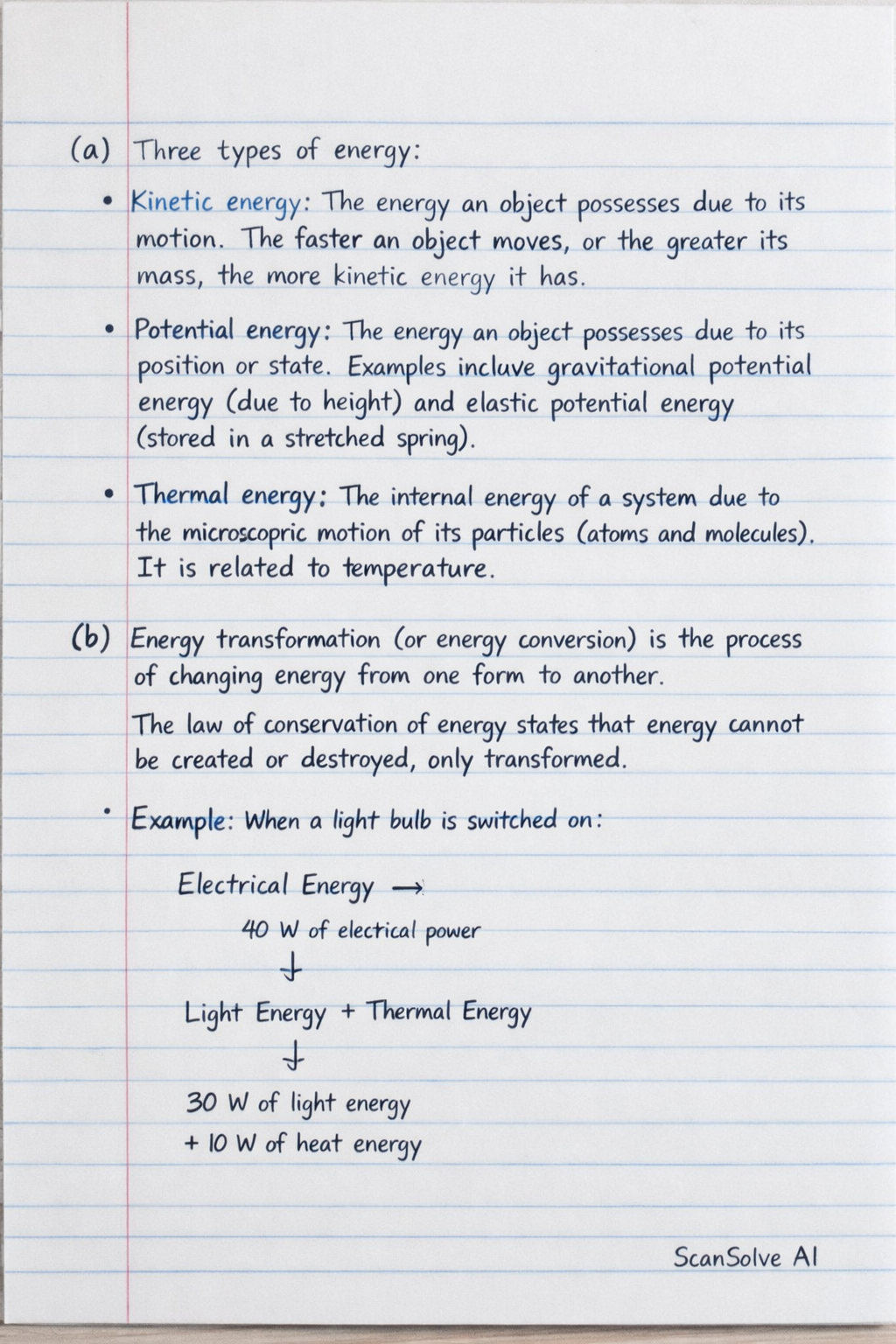
a) Three types of energy:

  • Kinetic energy: The energy an object possesses due to its motion. The faster an object moves, or the greater its mass, the more kinetic energy it has.
  • Potential energy: The energy an object possesses due to its position or state. Examples include gravitational potential energy (due to height) and elastic potential energy (stored in a stretched spring).
  • Thermal energy: The internal energy of a system due to the microscopic motion of its particles (atoms and molecules). It is related to temperature.

b) Energy transformation (or energy conversion) is the process of changing energy from one form to another. The law of conservation of energy states that energy cannot be created or destroyed, only transformed.

  • Example: When a light bulb is switched on, electrical energy is transformed into light energy and thermal energy.
Was this helpful?

Need help with your own homework?

Get instant step-by-step solutions to any question. Free to start.

Ask Your Question
Handwritten step-by-step solution preview

Handwritten Step-by-Step Solution

Get this as a handwritten image on WhatsApp — like a tutor wrote it for you.

Try on WhatsApp

Still have questions?

Quick Answer

a) Three types of energy: Kinetic energy*: The energy an object possesses due to its motion.

Elucidate the history of The Last and present of the Universe.
Physics

This physics problem tests your understanding of fundamental physical laws and their applications. The step-by-step solution below breaks down the problem using relevant equations and physical reasoning.

ScanSolve AI Answer
a) Three types of energy: Kinetic energy*: The energy an object possesses due to its motion. The faster an object moves, or the greater its mass, the more kinetic energy it has. Potential energy*: The energy an object possesses due to its position or state. Examples include gravitational potential energy (due to height) and elastic potential energy (stored in a stretched spring). Thermal energy*: The internal energy of a system due to the microscopic motion of its particles (atoms and molecules). It is related to temperature. b) Energy transformation (or energy conversion) is the process of changing energy from one form to another. The law of conservation of energy states that energy cannot be created or destroyed, only transformed. Example: When a light bulb is switched on, electrical energy is transformed into light energy and thermal energy.