
We read your photo as:
A U-tube manometer contains a liquid with density 0.8 g/cm³. If the liquid levels in the open and gas sides are 9 cm above and 9 cm below a reference line, respectively, what is the gas pressure?
Physics
ScanSolve AI Answer
Answer
Step-by-step solution
4 stepsHere's how to determine the gas pressure:
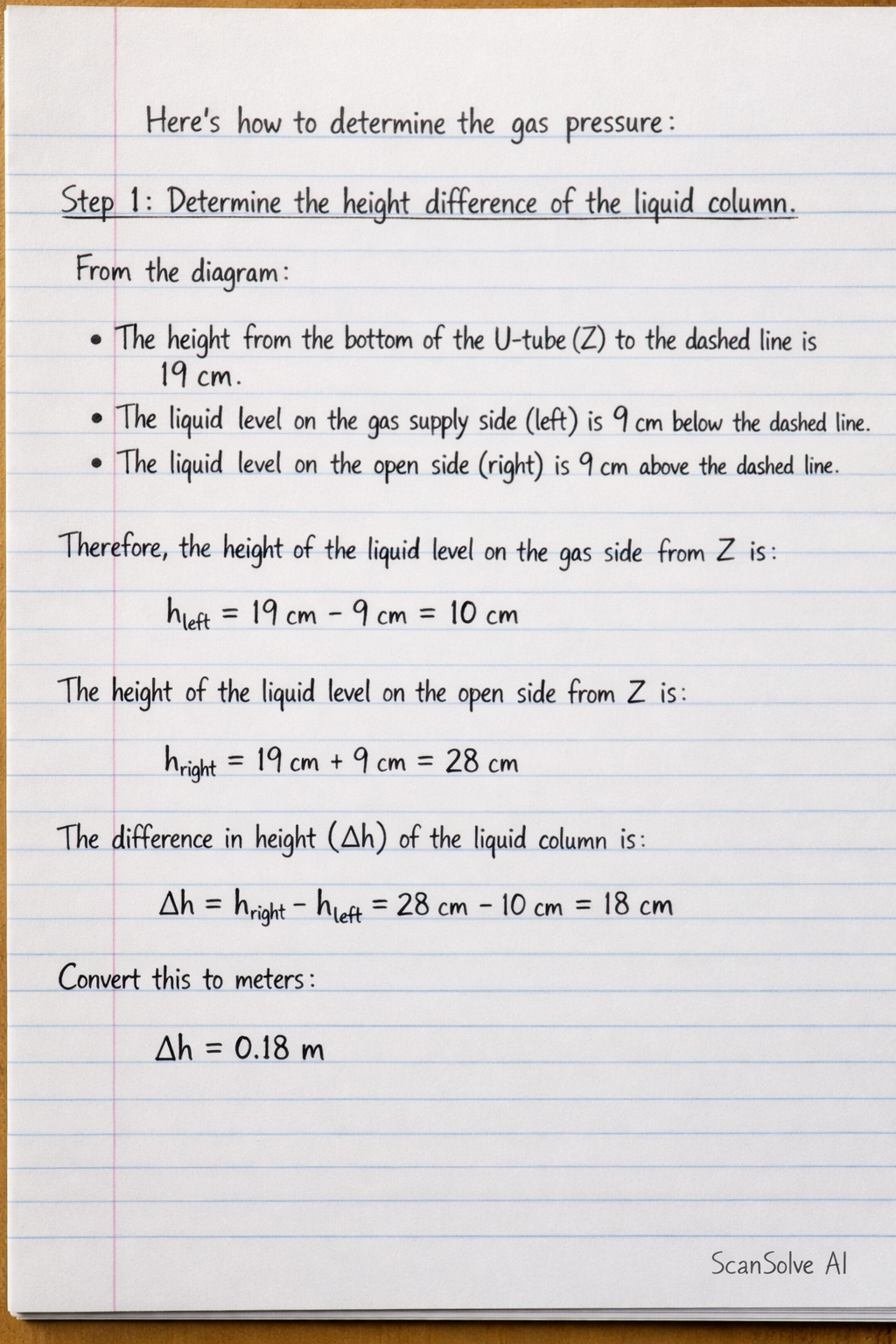
Determine the height difference of the liquid column.
From the diagram:
- The height from the bottom of the U-tube (Z) to the dashed line is .
- The liquid level on the gas supply side (left) is below the dashed line.
- The liquid level on the open side (right) is above the dashed line.
Therefore, the height of the liquid level on the gas side from Z is:
The height of the liquid level on the open side from Z is:
The difference in height () of the liquid column is:
Convert this to meters:
Convert the density of the liquid to SI units.
Given density of the liquid () is .
Calculate the pressure due to the liquid column.
We use the formula . We'll use .
Determine the gas pressure.
Since the liquid level on the gas supply side is lower than on the open side, the gas pressure is greater than the atmospheric pressure.
Given .
The gas pressure is .
Was this helpful?
Try one yourself
A new problem that tests the same skill.
Still stuck on this one?
Ask a follow-up, and the answer starts from this question.
Got a different question?Ask your own question
More Physics Questions
QA U-tube manometer measures the pressure of a gas supply. The water level on the gas supply side is…QA U-tube manometer contains mercury. The open end is exposed to atmospheric pressure of 75 cmHg. A…QA gas is supplied at atmospheric pressure of 74 cmHg. A manometer containing water shows a…QThe figure below shows a water U-tube manometer used to measure the gas pressure of a gas supply…QA U-tube contains two liquids, X and Y, with densities hoX = 1000 ext kg/m3 and hoY = 800 ext kg/m3…
Handwritten Step-by-Step Solution
Get this as a handwritten image on WhatsApp — like a tutor wrote it for you.
Try on WhatsApp