
We read your photo as:
A) What is a homogeneous equation? B) Determine the values of alpha and beta for the relation T = Ck^alpha m^beta where T is period, k is spring constant, and m is mass.
ScanSolve AI Answer
Step-by-step solution
4 stepsa) An equation is homogeneous if the dimensions of all terms on both sides of the equation are identical. This means that the units on the left side of the equation must match the units on the right side, ensuring the equation is physically consistent.
b) Determine the values of and .
Write down the dimensions of each physical quantity in the given relation .
- The dimension of period is time: .
- The constant is dimensionless: .
- The dimension of mass is: .
- The dimension of spring constant : From Hooke's Law, , so . The dimension of force is . The dimension of length is . Therefore, the dimension of is .
Substitute the dimensions into the given equation.
Combine the powers of the same fundamental dimensions:
Equate the powers of the fundamental dimensions on both sides of the equation.
For mass :
For time :
Solve the system of equations for and .
From equation (2):
Substitute the value of into equation (1):
The values are and .
The relation is .The values of and are .
Still stuck on this one?
Ask a follow-up, and the answer starts from this question.
More Physics Questions
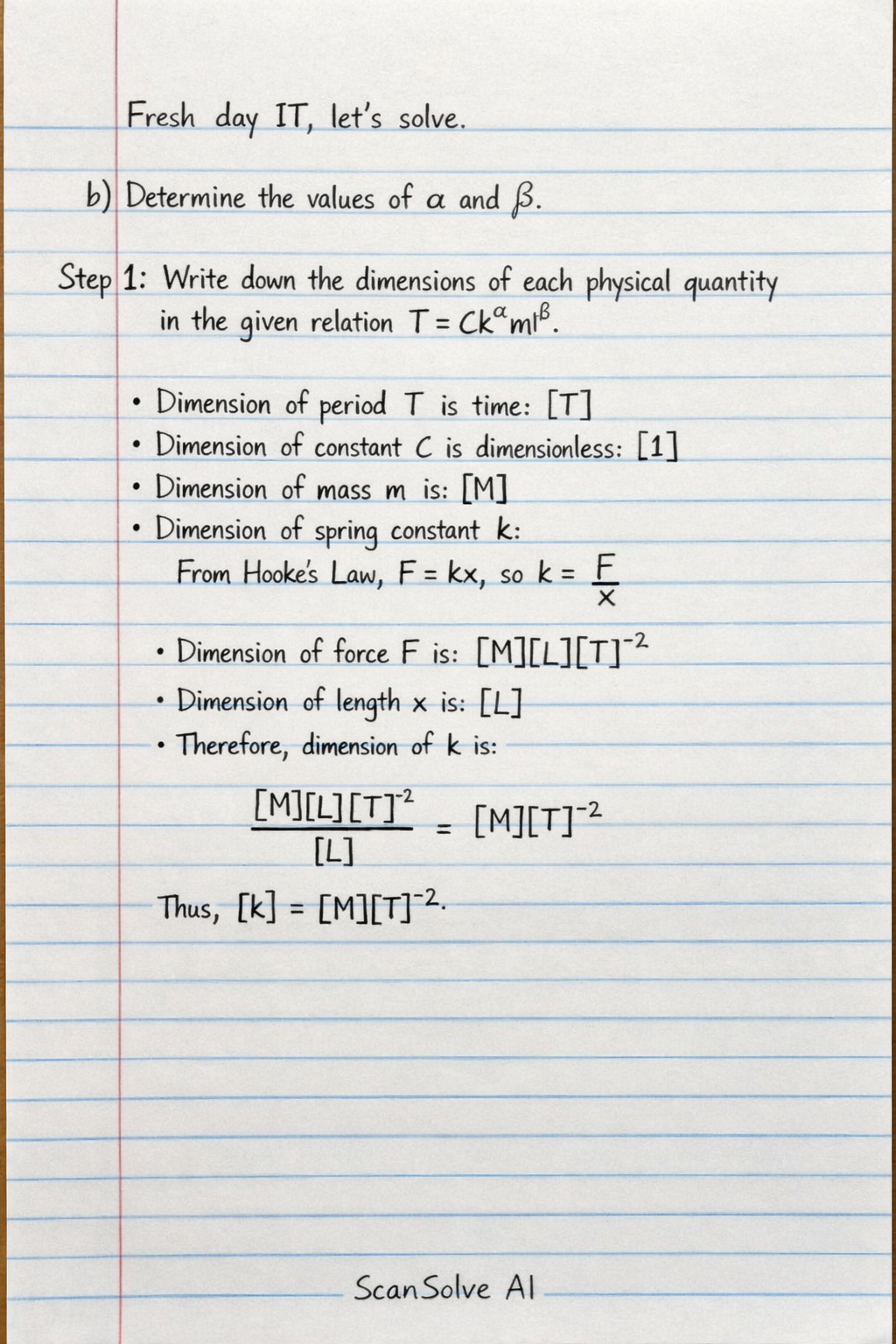
Handwritten Step-by-Step Solution
Get this as a handwritten image on WhatsApp — like a tutor wrote it for you.
Try on WhatsApp