
We read your photo as:
A wire of diameter 1mm carries a current of 20A. What is the current density in the wire?
ScanSolve AI Answer
Answer
Step-by-step solution
22 stepsHere are the solutions to the questions:
6. The change in potential energy of an electron is when it transverse between two points A and B. Find the change in potential between these points. ()
Identify the given values and the formula.
The change in potential energy () is related to the charge () and the change in potential () by the formula .
Given:
The charge of an electron is . (The problem states , which is the magnitude of the elementary charge. For an electron, the charge is negative.)Rearrange the formula and substitute the values.
Calculate the change in potential.
There is a significant discrepancy between this calculated value and the provided options. If we assume a typo in the question and that the potential energy was instead of , then:
This value is approximately , which matches option (d). Assuming this typo:
The correct option is (d).7. Two charges and are situated at and respectively on the positive x-axis of a co-ordinate system. Find the total electric potential at a point away from the origin due to these charges.
Identify the given values and the formula for electric potential.
The electric potential () due to a point charge () at a distance () is given by , where .
Given:
at
at
Point of interest is at .Calculate the distance from each charge to the point of interest.
Distance from to :
Distance from to :Calculate the potential due to each charge and sum them.
Total potential
Compare with options.
The calculated value is approximately .
The correct option is (b).8. Copper contains free electrons/m. A copper wire of cross-sectional area carries a current of . The electron drift speed is approximately:
Identify the given values and the formula for drift speed.
The current () in a conductor is related to the number density of charge carriers (), the cross-sectional area (), the drift speed (), and the charge of each carrier () by the formula .
Given:
Charge of an electronRearrange the formula to solve for drift speed.
Substitute the values and calculate the drift speed.
The correct option is (d).
9. A given wire of resistance has a length of and a cross-sectional area of . Calculate the conductivity of the wire.
Identify the given values and the formulas for resistivity and conductivity.
Resistance () is given by , where is resistivity, is length, and is cross-sectional area. Conductivity () is the reciprocal of resistivity, .
Given:
Calculate the resistivity ().
Rearrange the resistance formula:
Calculate the conductivity ().
Convert the conductivity to and compare with options.
Since , then .
There is a significant discrepancy between this calculated value and the provided options, which are in the range of to . If we assume a typo in the cross-sectional area, and it was instead of , then:
Converting to :
This matches option (b). Assuming this typo:
The correct option is (b).10. A wire of diameter carries a current of . What is the current density in the wire?
Identify the given values and the formula for current density.
Current density () is defined as current () per unit cross-sectional area (), .
Given:
Diameter
CurrentConvert diameter to meters and calculate the radius.
Calculate the cross-sectional area ().
Calculate the current density ().
Compare with options.
The calculated value is approximately .
The correct option is (a).11. An electric bulb is rated . Calculate the resistance of its Filament when it is operating normally.
Identify the given values and the formula for power, voltage, and resistance.
The power () dissipated by a resistor is related to the voltage () across it and its resistance () by the formula .
Given:
Power
VoltageRearrange the formula to solve for resistance.
Substitute the values and calculate the resistance.
The options are not visible for this question, but the calculation is straightforward.
Try one yourself
A new problem that tests the same skill.
Still stuck on this one?
Ask a follow-up, and the answer starts from this question.
More Physics Questions
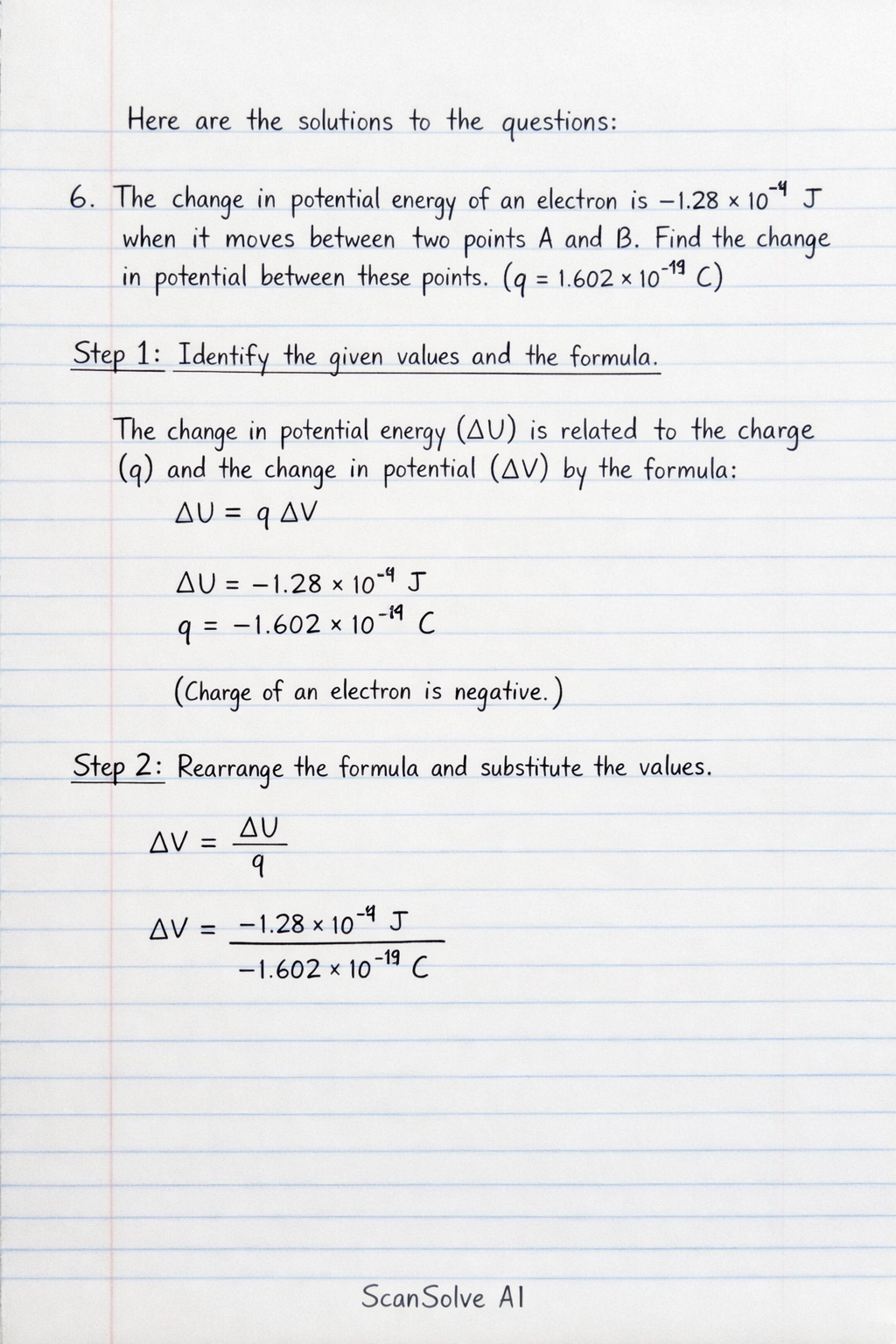
Handwritten Step-by-Step Solution
Get this as a handwritten image on WhatsApp — like a tutor wrote it for you.
Try on WhatsApp