
We read your photo as:
A cell of internal resistance 5Ω is connected to a resistor of 3Ω. Find the current flowing through the resistor if the e.m.f. of the battery is 1.2V.
ScanSolve AI Answer
Answer
Step-by-step solution
11 stepsHere are the solutions to the questions:
1. A cell of internal resistance is connected to a resistor of . Find the current flowing through the resistor if the e.m.f. of the battery is .
Calculate the total resistance in the circuit.
The internal resistance () and the external resistance () are in series.
Use Ohm's Law to find the current.
Ohm's Law states that , where is the e.m.f., is the current, and is the total resistance.
The correct option is (a).
2. What is the resistivity of a wire of length and cross sectional area of if it offers a resistance of to the flow of current?
Convert the length to meters.
Use the formula for resistance to find resistivity.
The resistance of a wire is given by , where is the resistivity, is the length, and is the cross-sectional area.
Rearrange the formula to solve for resistivity :The correct option is (b).
3. A heating filament with p.d. of across its ends has a current of flowing through it for 3 seconds. Determine the heat energy generated in the filament if 80 percent of the electrical energy produced is converted to heat.
Calculate the total electrical energy produced.
The electrical energy () produced is given by , where is the potential difference, is the current, and is the time.
Calculate the heat energy generated.
Only of the electrical energy is converted to heat.
The correct option is (d).
4. If the current flowing through a conductor is doubled and the resistance is constant, the power consumed by the conductor will increase to ..... times the original amount.
Recall the formula for power.
Power () consumed by a conductor is given by , where is the current and is the resistance.
Analyze the change in power when current is doubled.
Let the original current be and the original power be .
If the current is doubled, the new current . The resistance remains constant.
The new power will be:Compare the new power to the original power.
Since , we have:
The power consumed will increase to 4 times the original amount.
The correct option is (b).5. In a series circuit with two resistors of equal value and a total current flow of , the current through each resistor is ............
Understand current in a series circuit.
In a series circuit, the current is the same at every point. This means the current flowing through each component (including each resistor) is equal to the total current flowing through the circuit.
Determine the current through each resistor.
Given that the total current flow is , the current through each resistor in the series circuit will also be . The fact that there are two resistors of equal value is relevant for calculating voltage drops or total resistance, but not for the current through individual components in a series circuit.
The question does not provide options that include . This suggests there might be a misunderstanding in the question or the provided options. However, based on the principles of series circuits, the current through each resistor must be the same as the total current. If this were a parallel circuit, the current would divide. Since it's explicitly stated as a series circuit, the current is constant.Given the options (a) and (b) , neither is . If the question intended to ask about a parallel circuit where the total current of splits equally between two identical resistors, then the current through each would be . However, the question clearly states "series circuit".
Assuming there might be a typo in the question and it meant to ask for current in a parallel circuit with two identical resistors and a total current of :
If it were a parallel circuit with two equal resistors, the total current would split equally between them.If we strictly follow the question as written (series circuit), the answer should be . Since is not an option, and is an option, it's highly probable the question implicitly assumes a parallel circuit or has a typo. Given the options, is the most plausible intended answer if the question meant to imply current division.
Let's assume the question intended to ask about a parallel circuit, as is an option.
In a parallel circuit, if two resistors are of equal value, the total current divides equally between them.The correct option would be (a) under this assumption.
However, if we strictly adhere to the "series circuit" statement:
In a series circuit, the current is the same through all components.
Therefore, the current through each resistor would be . Since is not an option, there is an inconsistency. I will proceed with the assumption that the question implies a scenario where the current divides, which would be a parallel circuit, given the options.Assuming the question implies a parallel circuit for the options to make sense:
Try one yourself
A new problem that tests the same skill.
Still stuck on this one?
Ask a follow-up, and the answer starts from this question.
More Physics Questions
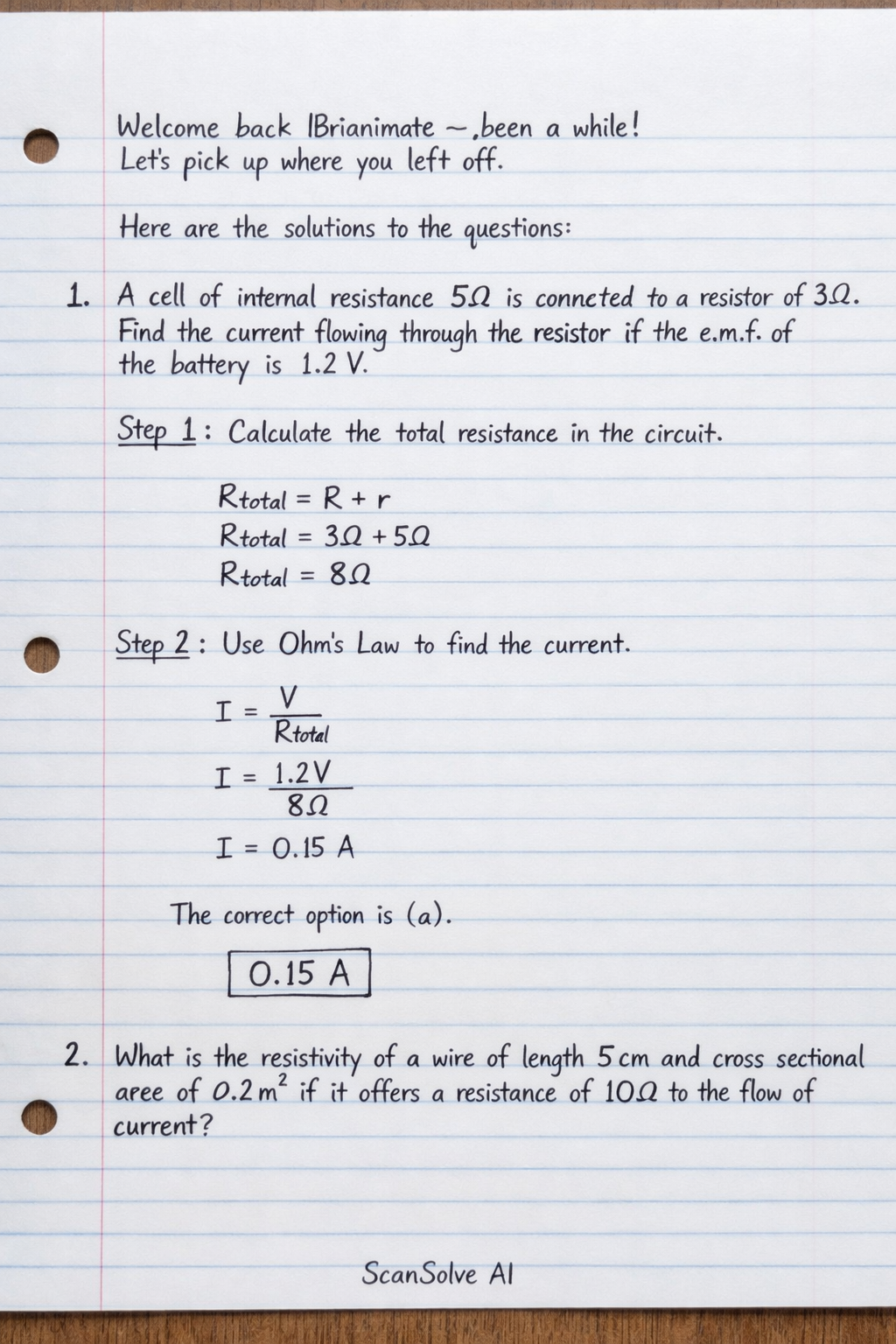
Handwritten Step-by-Step Solution
Get this as a handwritten image on WhatsApp — like a tutor wrote it for you.
Try on WhatsApp