
We read your photo as:
Determine the Emf of the battery and its internal resistance using the provided circuit data.
ScanSolve AI Answer
Step-by-step solution
3 stepsAddress Question 3 - Determine the Emf of the battery.
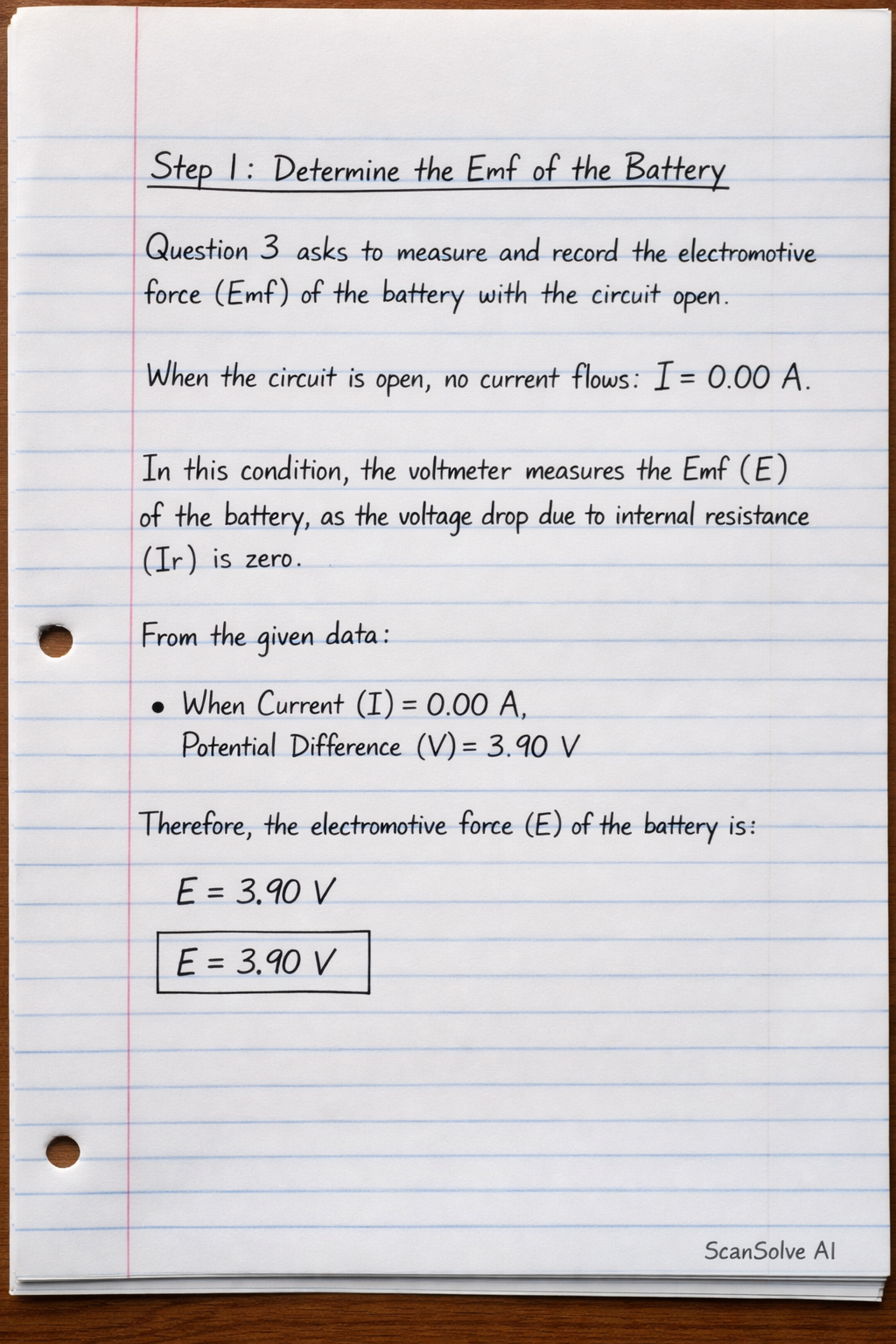
Question 3 asks to measure and record the electromotive force (Emf) of the battery with the circuit open. When the circuit is open, no current flows (). In this condition, the voltmeter measures the Emf () of the battery, as the voltage drop due to internal resistance () is zero.
From the given data:- When Current () , Potential Difference () . Therefore, the electromotive force () of the battery is:
Address Question 4 - Use the data to determine the internal resistance ().
Question 4 instructs to record ammeter and voltmeter readings for different external resistances. The provided data is:
Reading Current (A) Potential Difference (V) 1 0.00 3.90 2 0.19 3.69 3 0.23 3.65 4 0.27 3.61 5 0.33 3.55 The relationship between terminal potential difference (), Emf (), current (), and internal resistance () is given by:
To find the internal resistance (), we can rearrange the formula or use the gradient of a vs graph. Since we already found , we can use any data point to calculate . Let's use the last data point and the calculated .
Substitute the values into the equation:
Calculate the internal resistance ().
Rearrange the equation to solve for :
Rounding to two decimal places, the internal resistance () is:
Still stuck on this one?
Ask a follow-up, and the answer starts from this question.
More Physics Questions
Handwritten Step-by-Step Solution
Get this as a handwritten image on WhatsApp — like a tutor wrote it for you.
Try on WhatsApp