
We read your photo as:
Explain Ohm's law and calculate the EMF and internal resistance of a battery from a V-I graph.
ScanSolve AI Answer
Step-by-step solution
10 stepshere are the solutions to your questions:
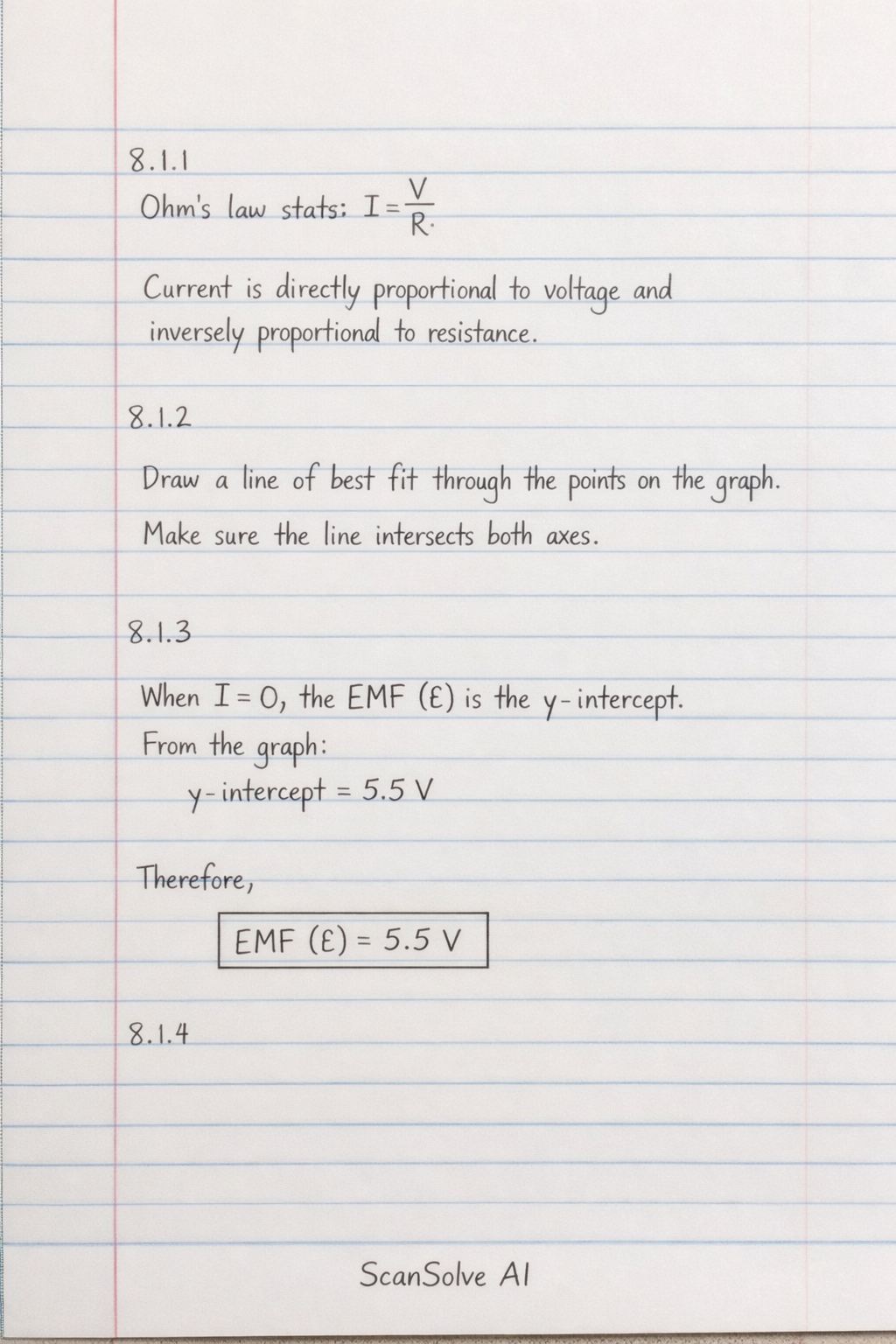
8.1.1
Ohm's law states that the current flowing through a conductor between two points is directly proportional to the potential difference across the two points, and inversely proportional to the resistance between them, provided the temperature and other physical conditions remain constant.
8.1.2
You need to draw a straight line of best fit through the plotted points on the graph. Ensure this line extends to cut both the potential difference (y-axis) and current (x-axis). For the calculations below, we will assume such a line has been drawn.
8.1.3
The EMF () of the battery is the terminal potential difference when the current () is zero. This corresponds to the y-intercept of the graph.
From the graph, the y-intercept is .
Therefore, the EMF of the battery is:
8.1.4
The internal resistance () of the battery is the negative of the gradient of the potential difference versus current graph ().
Identify two points from the line of best fit.
We'll use the intercepts for accuracy:
Point 1 (y-intercept):
Point 2 (x-intercept, estimated from the graph):Calculate the gradient () of the line.
Determine the internal resistance ().
The internal resistance of the battery is .
8.2.1
To calculate the current in the resistor, we use Ohm's law.
Apply Ohm's law () to the resistor.
The current in the resistor is .
8.2.2
To calculate the equivalent resistance of the resistors in parallel, we use the formula for two parallel resistors.
Calculate the equivalent resistance for the and resistors in parallel.
The equivalent resistance of the resistors in parallel is .
8.2.3
To determine the internal resistance of the battery, we use the total current and the EMF equation for a circuit with internal resistance.
Determine the total current () in the circuit.
Since the resistor is in series with the parallel combination, the current through it is the total current.
Calculate the total external resistance ().
This is the sum of the resistor and the equivalent parallel resistance.
Use the EMF equation and solve for .
Given .
Divide both sides by :
The internal resistance of the battery is .
8.2.4
To calculate the heat dissipated in the external circuit, we use the formula .
Identify the values.
Total current () = (from 8.2.1)
Total external resistance () = (from 8.2.3)
Time () =Calculate the heat dissipated ().
The heat dissipated in the external circuit in 0.2 seconds is .
Still stuck on this one?
Ask a follow-up, and the answer starts from this question.
More Physics Questions
Handwritten Step-by-Step Solution
Get this as a handwritten image on WhatsApp — like a tutor wrote it for you.
Try on WhatsApp