This physics problem tests your understanding of fundamental physical laws and their applications. The step-by-step solution below breaks down the problem using relevant equations and physical reasoning.
ScanSolve AI Answer
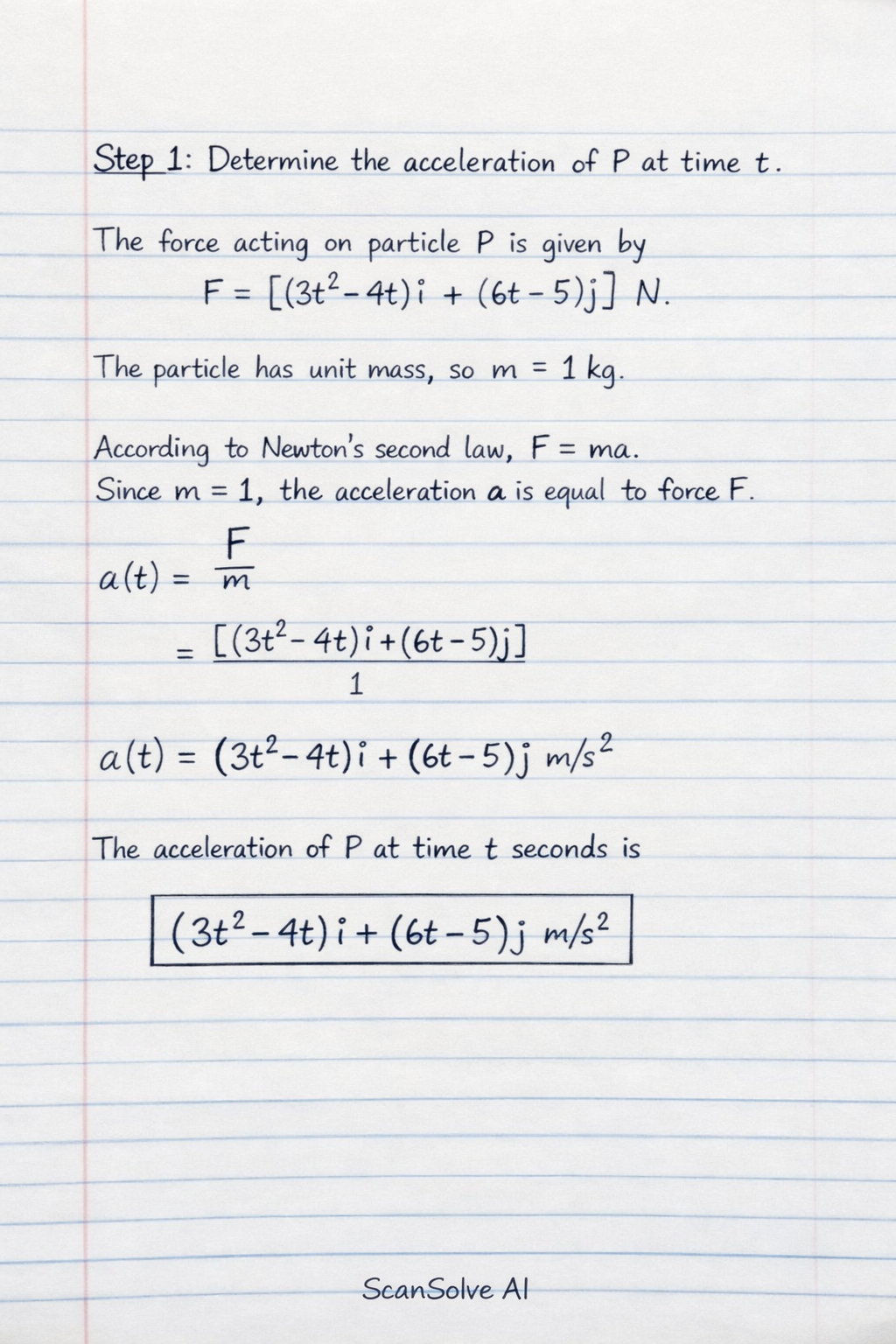
Step 1: Determine the acceleration of P at time $t$.
The force acting on particle P is given by $F = [(3t^2 - 4t)i + (6t - 5)j]$ N.
The particle has unit mass, so $m = 1$ kg.
According to Newton's second law, $F = ma$. Since $m=1$, the acceleration $a$ is equal to the force $F$.
$$a(t) = \frac{F}{m} = \frac{[(3t^2 - 4t)i + (6t - 5)j]}{1}$$
$$a(t) = (3t^2 - 4t)i + (6t - 5)j \text{ m/s}^2$$
The acceleration of P at time $t$ seconds is $\boxed{(3t^2 - 4t)i + (6t - 5)j \text{ m/s}^2}$.
Step 2: Determine the velocity of P at time $t$ seconds.
Velocity is the integral of acceleration with respect to time.
$$v(t) = \int a(t)\,dt = \int [(3t^2 - 4t)i + (6t - 5)j]\,dt$$
$$v(t) = \left(\int (3t^2 - 4t)\,dt\right)i + \left(\int (6t - 5)\,dt\right)j$$
$$v(t) = (t^3 - 2t^2 + C_1)i + (3t^2 - 5t + C_2)j$$
We can write the constants of integration as a single vector $C = C_1 i + C_2 j$.
$$v(t) = (t^3 - 2t^2)i + (3t^2 - 5t)j + C$$
We are given that at $t=3$ seconds, the velocity is $v(3) = (11i + 10j)$ m/s.
Substitute $t=3$ into the velocity equation:
$$v(3) = (3^3 - 2(3^2))i + (3(3^2) - 5(3))j + C$$
$$v(3) = (27 - 18)i + (27 - 15)j + C$$
$$v(3) = 9i + 12j + C$$
Equating this to the given velocity:
$$11i + 10j = 9i + 12j + C$$
$$C = (11i + 10j) - (9i + 12j)$$
$$C = (11 - 9)i + (10 - 12)j$$
$$C = 2i - 2j$$
Substitute $C$ back into the velocity equation:
$$v(t) = (t^3 - 2t^2)i + (3t^2 - 5t)j + (2i - 2j)$$
$$v(t) = (t^3 - 2t^2 + 2)i + (3t^2 - 5t - 2)j \text{ m/s}$$
The velocity of P at time $t$ seconds is $\boxed{(t^3 - 2t^2 + 2)i + (3t^2 - 5t - 2)j \text{ m/s}}$.
Step 3: Determine the kinetic energy of P when it is moving parallel to the vector $i$.
When the particle is moving parallel to the vector $i$, its $j$-component of velocity is zero.
From the velocity equation in Step 2, set the $j$-component to zero:
$$3t^2 - 5t - 2 = 0$$
Factor the quadratic equation:
$$(3t + 1)(t - 2) = 0$$
This gives two possible values for $t$: $t = -\frac{1}{3}$ s or $t = 2$ s.
Since time cannot be negative, we take $t = 2$ s.
Now, find the velocity of P at $t=2$ s:
$$v(2) = (2^3 - 2(2^2) + 2)i + (3(2^2) - 5(2) - 2)j$$
$$v(2) = (8 - 8 + 2)i + (12 - 10 - 2)j$$
$$v(2) = 2i + 0j$$
So, $v(2) = 2i$ m/s.
The magnitude of the velocity is $|v(2)| = \sqrt{2^2 + 0^2} = 2$ m/s.
The kinetic energy $KE$ is given by the formula $KE = \frac{1}{2}mv^2$.
Given $m=1$ kg and $v=2$ m/s:
$$KE = \frac{1}{2}(1 \text{ kg})(2 \text{ m/s})^2$$
$$KE = \frac
Determine the acceleration of P at time t.
|Physics
Determine the acceleration of P at time t.
ScanSolve AI Answer
Step 1: Determine the acceleration of P at time t.
The force acting on particle P is given by F=[(3t2β4t)i+(6tβ5)j] N.
The particle has unit mass, so m=1 kg.
According to Newton's second law, F=ma. Since m=1, the acceleration a is equal to the force F.
a(t)=mFβ=1[(3t2β4t)i+(6tβ5)j]βa(t)=(3t2β4t)i+(6tβ5)jm/s2
The acceleration of P at time t seconds is β(3t2β4t)i+(6tβ5)jm/s2ββ.
Step 2: Determine the velocity of P at time t seconds.
Velocity is the integral of acceleration with respect to time.
v(t)=β«a(t)dt=β«[(3t2β4t)i+(6tβ5)j]dtv(t)=(β«(3t2β4t)dt)i+(β«(6tβ5)dt)jv(t)=(t3β2t2+C1β)i+(3t2β5t+C2β)j
We can write the constants of integration as a single vector C=C1βi+C2βj.
v(t)=(t3β2t2)i+(3t2β5t)j+C
We are given that at t=3 seconds, the velocity is v(3)=(11i+10j) m/s.
Substitute t=3 into the velocity equation:
v(3)=(33β2(32))i+(3(32)β5(3))j+Cv(3)=(27β18)i+(27β15)j+Cv(3)=9i+12j+C
Equating this to the given velocity:
11i+10j=9i+12j+CC=(11i+10j)β(9i+12j)C=(11β9)i+(10β12)jC=2iβ2j
Substitute C back into the velocity equation:
v(t)=(t3β2t2)i+(3t2β5t)j+(2iβ2j)v(t)=(t3β2t2+2)i+(3t2β5tβ2)jΒ m/s
The velocity of P at time t seconds is β(t3β2t2+2)i+(3t2β5tβ2)jm/sββ.
Step 3: Determine the kinetic energy of P when it is moving parallel to the vector i.
When the particle is moving parallel to the vector i, its j-component of velocity is zero.
From the velocity equation in Step 2, set the j-component to zero:
3t2β5tβ2=0
Factor the quadratic equation:
(3t+1)(tβ2)=0
This gives two possible values for t: t=β31β s or t=2 s.
Since time cannot be negative, we take t=2 s.
Now, find the velocity of P at t=2 s:
v(2)=(23β2(22)+2)i+(3(22)β5(2)β2)jv(2)=(8β8+2)i+(12β10β2)jv(2)=2i+0j
So, v(2)=2i m/s.
The magnitude of the velocity is β£v(2)β£=22+02β=2 m/s.
The kinetic energy KE is given by the formula KE=21βmv2.
Given m=1 kg and v=2 m/s:
KE=21β(1kg)(2m/s)2
Need help with your own homework?
Get instant step-by-step solutions to any question. Free to start.