

This physics problem tests your understanding of fundamental physical laws and their applications. The step-by-step solution below breaks down the problem using relevant equations and physical reasoning.
ScanSolve AI Answer
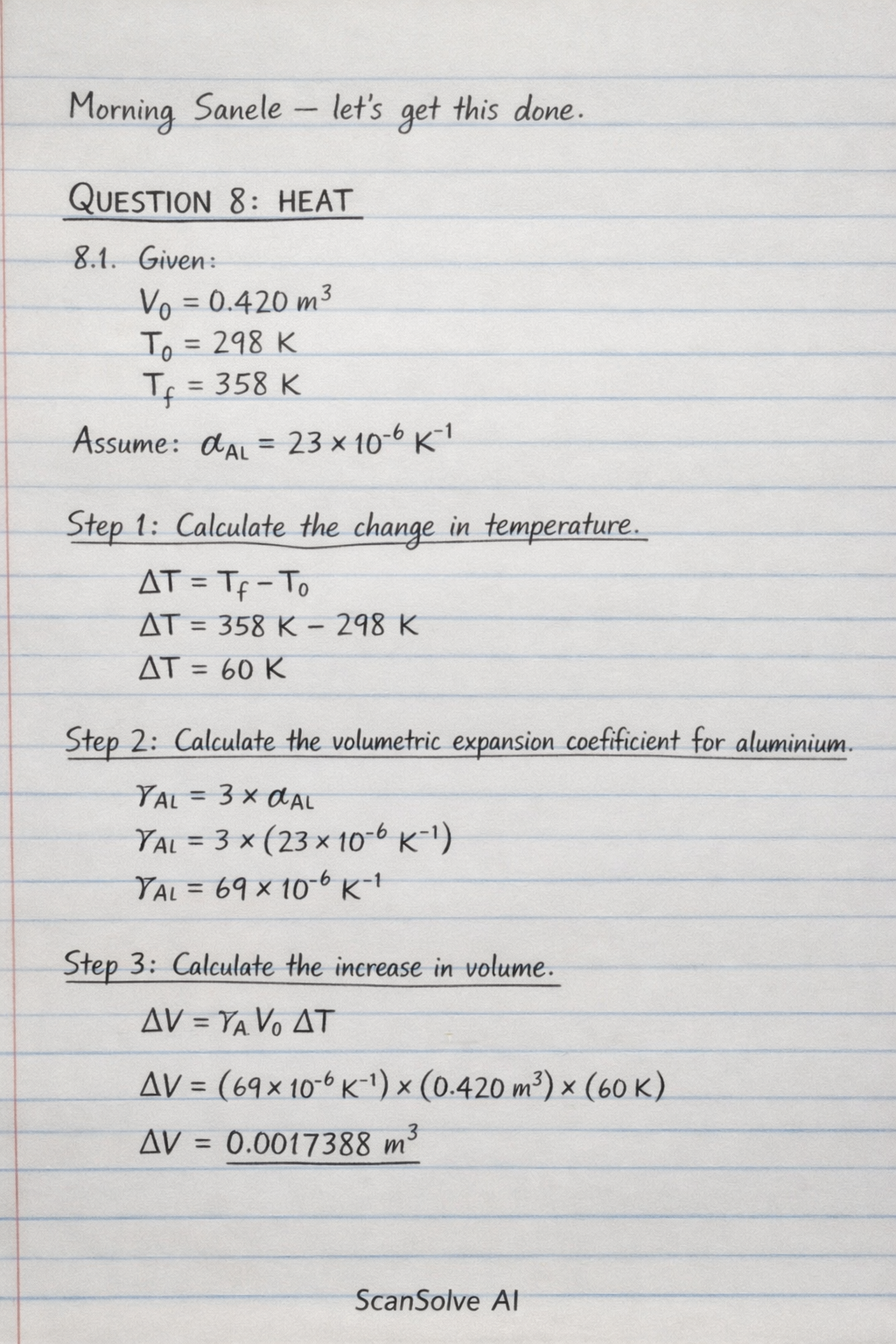
QUESTION 8: HEAT 8.1 Given: Initial volume V_0 = 0.420 m^3. Initial temperature T_0 = 298 K. Final temperature T_f = 358 K. Assumption*: The volumetric thermal expansion coefficient for aluminium is not provided. We will use a standard value for the linear expansion coefficient of aluminium, _Al = 23 × 10^-6 K^-1. The volumetric expansion coefficient is then _Al = 3_Al. Step 1: Calculate the change in temperature. T = T_f - T_0 = 358 K - 298 K = 60 K Step 2: Calculate the volumetric expansion coefficient for aluminium. _Al = 3 × _Al = 3 × (23 × 10^-6 K^-1) = 69 × 10^-6 K^-1 Step 3: Calculate the increase in volume. V = _Al V_0 T V = (69 × 10^-6 K^-1) × (0.420 m^3) × (60 K) V = 0.0017388 m^3 The increase in volume of the aluminium block is 0.00174 m^3. 8.2 Given: Volume V = 0.85 m^3. Temperature T = 27^ C. Pressure P = 520 kPa. Gas constant R = 287 J/kg·K. Step 1: Convert temperature to Kelvin and pressure to Pascals. T = 27^ C + 273 = 300 K P = 520 kPa = 520 × 10^3 Pa Step 2: Use the ideal gas law PV = mRT to calculate the mass of the gas. m = (PV)/(RT) m = (520 × 10^3 Pa) × (0.85 m^3)(287 J/kg·K) × (300 K) m = (442000)/(86100) ≈ 5.1336 kg The mass of the gas is 5.13 kg. 8.3 Given: Initial mass m_1 = 15 kg of CO_2. Initial pressure P_1 = 150 kPa. Initial temperature T_1 = 18^ C. Final pressure P_2 = 210 kPa. Final temperature T_2 = 38^ C. Assumption*: The specific gas constant for CO_2 is not given. We will use the universal gas constant R_u = 8.314 J/mol·K and the molar mass of CO_2 (M_CO_2 = 44.01 g/mol = 0.04401 kg/mol) to find the specific gas constant R_CO_2 = R_u/M_CO_2 ≈ 188.90 J/kg·K. However, since the volume of the cylinder is constant and the gas constant for CO_2 is the same for both states, it will cancel out in the calculation. Step 1: Convert temperatures to Kelvin and pressures to Pascals. T_1 = 18^ C + 273 = 291 K P_1 = 150 kPa = 150 × 10^3 Pa T_2 = 38^ C + 273 = 311 K P_2 = 210 kPa = 210 × 10^3 Pa Step 2: Use the ideal gas law for both states. Since the volume V is constant: V = (m_1 R T_1)/(P_1) = (m_2 R T_2)/(P_2) The gas constant R cancels out: (m_1 T_1)/(P_1) = (m_2 T_2)/(P_2) Step 3: Solve for the final mass m_2. m_2 = m_1 ((P_2)/(P_1)) ((T_1)/(T_2)) m_2 = 15 kg × (210 × 10^3 Pa150 × 10^3 Pa) × (291 K311 K) m_2 = 15 × 1.4 × 0.935691 ≈ 19.6495 kg Step 4: Calculate the mass of carbon dioxide that was added. m = m_2 - m_1 = 19.6495 kg - 15 kg = 4.6495 kg The mass of carbon dioxide that was added is 4.65 kg. 8.4 Given: Initial container capacity V_c0 = 600 ml = 600 × 10^-6 m^3. Initial temperature T_0 = 18^ C. Final temperature T_f = 48^ C. Linear expansion coefficient of container _c = 10.8 × 10^-6 K^-1. Volumetric expansion coefficient of toluene _t = 1.15 × 10^-3 K^-1. Step 1: Calculate the change in temperature. T = T_f - T_0 = 48^ C - 18^ C = 30^ C = 30 K Step 2: Calculate the volumetric expansion coefficient of the container. _c = 3_c = 3 × (10.8 × 10^-6 K^-1) = 32.4 × 10^-6 K^-1 Step 3: Calculate the increase in volume of the toluene. Since the container is completely filled, the initial volume of toluene V_t0 is equal to the initial volume of the container V_c0. V_t = _t V_t0 T = (1.15 × 10^-3 K^-1) × (600 × 10^-6 m^3) × (30 K) V_t = 2.07 × 10^-5 m^3 Step 4: Calculate the increase in volume of the container. V_c = _c V_c0 T = (32.4 × 10^-6 K^-1) × (600 × 10^-6 m^3) × (30 K) V_c = 5.832 × 10^-7 m^3 Step 5: Calculate the volume of toluene that will overflow. V_overflow = V_t - V_c V_overflow = 2.07 × 10^-5 m^3 - 5.832 × 10^-7 m^3 V_overflow = (20.7 × 10^-6 m^3) - (0.5832 × 10^-6 m^3) V_overflow = 20.1168 × 10^-6 m^3 Step 6: Convert the overflow volume to millilitres. V_overflow = 20.1168 × 10^-6 m^3 × 1000 L1 m^3 × 1000 ml1 L = 20.1168 ml The volume of toluene that will overflow is 20.12 ml. Send me the next one 📸