An object on the end of a spring oscillates with SHM of regular frequency 2.0rads, what is the period of the oscillation

Physics

ScanSolve AI Answer

Answer

3.14 s

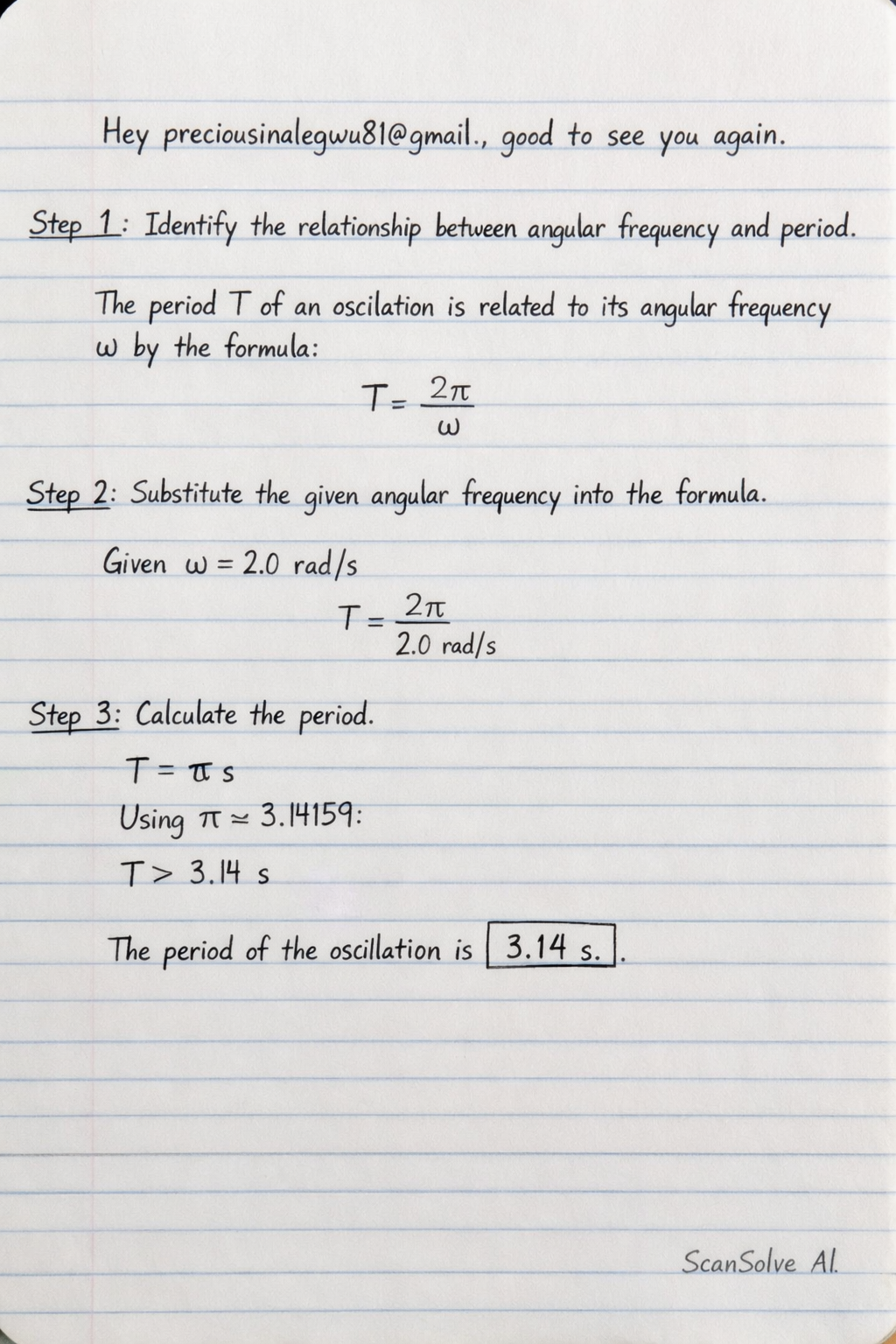
Step 1: Identify the relationship between angular frequency and period. The period TT of an oscillation is related to its angular frequency ω\omega by the formula: T=2πωT = \frac{2\pi}{\omega}

Step 2: Substitute the given angular frequency into the formula. Given ω=2.0 rad/s\omega = 2.0 \text{ rad/s}. T=2π2.0rad/sT = \frac{2\pi}{2.0 rad/s}

Step 3: Calculate the period. T=π sT = \pi \text{ s} Using π3.14159\pi \approx 3.14159: T3.14 sT \approx 3.14 \text{ s}

The period of the oscillation is 3.14s\boxed{3.14 s}.

Send me the next one 📸

Was this helpful?

Need help with your own homework?

Get instant step-by-step solutions to any question. Free to start.

Ask Your Question
Handwritten step-by-step solution preview

Handwritten Step-by-Step Solution

Get this as a handwritten image on WhatsApp — like a tutor wrote it for you.

Try on WhatsApp

Still have questions?

Quick Answer

Identify the relationship between angular frequency and period. The period T of an oscillation is related to its angular frequency by the formula: T = (2)/() Step 2: Substitute the given angular frequency into the formula.

An object on the end of a spring oscillates with SHM of regular frequency 2.0rads, what is the period of the oscillation
Physics

This physics problem tests your understanding of fundamental physical laws and their applications. The step-by-step solution below breaks down the problem using relevant equations and physical reasoning.

ScanSolve AI Answer
Step 1: Identify the relationship between angular frequency and period. The period T of an oscillation is related to its angular frequency by the formula: T = (2)/() Step 2: Substitute the given angular frequency into the formula. Given = 2.0 rad/s. T = (2)/(2.0 rad/s) Step 3: Calculate the period. T = s Using ≈ 3.14159: T ≈ 3.14 s The period of the oscillation is 3.14 s. Send me the next one 📸