
We read your photo as:
Analyze the physics principles behind a magic mirror, car headlights, and side-view mirrors, including mirror types, image characteristics, and optical functions.
ScanSolve AI Answer
Step-by-step solution
3 stepsAnswer Question 7.
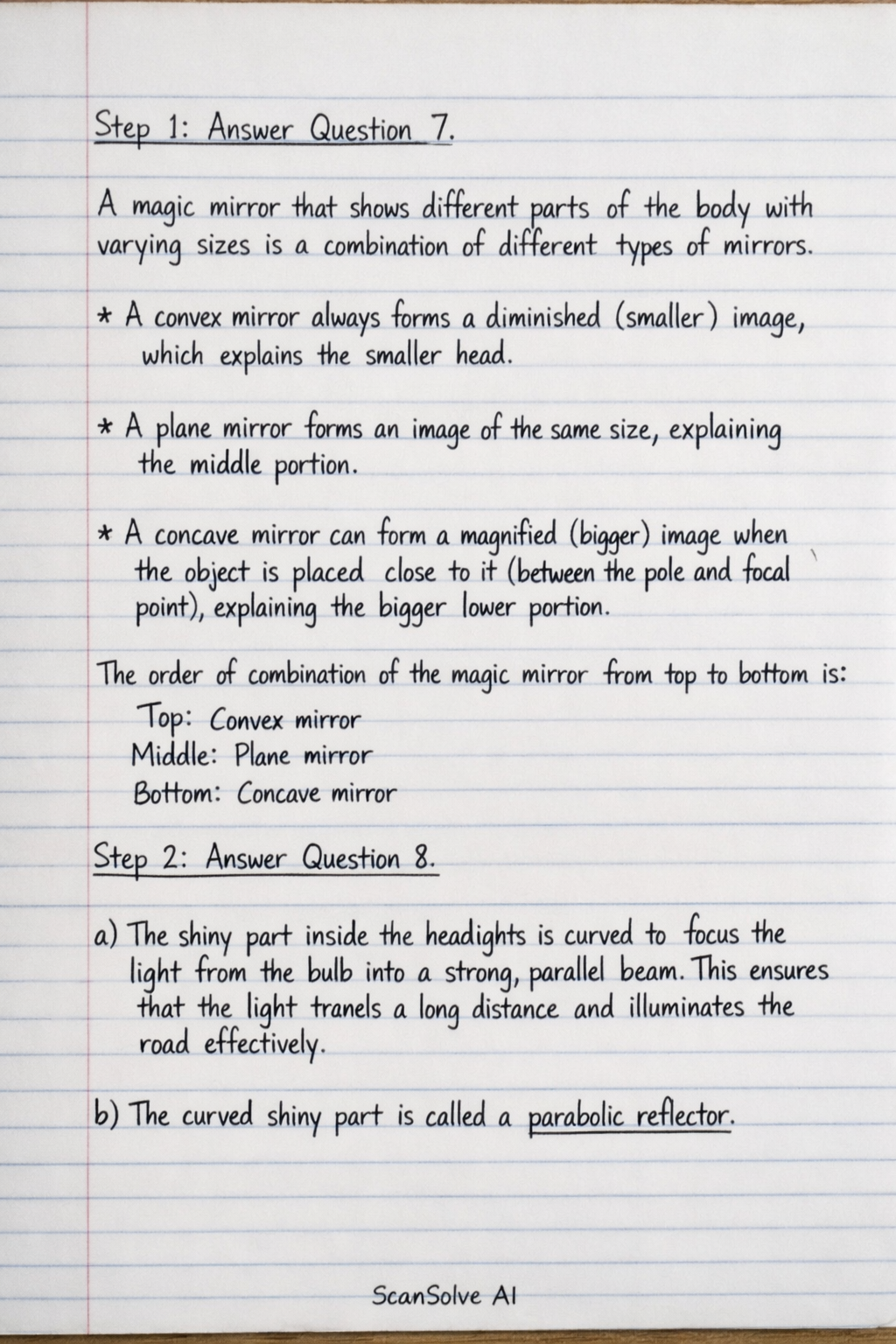
A magic mirror that shows different parts of the body with varying sizes is a combination of different types of mirrors.
- A convex mirror always forms a diminished (smaller) image, which explains the smaller head.
- A plane mirror forms an image of the same size, explaining the middle portion.
- A concave mirror can form a magnified (bigger) image when the object is placed close to it (between the pole and focal point), explaining the bigger lower portion.
The order of combination of the magic mirror from top to bottom is:
- Top: Convex mirror
- Middle: Plane mirror
- Bottom: Concave mirror
Answer Question 8.
a) The shiny part inside the headlights is curved to focus the light from the bulb into a strong, parallel beam. This ensures that the light travels a long distance and illuminates the road effectively.
b) The curved shiny part is called a parabolic reflector.
Answer Question 9.
a) The type of curved mirror used in the side mirror is a convex mirror. Convex mirrors provide a wider field of view and always form diminished images, which is why the water tank appeared very small.
b) Two other characteristics of the image observed in the side mirror (formed by a convex mirror) are:
- The image is virtual.
- The image is upright.
Still stuck on this one?
Ask a follow-up, and the answer starts from this question.
More Physics Questions
Handwritten Step-by-Step Solution
Get this as a handwritten image on WhatsApp — like a tutor wrote it for you.
Try on WhatsApp