
We read your photo as:
Identify and explain the components of concave and convex mirrors and analyze image formation for a concave mirror.
ScanSolve AI Answer
Step-by-step solution
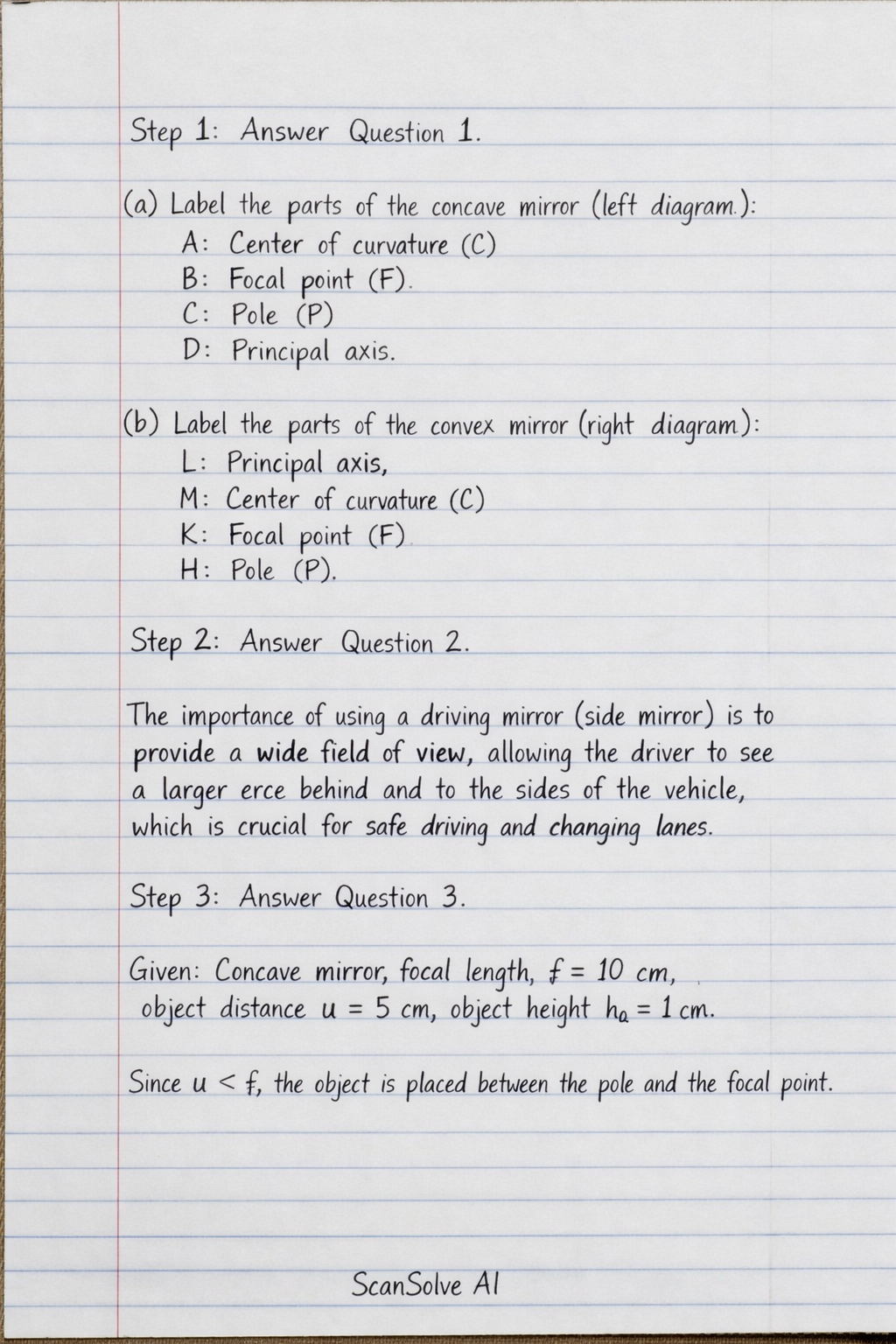
5 stepsAnswer Question 1.
a) Label the parts of the concave mirror (left diagram):
- A: Center of curvature (C)
- B: Focal point (F)
- C: Pole (P)
- D: Principal axis
b) Label the parts of the convex mirror (right diagram):
- L: Principal axis
- M: Center of curvature (C)
- K: Focal point (F)
- H: Pole (P)
Answer Question 2.
The importance of using a driving mirror (side mirror) is to provide a wide field of view, allowing the driver to see a larger area behind and to the sides of the vehicle, which is crucial for safe driving and changing lanes.
Answer Question 3.
Given: Concave mirror, focal length , object distance , object height .
Since , the object is placed between the pole and the focal point.a) Ray Diagram:
- Draw a ray from the top of the object parallel to the principal axis. After reflection, this ray passes through the focal point (F).
- Draw a ray from the top of the object directed towards the center of curvature (C). This ray reflects back along the same path.
- Draw a ray from the top of the object directed towards the pole (P). This ray reflects symmetrically about the principal axis. The intersection of the extended reflected rays behind the mirror gives the position of the image.
b) Position and characteristics of the image:
Using the mirror formula:The negative sign indicates the image is formed behind the mirror.
Using the magnification formula:
The image is 2 cm tall.
Characteristics of the image:
- Virtual
- Upright (erect)
- Magnified (2 times larger)
- Located 10 cm behind the mirror
Answer Question 4.
A supermarket security manager installs convex mirrors instead of concave mirrors because convex mirrors provide a wider field of view, allowing them to monitor a larger area of the shop with fewer mirrors. Concave mirrors would only show a small, magnified view.
Answer Question 5.
The diagram shows an object placed between the center of curvature (C) and the focal point (F) of a concave mirror.
a) Locate the position of the image:
- Draw a ray from the top of the object parallel to the principal axis. After reflection, this ray passes through the focal point (F).
- Draw a ray from the top of the object passing through the focal point (F). After reflection, this ray travels parallel to the principal axis. The intersection of these two reflected rays will form the image. The image will be located beyond the center of curvature (C).
b) Describe the characteristics of the image:
- Real
- Inverted
- Magnified
Still stuck on this one?
Ask a follow-up, and the answer starts from this question.
More Physics Questions
Handwritten Step-by-Step Solution
Get this as a handwritten image on WhatsApp — like a tutor wrote it for you.
Try on WhatsApp