

This physics problem tests your understanding of fundamental physical laws and their applications. The step-by-step solution below breaks down the problem using relevant equations and physical reasoning.
ScanSolve AI Answer
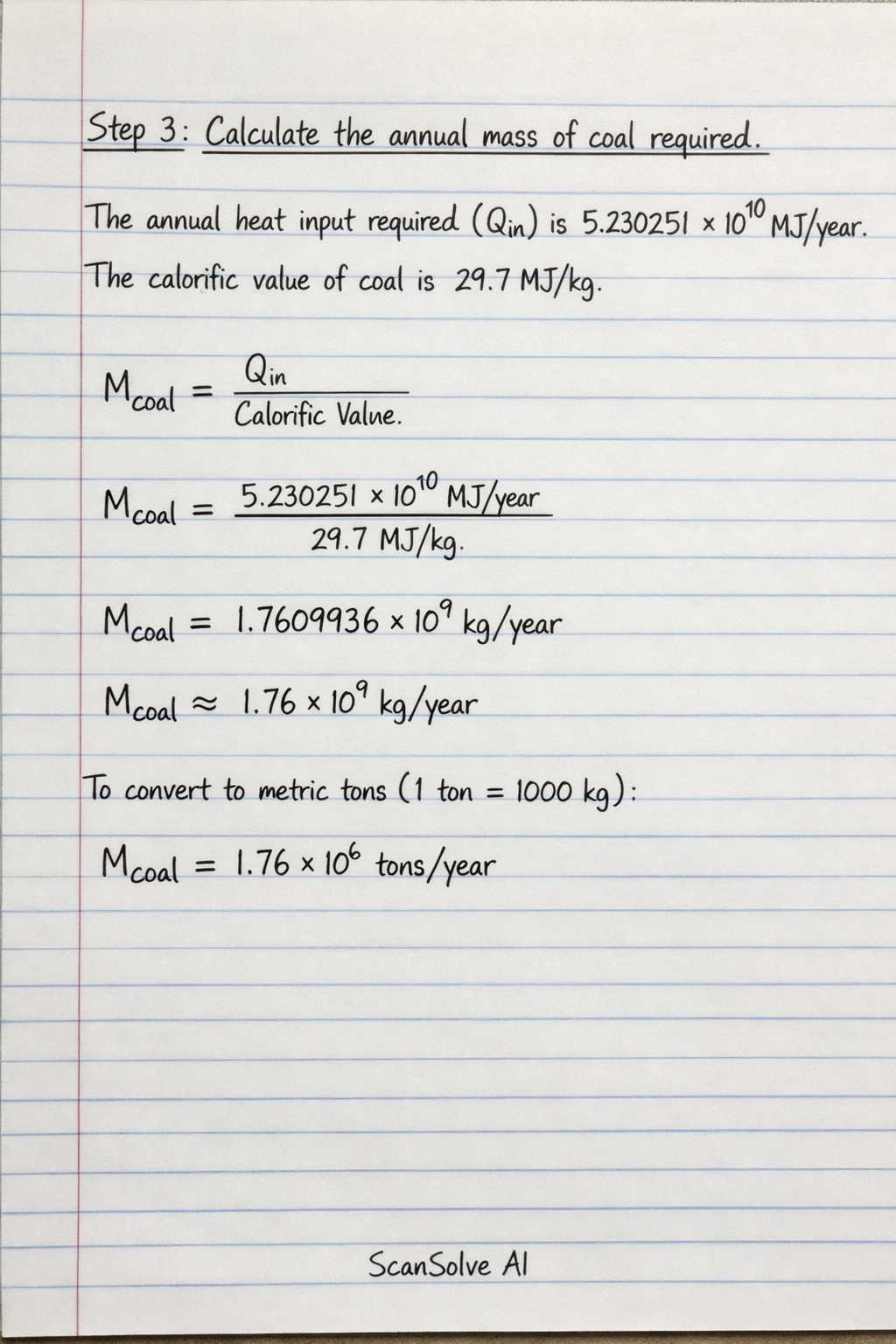
Step 3: Calculate the annual mass of coal required. The annual heat input required (Q_in) is 5.230251 × 10^10 MJ/year. The calorific value of coal is 29.7 MJ/kg. M_coal = Q_inCalorific Value M_coal = 5.230251 × 10^10 MJ/year29.7 MJ/kg M_coal = 1.7609936 × 10^9 kg/year M_coal ≈ 1.76 × 10^9 kg/year To convert to metric tons (1 ton = 1000 kg): M_coal = 1.76 × 10^6 tons/year Step 4: Determine the amount of particulates produced. Particulates are primarily composed of ash. The ash content in the coal is 7.7\%. M_particulates = M_coal × Ash content M_particulates = 1.7609936 × 10^9 kg/year × 0.077 M_particulates = 1.3569651 × 10^8 kg/year M_particulates ≈ 1.36 × 10^8 kg/year To convert to metric tons: M_particulates = 1.36 × 10^5 tons/year The amount of particulates produced annually is 1.36 × 10^8 kg/year. Step 5: Determine the amount of CO_2 produced. The carbon content in the coal is 77.0\%. The combustion reaction for carbon is C + O_2 → CO_2. Molar mass of C ≈ 12.01 g/mol. Molar mass of CO_2 ≈ 44.01 g/mol. The mass of carbon in the coal is: M_C = M_coal × Carbon content M_C = 1.7609936 × 10^9 kg/year × 0.770 M_C = 1.3569651 × 10^9 kg/year The mass of CO_2 produced is: M_CO_2 = M_C × Molar mass of CO_2Molar mass of C M_CO_2 = 1.3569651 × 10^9 kg/year × (44.01)/(12.01) M_CO_2 = 4.97400 × 10^9 kg/year M_CO_2 ≈ 4.97 × 10^9 kg/year To convert to metric tons: M_CO_2 = 4.97 × 10^6 tons/year The amount of CO_2 produced annually is 4.97 × 10^9 kg/year. Step 6: Determine the amount of SO_2 produced. The sulfur content in the coal is 1.0\%. The combustion reaction for sulfur is S + O_2 → SO_2. Molar mass of S ≈ 32.07 g/mol. Molar mass of SO_2 ≈ 64.07 g/mol. The mass of sulfur in the coal is: M_S = M_coal × Sulfur content M_S = 1.7609936 × 10^9 kg/year × 0.010 M_S = 1.7609936 × 10^7 kg/year The mass of SO_2 produced is: M_SO_2 = M_S × Molar mass of SO_2Molar mass of S M_SO_2 = 1.7609936 × 10^7 kg/year × (64.07)/(32.07) M_SO_2 = 3.5182 × 10^7 kg/year M_SO_2 ≈ 3.52 × 10^7 kg/year To convert to metric tons: M_SO_2 = 3.52 × 10^4 tons/year The amount of SO_2 produced annually is 3.52 × 10^7 kg/year.