
We read your photo as:
Apply Gauss's Law, which states that the total electric flux through a closed surface is equal to the total charge enclosed divided by the permittivity of free space (0).
Physics
ScanSolve AI Answer
Step-by-step solution
2 stepsHere are the solutions to the physics problems:
1. The electric field in a certain region is acting radially outward and is given by . A charge contained in a sphere of radius centred at the origin of the field will be given by
Apply Gauss's Law, which states that the total electric flux through a closed surface is equal to the total charge enclosed divided by the permittivity of free space ().
Choose a spherical Gaussian surface of radius centered at the origin.
Since the electric field is radially outward and given
Was this helpful?
Still stuck on this one?
Ask a follow-up, and the answer starts from this question.
Got a different question?Ask your own question
More Physics Questions
QThe statement that the flux through any closed surface is 1/ε₀ times the total charge enclosed in it…QState Gauss' law in magnetism. Show that this law proved the non-existence of magnetic monopoles.QSolve for the electric field intensity between parallel plates, the factors affecting electric flux…QQ3. A charge Q is enclosed by a Guassian spherical surface of radius R. If the radius is doubled…QCalculate the electric field at a point 2.0 m away from a 4.0 nC charge, and the forces between…
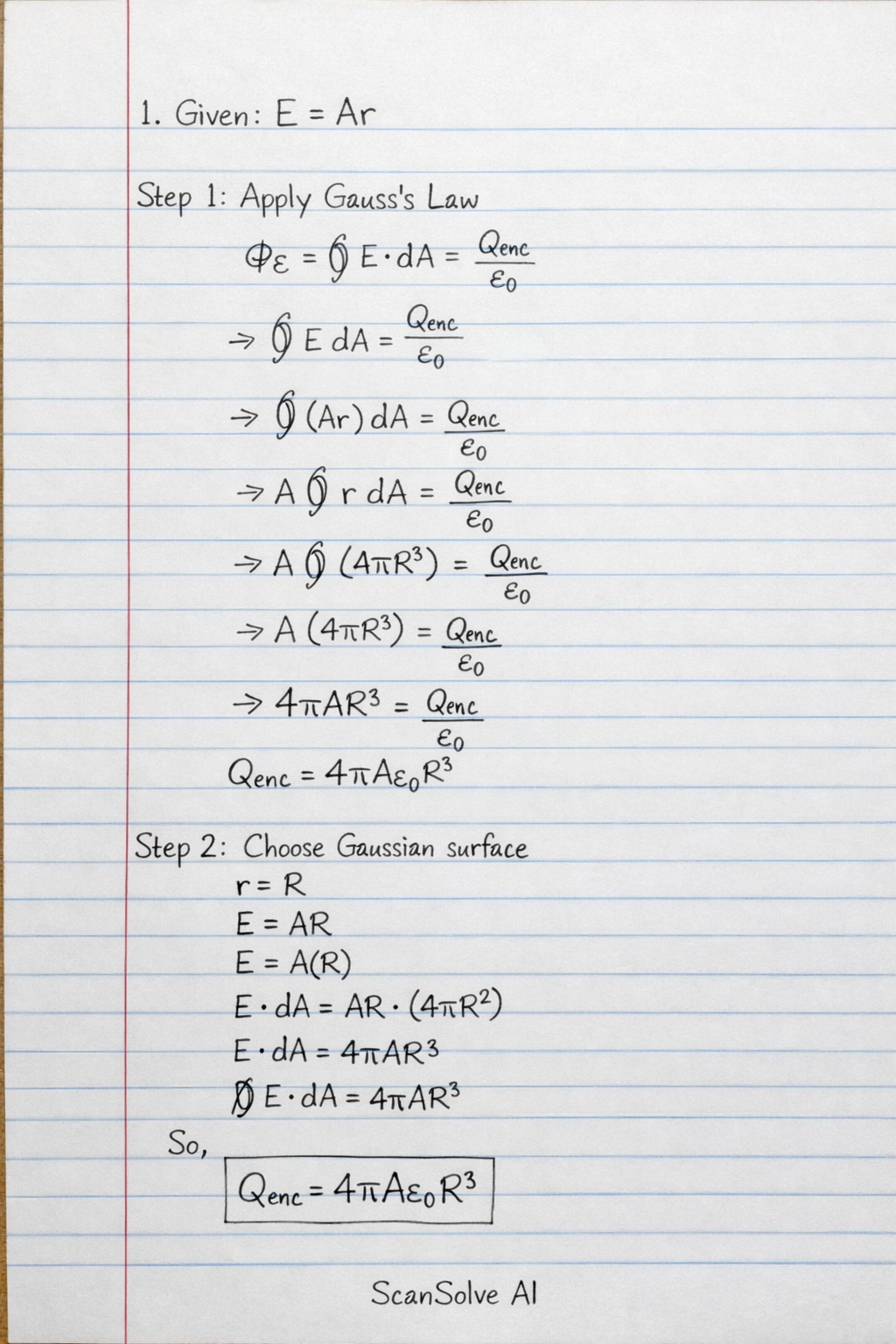
Handwritten Step-by-Step Solution
Get this as a handwritten image on WhatsApp — like a tutor wrote it for you.
Try on WhatsApp