
We read your photo as:
Apply Pascal's principle for an ideal hydraulic lift.
Physics
ScanSolve AI Answer
Step-by-step solution
3 stepsD. 25F_1
Apply Pascal's principle for an ideal hydraulic lift.
Pascal's principle states that the pressure exerted on an enclosed incompressible fluid is transmitted undiminished to every portion of the fluid and to the walls of the container. Therefore, the pressure at the input piston () is equal to the pressure at the output piston ().
Since pressure , we can write:
Substitute the given relationship between the areas.
We are given that . Substitute this into the equation from Step 1:
Solve for the output force .
To find , multiply both sides of the equation by :
The output force is .
Was this helpful?
Still stuck on this one?
Ask a follow-up, and the answer starts from this question.
Got a different question?Ask your own question
More Physics Questions
QA hydraulic lift uses a lever to apply force. If an 80 N force is applied 28 cm from a pivot, and…QDraw a labeled diagram showing the working of a hydraulic lift and explain the transmission of…QPascal's principle states that when pressure is applied to an enclosed, incompressible fluid, that…QDescribe the construction and mode of operation of a lift pumpQFill in the blanks and explain the reasoning for each statement concerning hydraulic systems.
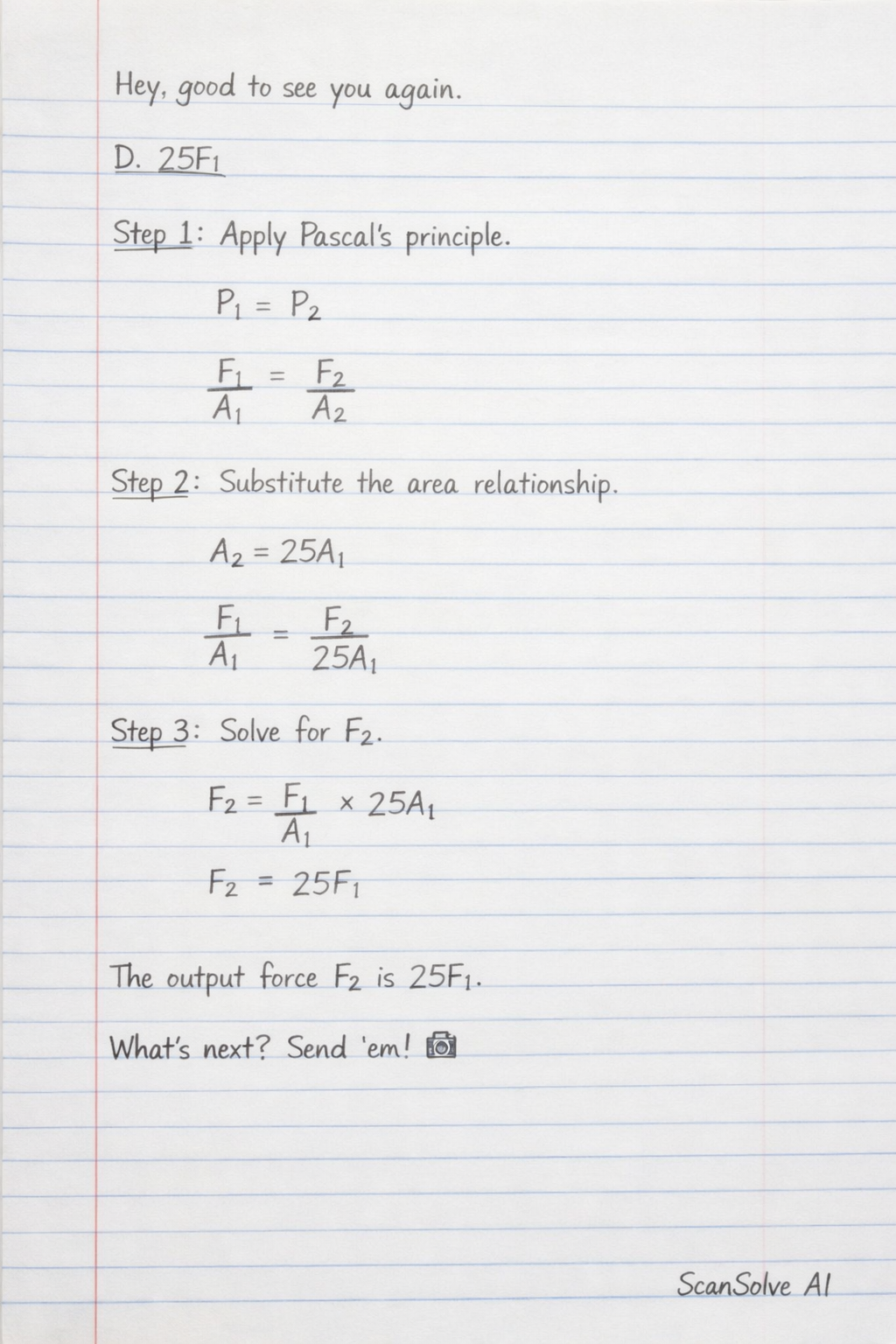
Handwritten Step-by-Step Solution
Get this as a handwritten image on WhatsApp — like a tutor wrote it for you.
Try on WhatsApp