
We read your photo as:
Derive the Bernoulli equation when the compressibility eff undergoing: a. An isothermal process, and b. An isentropic process
ScanSolve AI Answer
Answers
2 partsStep-by-step solution
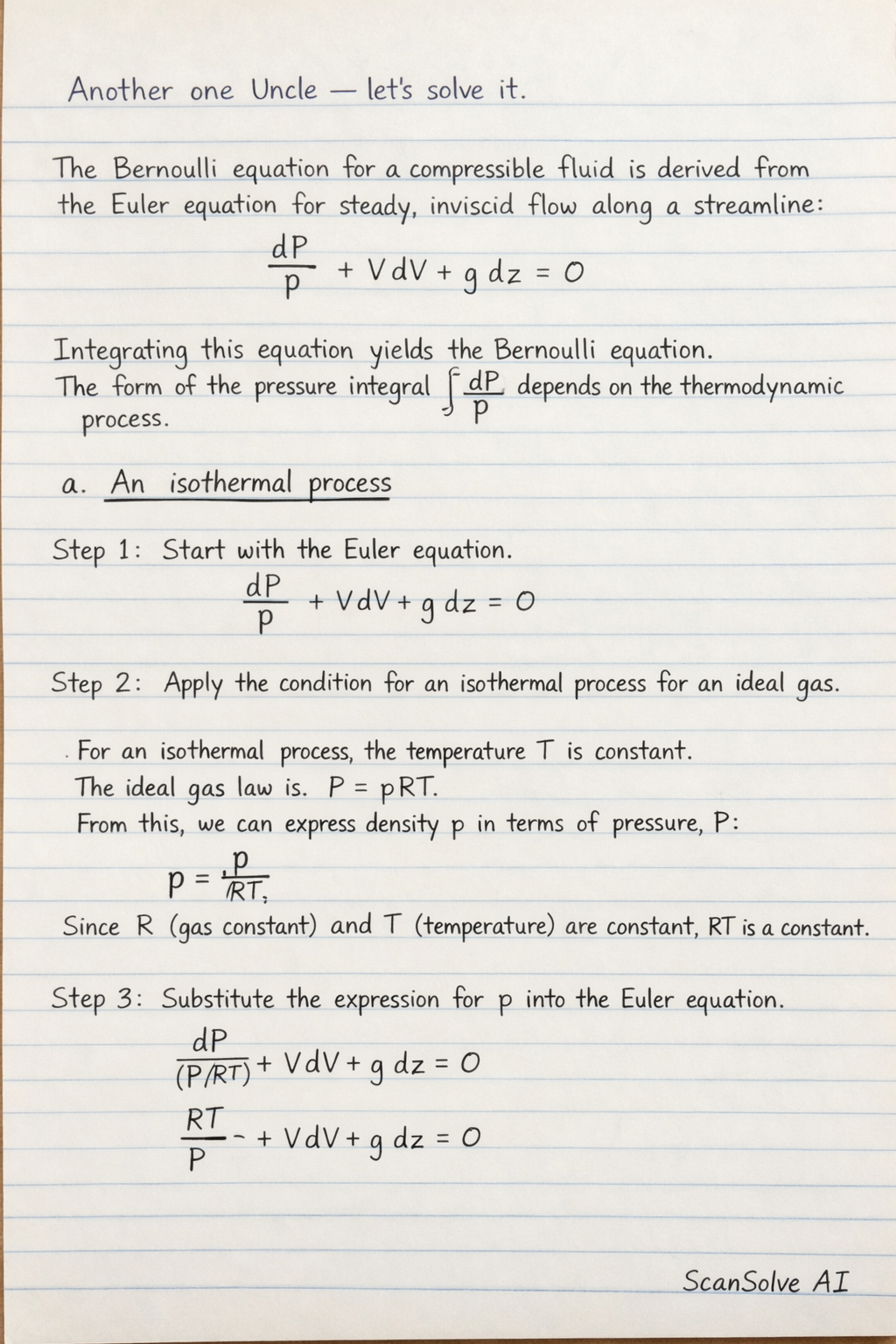
10 stepsThe Bernoulli equation for a compressible fluid is derived from the Euler equation for steady, inviscid flow along a streamline:
Integrating this equation yields the Bernoulli equation. The form of the pressure integral depends on the thermodynamic process.
Part a· 5 steps
An isothermal process
Start with the Euler equation.
Apply the condition for an isothermal process for an ideal gas.
For an isothermal process, the temperature is constant.
The ideal gas law is .
From this, we can express density in terms of pressure :Since (gas constant) and (temperature) are constant, is a constant.
Substitute the expression for into the Euler equation.
Integrate the equation.
Integrate each term along a streamline from an initial point to a final point:
State the Bernoulli equation for an isothermal process.
The Bernoulli equation for a compressible fluid undergoing an isothermal process is:
Part b
An isentropic process
Start with the Euler equation.
Apply the condition for an isentropic process for an ideal gas.
For an isentropic process (adiabatic and reversible), the relationship between pressure and density for an ideal gas is:
where is a constant and is the ratio of specific heats.
From this, we can express in terms of :Substitute the expression for into the Euler equation.
Integrate the equation.
Integrate each term along a streamline:
Let's evaluate the pressure integral:
Now, substitute :
So, the integrated pressure term is .
State the Bernoulli equation for an isentropic process.
The Bernoulli equation for a compressible fluid undergoing an isentropic process is:
Try one yourself
A new problem that tests the same skill.
Still stuck on this one?
Ask a follow-up, and the answer starts from this question.
More Physics Questions
Handwritten Step-by-Step Solution
Get this as a handwritten image on WhatsApp — like a tutor wrote it for you.
Try on WhatsApp