
We read your photo as:
Calculer grad r et div r pour le vecteur position r = x ex + y ey + z ez
Physics
ScanSolve AI Answer
Answer
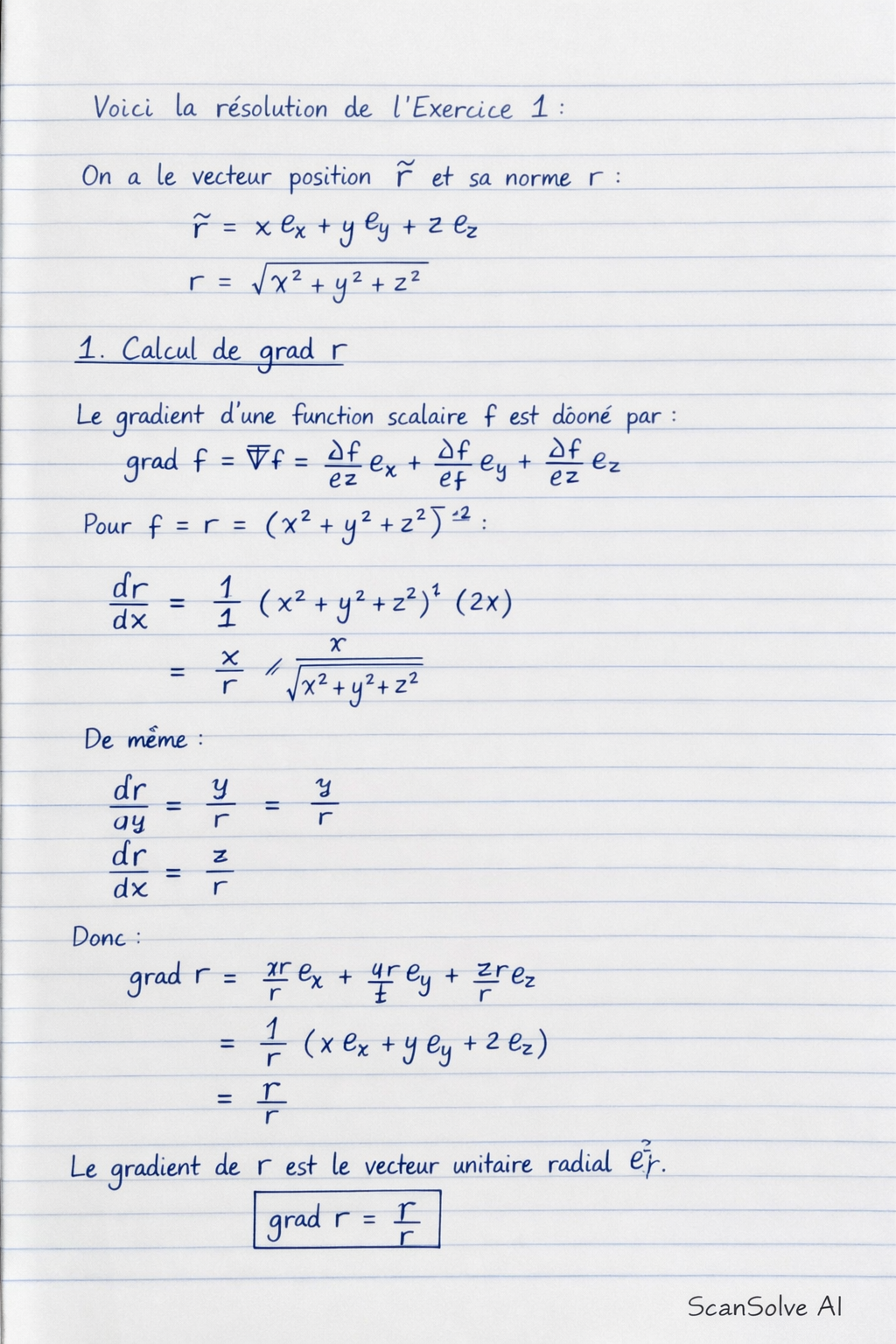
Voici la résolution de l'Exercice 1 :
On a le vecteur position et sa norme :
1. Calcul de
Le gradient d'une fonction scalaire est donné par:
Pour :
De même:
Donc:
Le gradient de est le vecteur unitaire radial .
2. Calcul de
La divergence d'un champ vectoriel est donnée par:
Pour , on a , , .
Donc:
3. Calcul de
Le rotationnel d'un champ vectoriel est donné par:
Pour , on a , , .
Donc:
Was this helpful?
Try one yourself
A new problem that tests the same skill.
Still stuck on this one?
Ask a follow-up, and the answer starts from this question.
Got a different question?Ask your own question
More Physics Questions
QGiven the position vector r = x ex + y ey + z e_z with magnitude r = sqrt(x² + y² + z²).QGiven the scalar function (x, y, z) = e^xy - x²yz².QGiven x=4, y=3, z=2 and p=6, q=2p, r=q+p, evaluate the following expressions: a) x2 - y, b) xy + 2z…QFor a complex number z = x + jy:QExpliquer moi les vecteur en 3e
Handwritten Step-by-Step Solution
Get this as a handwritten image on WhatsApp — like a tutor wrote it for you.
Try on WhatsApp