We read your photo as:

Calculate the capacitance needed to store 10 kWh of energy at 1000 V and the energy stored in a 1.0 m3 volume of air with an electric field of 15 V/m.

Physics

ScanSolve AI Answer

Step-by-step solution

8 steps

:
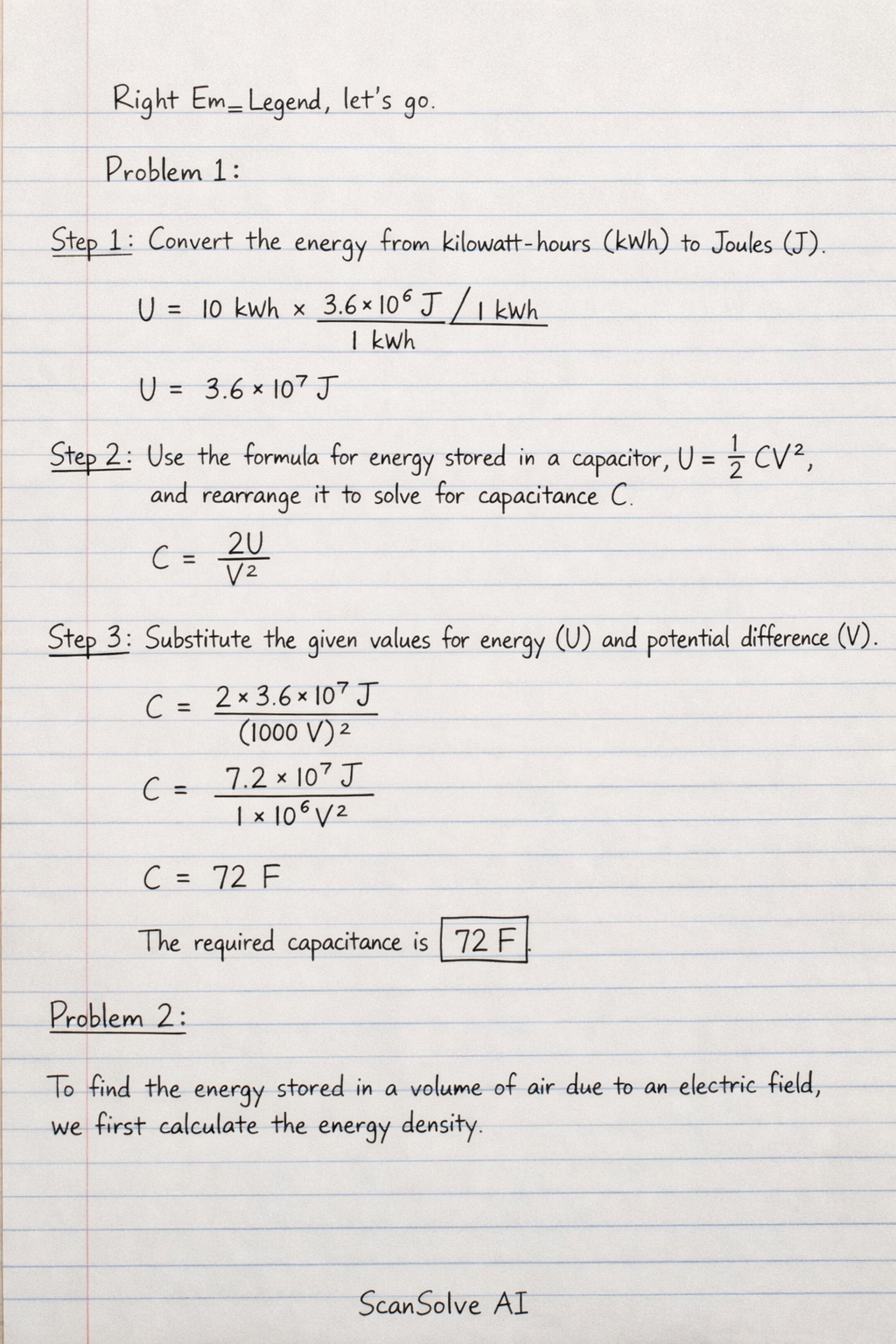
To find the capacitance required, we use the formula for energy stored in a capacitor.

  1. Convert the energy from kilowatt-hours (kWh) to Joules (J).

    U=10 kWh×3.6×106 J1 kWhU = 10 \text{ kWh} \times \frac{3.6 \times 10^6 \text{ J}}{1 \text{ kWh}} U=3.6×10⁷ JU = 3.6 \times 10^7 \text{ J}
  2. Use the formula for energy stored in a capacitor, U=12CV2U = \frac{1}{2}CV^2, and rearrange it to solve for capacitance CC.

    C=2UV2C = \frac{2U}{V^2}
  3. Substitute the given values for energy (UU) and potential difference (VV).

    C=2×3.6×107 J(1000 V)2C = \frac{2 \times 3.6 \times 10^7 \text{ J}}{(1000 \text{ V})^2} C=7.2×10⁷ J1×106 V2C = \frac{7.2 \times 10^7 \text{ J}}{1 \times 10^6 \text{ V}^2} C=72 FC = 72 \text{ F}

    The required capacitance is 72 F\boxed{\text{72 F}}.

    :
    To find the energy stored in a volume of air due to an electric field, we first calculate the energy density.

  4. Calculate the energy density (uu) using the formula u=12ϵE2u = \frac{1}{2}\epsilon E^2.

    For air, the permittivity ϵ\epsilon is approximately equal to the permittivity of free space ϵ0=8.85×10⁻¹² F/m\epsilon_0 = 8.85 \times 10^{-12} \text{ F/m}.

    u=12ϵ0E2u = \frac{1}{2} \epsilon_0 E^2 u=12(8.85×10⁻¹² F/m)(15 V/m)2u = \frac{1}{2} (8.85 \times 10^{-12} \text{ F/m}) (15 \text{ V/m})^2 u=12(8.85×10⁻¹² F/m)(225 V2/m2)u = \frac{1}{2} (8.85 \times 10^{-12} \text{ F/m}) (225 \text{ V}^2/\text{m}^2) u=9.95625×10⁻¹⁰ J/m3u = 9.95625 \times 10^{-10} \text{ J/m}^3
  5. Multiply the energy density by the given volume to find the total energy stored.

    U=u×VolumeU = u \times \text{Volume} U=(9.95625×10⁻¹⁰ J/m3)×(1 m3)U = (9.95625 \times 10^{-10} \text{ J/m}^3) \times (1 \text{ m}^3) U=9.95625×10⁻¹⁰ JU = 9.95625 \times 10^{-10} \text{ J}

    The energy stored is 9.96×10⁻¹⁰ J\boxed{\text{9.96} \times 10^{-10} \text{ J}}.

    :
    To calculate the capacitance of a parallel plate capacitor with a dielectric, we use the formula C=κϵ0AdC = \frac{\kappa \epsilon_0 A}{d}.

  6. Identify the given values and constants.

    • Area (AA) = 1 m²
    • Distance (dd) = 8.8×10−128.8 \times 10^{-12} m
    • Dielectric constant (κ\kappa) = 5 (assuming "factors 0r 5" means κ=5\kappa=5)
    • Permittivity of free space (ϵ0\epsilon_0) = 8.85×10−128.85 \times 10^{-12} F/m
  7. Substitute these values into the capacitance formula.

    C=κϵ0AdC = \frac{\kappa \epsilon_0 A}{d} C=5×(8.85×10−12 F/m)×(1 m2)8.8×10⁻¹² mC = \frac{5 \times (8.85 \times 10^{-12} \text{ F/m}) \times (1 \text{ m}^2)}{8.8 \times 10^{-12} \text{ m}}
  8. Calculate the capacitance.

    C=44.25×10⁻¹² F8.8×10−12C = \frac{44.25 \times 10^{-12} \text{ F}}{8.8 \times 10^{-12}} C≈5.028 FC \approx 5.028 \text{ F}

    The capacitance is approximately 5.03 F\boxed{\text{5.03 F}}.

Was this helpful?

Still stuck on this one?

Ask a follow-up, and the answer starts from this question.

Got a different question?Ask your own question
Handwritten step-by-step solution preview

Handwritten Step-by-Step Solution

Get this as a handwritten image on WhatsApp — like a tutor wrote it for you.

Try on WhatsApp