
This physics problem tests your understanding of fundamental physical laws and their applications. The step-by-step solution below breaks down the problem using relevant equations and physical reasoning.
ScanSolve AI Answer
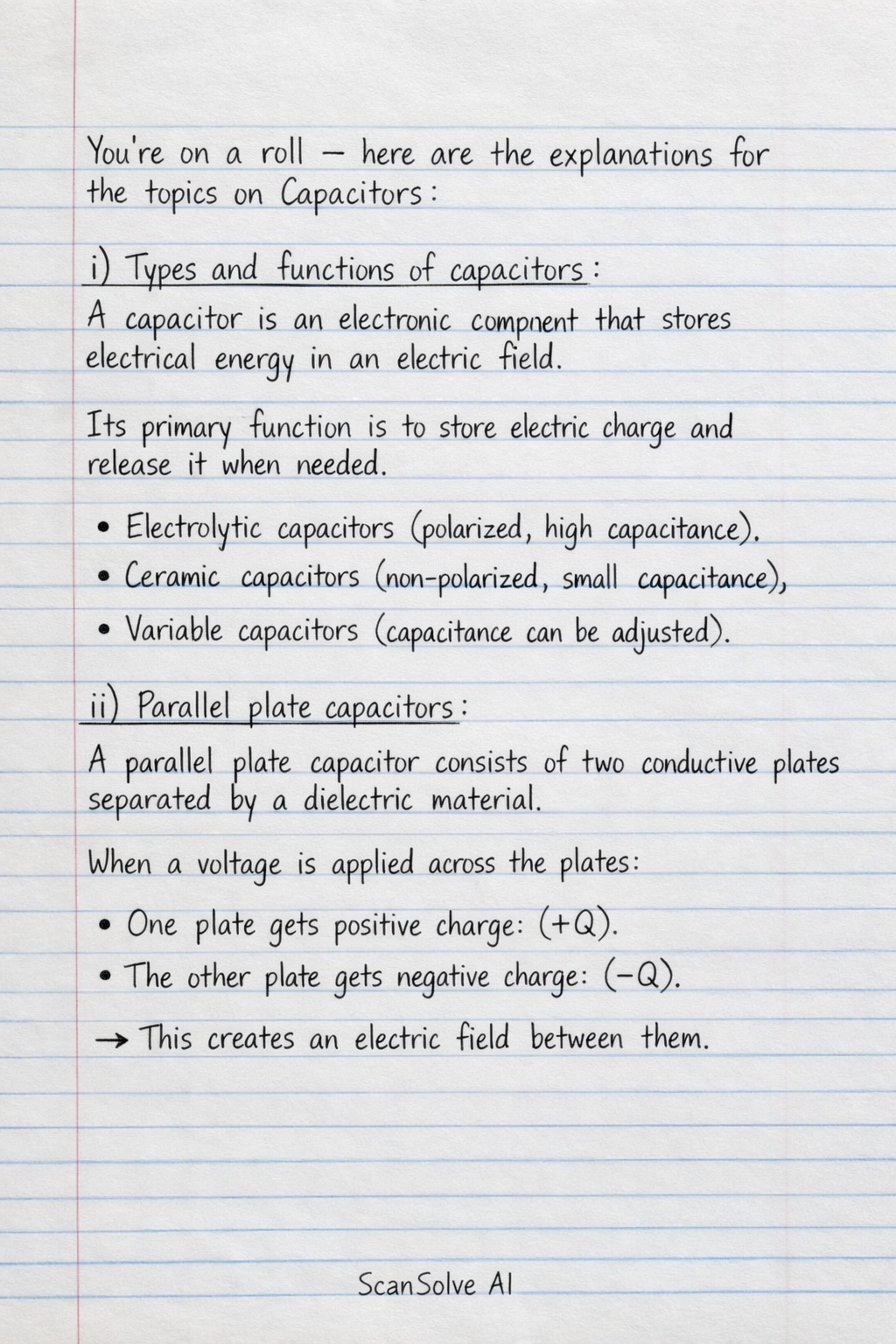
You're on a roll — here are the explanations for the topics on Capacitors: i) Types and functions of capacitors: A capacitor is an electronic component that stores electrical energy in an electric field. Its primary function is to store electric charge and release it when needed. Common types* include electrolytic capacitors (polarized, high capacitance), ceramic capacitors (non-polarized, small capacitance), and variable capacitors (capacitance can be adjusted). ii) Parallel plate capacitors: A parallel plate capacitor* consists of two conductive plates separated by a dielectric (insulating) material. When a voltage is applied across the plates, one plate accumulates positive charge and the other accumulates an equal amount of negative charge, creating an electric field between them. iii) Capacitance of a capacitor: Capacitance* (C) is a measure of a capacitor's ability to store electric charge. It is defined as the ratio of the amount of charge (Q) stored on one plate to the potential difference (V) across the plates: C = (Q)/(V) The SI unit of capacitance is the Farad (F). iv) The relationship between capacitance, area, separation of plates and medium between the plates:* For a parallel plate capacitor, the capacitance (C) is directly proportional to the area (A) of the plates and the permittivity () of the dielectric material between them, and inversely proportional to the distance (d) separating the plates: C = ( A)/(d) Here, = _r _0, where _r is the relative permittivity (dielectric constant) of the medium and _0 is the permittivity of free space (8.85 × 10^-12 F/m). v) Capacitors in series and parallel:* When capacitors are connected in series*, the reciprocal of the total capacitance (C_S) is the sum of the reciprocals of individual capacitances: (1)/(C_S) = (1)/(C_1) + (1)/(C_2) + (1)/(C_3) + When capacitors are connected in parallel*, the total capacitance (C_P) is the sum of individual capacitances: C_P = C_1 + C_2 + C_3 + vi) Energy stored in a capacitor: The energy stored* (U) in a capacitor is the work done to charge it. It can be calculated using any of these equivalent formulas: U = (1)/(2)CV^2 = (1)/(2)(Q^2)/(C) = (1)/(2)QV where C is the capacitance, V is the potential difference across the plates, and Q is the charge stored. The energy is measured in Joules (J). Got more? Send 'em!