
We read your photo as:
Define mechanical energy, calculate potential energy, distinguish between alkali and base, and name sources of bases.
ScanSolve AI Answer
Step-by-step solution
8 stepsQuestion 2(b)(i): Define mechanical energy.
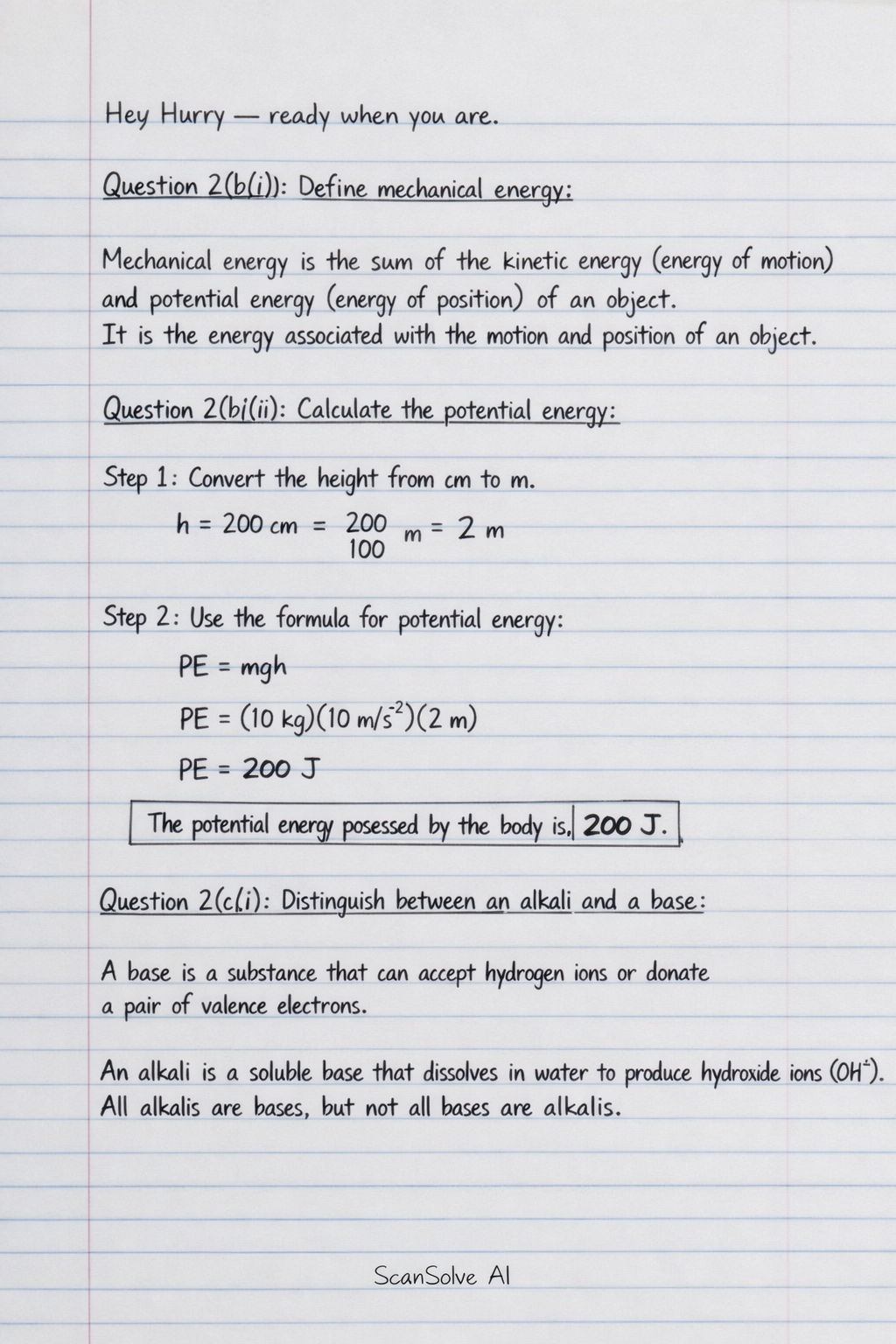
Mechanical energy is the sum of the kinetic energy (energy of motion) and potential energy (energy of position) of an object. It is the energy associated with the motion and position of an object.
Question 2(b)(ii): Calculate the potential energy.
Convert the height from cm to m.
Use the formula for potential energy.
The potential energy possessed by the body is .
Question 2(c)(i): Distinguish between an alkali and a base.
A base is a substance that can accept hydrogen ions or donate a pair of valence electrons. An alkali is a soluble base that dissolves in water to produce hydroxide ions (). All alkalis are bases, but not all bases are alkalis.Question 2(c)(ii): Name one natural source of each of the following bases:
- (α) Ammonia: Decomposition of organic matter (e.g., urea in urine).
- (β) Calcium oxide: Limestone (calcium carbonate, which is heated to produce calcium oxide).
- (γ) Potassium hydroxide: Wood ash.
Question 2(d)(i): Explain the term mulching.
Mulching is the practice of covering the soil surface with a layer of material (mulch) to conserve soil moisture, suppress weed growth, regulate soil temperature, and improve soil health.Question 2(d)(ii): List three materials used for mulching.
- Straw
- Wood chips
- Leaves
Question 4(a)(i): Differentiate between pest and parasite.
A pest is an organism that causes damage or nuisance to humans, their crops, livestock, or property. A parasite is an organism that lives on or in a host organism, obtaining nutrients from the host and often causing harm, but typically not killing the host immediately.Question 4(a)(ii): Name the stages in the life cycle of a weevil.
The stages in the life cycle of a weevil (complete metamorphosis) are:- Egg
- Larva
- Pupa
- Adult
Question 4(b)(i): Calculate the concentration of the solution in mol dm⁻³.
Given: Mass of KOH g, Volume of solution cm³, Molar masses: K , O , H .Calculate the molar mass of KOH.
Calculate the number of moles of KOH.
Convert the volume of the solution to dm³.
Calculate the concentration in mol dm⁻³.
The concentration of the solution is approximately .
Question 4(b)(ii): Calculate the concentration of the diluted solution in mol dm⁻³.
Given: Initial concentration mol/dm³ (from part i), Initial volume cm³, Final volume cm³.Use the dilution formula .
Substitute the values and calculate .
The concentration of the diluted solution is approximately .
Question 4(c): Name the discrete electronic component described by each of the following statements:
- (i) It stores electric charge: Capacitor
- (ii) It stores magnetic field when electric current flows through it: Inductor (or Coil)
- (iii) It opposes the flow of electric charge: Resistor
- (iv) It is made of two parallel plates separated by an insulator: Capacitor
- (v) It allows electric current to flow in one direction only: Diode
Still stuck on this one?
Ask a follow-up, and the answer starts from this question.
More Physics Questions
Handwritten Step-by-Step Solution
Get this as a handwritten image on WhatsApp — like a tutor wrote it for you.
Try on WhatsApp