
We read your photo as:
Calculate the combined resistance of the 2 and 3 resistors.
ScanSolve AI Answer
Step-by-step solution
3 stepsCalculate the combined resistance of the and resistors.
These two resistors are connected in parallel.
The combined resistance of the and resistors is .
Calculate the total resistance in the circuit when the switch is closed.
The equivalent resistance of the parallel combination () is in series with the resistor.
The total resistance in the circuit when the switch is closed is .
Calculate the potential difference across the resistor.
First, calculate the total current () flowing from the source using Ohm's Law.
The potential difference across the parallel combination () is the product of the total current and the equivalent parallel resistance. The resistor is part of this parallel combination, so the potential difference across it is .
The potential difference across the resistor is .
Still stuck on this one?
Ask a follow-up, and the answer starts from this question.
More Physics Questions
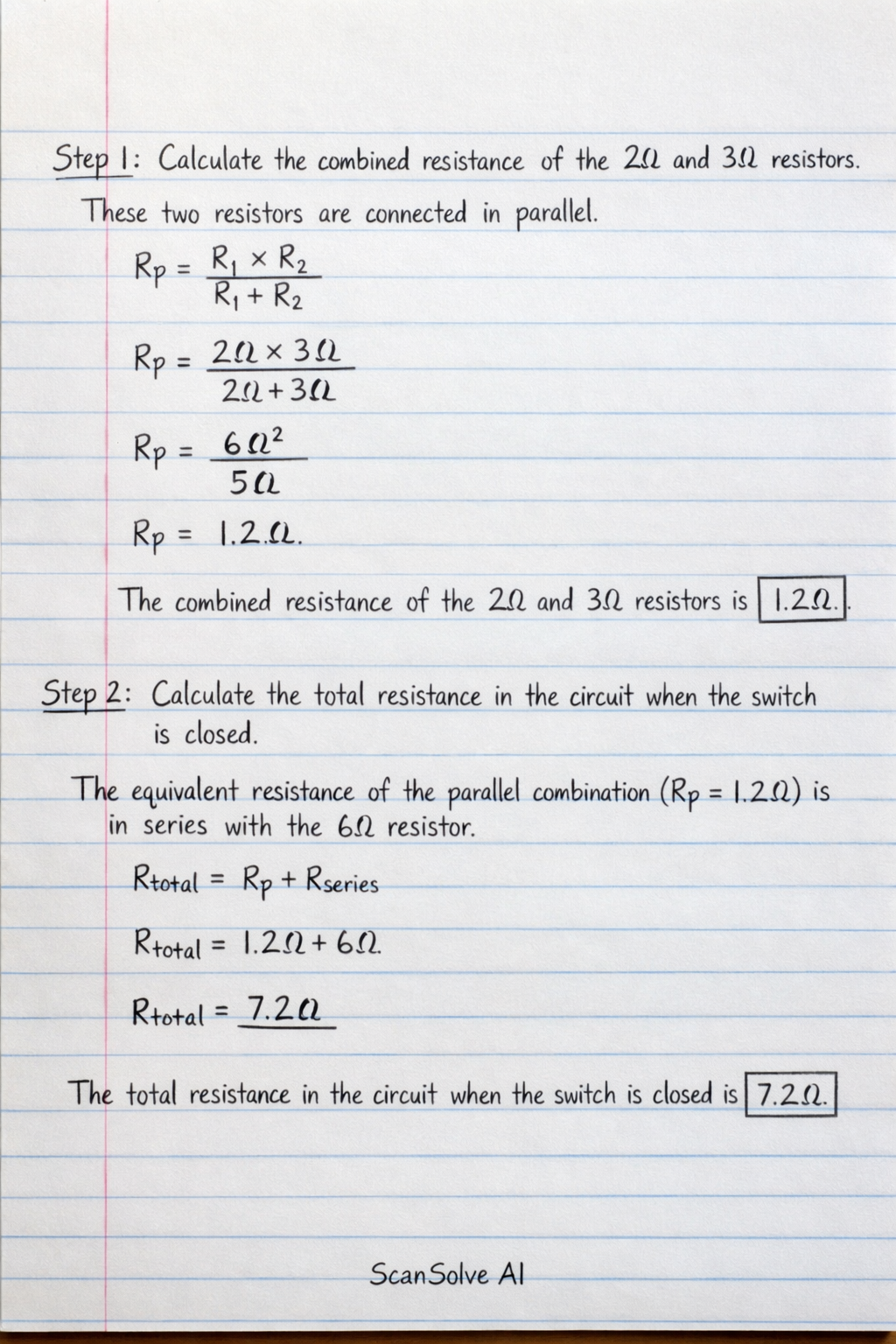
Handwritten Step-by-Step Solution
Get this as a handwritten image on WhatsApp — like a tutor wrote it for you.
Try on WhatsApp