
We read your photo as:
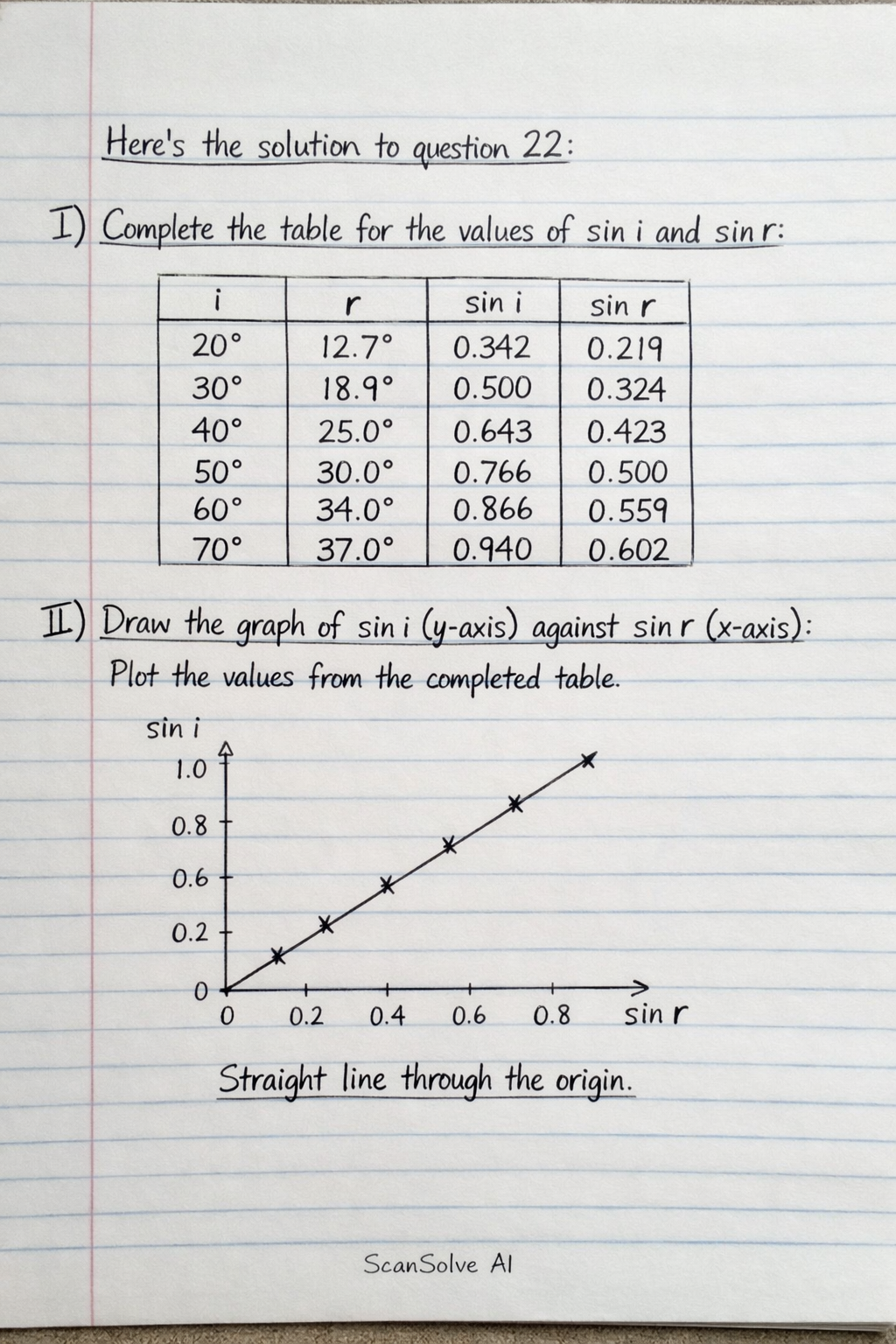
Complete the table for the values of sin i and sin r, draw the graph of sin i against sin r, and determine the slope.
ScanSolve AI Answer
Step-by-step solution
5 stepsHere's the solution to question 22:
I) Complete the table for the values of and .
| 0.342 | 0.219 | ||
| 0.500 | 0.324 | ||
| 0.643 | 0.423 | ||
| 0.766 | 0.500 | ||
| 0.866 | 0.559 | ||
| 0.940 | 0.602 |
II) Draw the graph of (y-axis) against (x-axis).
Plot the values from the completed table with on the x-axis and on the y-axis. The graph should be a straight line passing through the origin.
III) Determine the slope of the graph. What does it represent?
Calculate the ratio for each pair of values.
This ratio represents the refractive index ().
- For :
- For :
- For :
- For :
- For :
- For :
Calculate the average of these ratios to find the slope (refractive index).
The slope of the graph is approximately .
The slope represents the refractive index of the glass.IV) Use the results in b (III) to calculate the velocity of light in glass, given that velocity of light in vacuum is m/s.
Use the formula for refractive index
n = \frac{\text{velocity of light in vacuum (c)}}{\text{velocity of light in glass (v_g)}}.Rearrange the formula to solve for .
Substitute the given values and the calculated refractive index.
Rounding to three significant figures:
The velocity of light in glass is .
Still stuck on this one?
Ask a follow-up, and the answer starts from this question.
More Physics Questions
Handwritten Step-by-Step Solution
Get this as a handwritten image on WhatsApp — like a tutor wrote it for you.
Try on WhatsApp