
We read your photo as:
Explain the concept of pressure and provide four applications in plumbing. Additionally, calculate the volume of water in a tank that is 2/3 full.
ScanSolve AI Answer
Step-by-step solution
8 steps1 a) Pressure is defined as the force applied perpendicular to the surface of an object per unit area over which that force is distributed.
where is pressure, is force, and is area.
1 b) Four practical applications of pressure in the plumbing industry are:
- Water supply systems: Pressure is essential to move water through pipes from a source to various outlets in buildings.
- Pressure testing: Pipes are tested under pressure to detect leaks before a system is put into service.
- Pressure relief valves: These devices use pressure to open and release excess fluid, preventing damage to plumbing systems from overpressure.
- Water hammer arrestors: These devices absorb pressure surges (water hammer) to protect pipes and fixtures.
2 a)
Calculate the total volume of the tank.
The cross-sectional area is .
The height is .
Total volume of tank = Area HeightCalculate the volume of water in the tank.
The tank is full of water.
Convert the volume of water to liters.
Since :
2 b)
Calculate the height of the water.
The tank is high and full.
Calculate the gauge pressure at the base of the tank.
The formula for gauge pressure is , where is the density of water (), is the acceleration due to gravity (), and is the height of the water.
Calculate the total pressure at the base of the tank.
Total pressure is the sum of atmospheric pressure () and gauge pressure.
3) An air lock is a bubble of air trapped in a pipe or plumbing system that obstructs or completely stops the flow of liquid. It is important in plumbing because air locks can prevent water from reaching fixtures, reduce the efficiency of heating systems, cause noisy pipes, and potentially damage pumps if they run dry.
4) A likely cause of leakage in plastic cisterns is material degradation due to prolonged exposure to ultraviolet (UV) radiation from sunlight or chemical attack from certain cleaning agents or water additives, which can make the plastic brittle and prone to cracking.
5 b) Required ways of controlling leakage in plastic cisterns include:
- Regular inspection: Periodically check the cistern for any signs of cracks or wear.
- Proper material selection: Use UV-stabilized plastics if the cistern is exposed to sunlight.
- Correct installation: Ensure the cistern is installed on a stable, flat surface to prevent stress points, and avoid overtightening connections.
- Pressure management: Maintain appropriate water pressure within the system to prevent excessive stress on the cistern walls.
- Prompt repair: Address any small cracks or leaks immediately using appropriate plastic repair techniques or sealants to prevent them from worsening.
6 a) Intensity of pressure is another term for pressure, which is the force exerted per unit area. In fluid mechanics, it specifically refers to the pressure at a certain point within a fluid.
6 b)
Convert the dimensions of the cistern to meters.
The cistern dimensions are .
Assuming the height of the water is the smallest dimension, .Calculate the intensity of pressure (gauge pressure) at the base of the cistern.
Using the formula , where (density of water) and .
7)
- i) Boiler core: The central part of a boiler where combustion takes place and heat is transferred to the water or other heat transfer fluid.
- ii) Patina: A thin layer that forms on the surface of metals, such as copper or bronze, due to oxidation or other chemical reactions, often providing a protective coating or a distinctive aesthetic finish.
- iii) Damper: A valve or plate used to regulate the flow of air or flue gases in a chimney, furnace, or air duct, controlling combustion or ventilation.
- iv) Flue: A duct, pipe, or channel that carries exhaust gases (like smoke or combustion byproducts) from a fireplace, furnace, water heater, or boiler to the outside atmosphere.
- v) Calorifier: A device used to heat water, typically by transferring heat from a primary heat source (like a boiler) through a coil or heat exchanger to a separate body of water for domestic or industrial use.
Still stuck on this one?
Ask a follow-up, and the answer starts from this question.
More Physics Questions
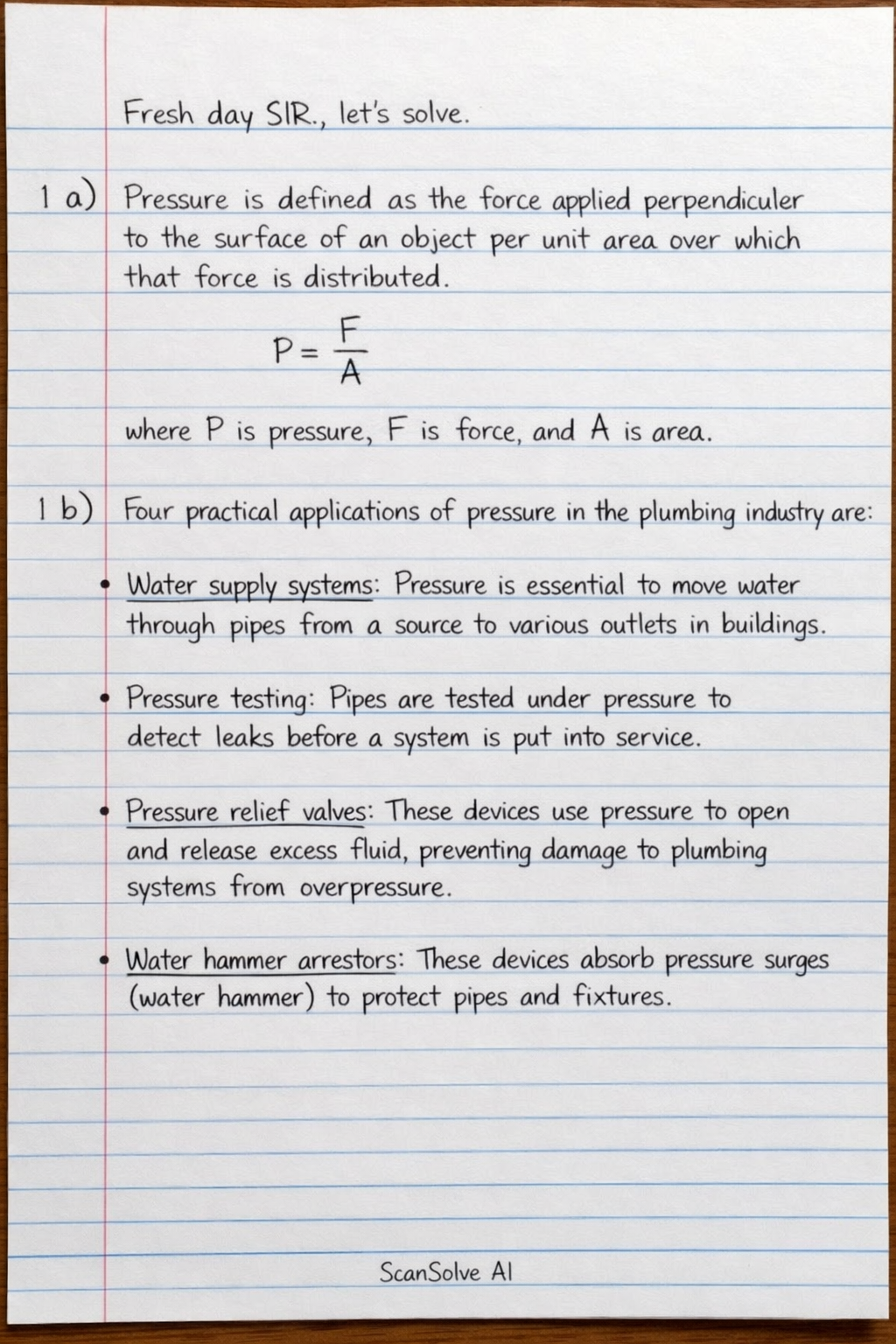
Handwritten Step-by-Step Solution
Get this as a handwritten image on WhatsApp — like a tutor wrote it for you.
Try on WhatsApp