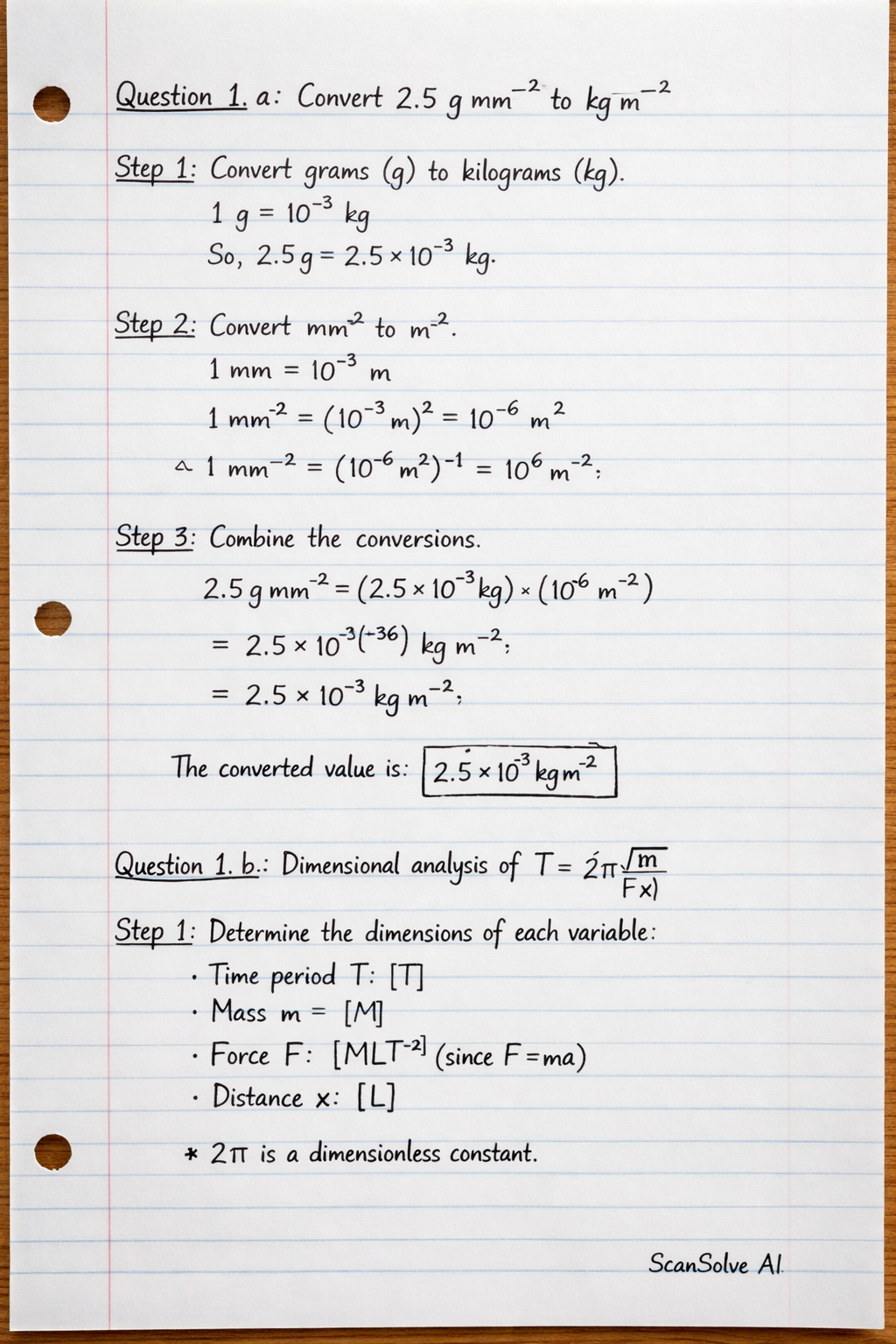
Step 3: Combine the conversions.
2.5gmm−2=(2.5×10⁻³kg)×(106m−2)2.5gmm−2=2.5×10(−3+6)kgm−22.5gmm−2=2.5×10³kgm−2
The converted value is:
2.5×10³kgm−2
Question 1. b: Dimensional analysis of T=2πFxm
Step 1: Determine the dimensions of each variable.
• Time period T: [T]
• Mass m: [M]
• Force F: [MLT−2] (since F=ma)
• Distance x: [L]
• 2π is a dimensionless constant.
Step 2: Determine the dimensions of the right-hand side (RHS) of the equation.
The term inside the square root is Fxm.
Dimensions of Fx: [MLT−2]×[L]=[ML2T−2]
Dimensions of Fxm: [ML2T−2][M]=[M1−1L−2T2]=[L−2T2]
Dimensions of Fxm: [L−2T2]=[L−1T]
Step 3: Compare the dimensions of the left-hand side (LHS) and RHS.
LHS dimensions: [T]
RHS dimensions: [L−1T]
Since [T]=[L−1T], the dimensions are not equal.
The formula is:
Dimensionallyincorrect
Question 2. a: Conditions for two vectors to be equal and examples of "magnitude"
• Two vectors are considered equal if they have the same magnitude and the same direction.
• Examples of the term "magnitude" as applied to vector and scalar quantities:
* The length of a displacement vector.
* The speed of a velocity vector.
* The mass of an object (a scalar quantity).
* The temperature of a substance (a scalar quantity).
Question 2. b: Magnitude of the resultant of two equal vectors
Step 1: State the formula for the magnitude of the resultant of two vectors.
If two vectors A and B have magnitudes A and B respectively, and the angle between them is θ, the magnitude of their resultant R is given by:
R=A2+B2+2ABcosθ
Step 2: Substitute the given information into the formula.
Given that the two vectors have equal magnitudes, A=F and B=F.
R=F2+F2+2(F)(F)cosθR=2F2+2F2cosθR=2F2(1+cosθ)
Step 3: Use the trigonometric identity 1+cosθ=2cos2(2θ).
R=2F2(2cos2(2θ))R=4F2cos2(2θ)R=2Fcos(2θ)
The magnitude of the resultant is:
2Fcos(2θ)
Question 3. a: Total mechanical energy of a particle in SHM
Step 1: Identify given values and convert units.
Mass m=40g=0.040 kg.
Amplitude A=2.0cm=0.020 m.
Time period T=0.20 s.
Step 2: Calculate the angular frequency (ω).
The relationship between time period and angular frequency is ω=T2π.
ω=0.20s2π=10π rad/s
Step 3: Calculate the spring constant (k).
For SHM, the angular frequency is also given by ω=mk.
Squaring both sides: ω2=mk.
So, k=mω2.
k=(0.040kg)×(10πrad/s)2k=0.040×100π2 N/mk=4π2 N/m
Using π2≈9.87:
k≈4×9.87N/m=39.48 N/m
Step 4: Calculate the total mechanical energy (E).
The total mechanical energy of a system in SHM is given by E=21kA2.
E=21×(4π2N/m)×(0.020m)2E=2π2×(0.0004) JE=0.0008π2 J
Using π2≈9.87:
E≈0.0008×9.87 JE≈0.007896 J
Rounding to two significant figures:
E≈0.0079 J
The total mechanical energy of the system is:
0.0079J
Question 4. a: Tensile stress developed in the wire
Step 1: Identify given values and convert units.
Mass m=4.0 kg.
Radius r=2.0mm=2.0×10⁻³ m.
Acceleration due to gravity g=9.8m/s2.
Step 2: Calculate the force (tension) in the wire.
At equilibrium, the tension force F in the wire is equal to the weight of the load.
F=mg=(4.0kg)×(9.8m/s2)F=39.2 N
Step 3: Calculate the cross-sectional area of the wire.
The area A of a circular wire is A=πr2.
A=π×(2.0×10⁻³m)2A=π×(4.0×10⁻⁶m2)A=4π×10−6m2
Using π≈3.14159:
A≈4×3.14159×10−6m2≈12.566×10⁻⁶m2
Step 4: Calculate the tensile stress (σ).
Tensile stress is defined as force per unit area: σ=AF.
σ=4π×10−6m239.2Nσ≈12.566×10−639.2 Paσ≈3.119×10⁶ Pa
Rounding to two significant figures:
σ≈3.1×10⁶ Pa
The tensile stress developed in the wire is:
3.1×10⁶Pa
Question 5. a: What is a fluid? Give two examples.
• A fluid is a substance that continuously deforms (flows) under an applied shear stress. Unlike solids, fluids cannot withstand shear stress at rest. They include liquids and gases.
• Examples: Water (liquid), Air (gas).
Question 5. b: Define the terms adhesion and cohesion.
• Adhesion: The attractive force between molecules of different substances. For example, water molecules adhering to glass.
• Cohesion: The attractive force between molecules of the same substance. For example, water molecules sticking to each other, forming droplets.
Question 6: Wave properties from y=5sin(x−60t)
Step 1: Compare the given wave equation with the general form.
The general equation for a sinusoidal wave traveling in the positive x-direction is y=Asin(kx−ωt), where:
• A is the amplitude
• k is the wave number
• ω is the angular frequency
Comparing y=5sin(x−60t) with the general form:
• Amplitude A=5 (units not specified, assume arbitrary units)
• Wave number k=1 (units are rad/m or m−1)
• Angular frequency ω=60 (units are rad/s)
Step 2: Find the wave number (k).
From comparison, k=1.
Step 3: Find the frequency (f).
The angular frequency ω is related to the frequency f by ω=2πf.
f=2πω=2π60 Hzf=π30 Hz
Step 4: Find the wavelength (λ).
The wave number k is related to the wavelength λ by k=λ2π.
λ=k2π=12π mλ=2π m
Step 5: Find the velocity (v) of the wave.
The velocity of the wave is given by v=fλ or v=kω.
Using v=kω:
v=1rad/m60rad/s=60 m/s
This physics problem tests your understanding of fundamental physical laws and their applications. The step-by-step solution below breaks down the problem using relevant equations and physical reasoning.
ScanSolve AI Answer
Right Blessing, let's go. Question 1. a: Convert 2.5 gmm^-2 to kgm^-2 Step 1: Convert grams (g) to kilograms (kg). 1 g = 10^-3 kg So, 2.5 g = 2.5 × 10^-3 kg. Step 2: Convert square millimeters (mm^2) to square meters (m^2). 1 mm = 10^-3 m 1 mm^2 = (10^-3 m)^2 = 10^-6 m^2 Therefore, 1 mm^-2 = (10^-6 m^2)^-1 = 10^6 m^-2. Step 3: Combine the conversions. 2.5 gmm^-2 = (2.5 × 10^-3 kg) × (10^6 m^-2) 2.5 gmm^-2 = 2.5 × 10^(-3+6) kgm^-2 2.5 gmm^-2 = 2.5 × 10^3 kgm^-2 The converted value is: 2.5 × 10^3 kgm^-2 Question 1. b: Dimensional analysis of T = 2 sqrt((m)/(Fx)) Step 1: Determine the dimensions of each variable. • Time period T: [T] • Mass m: [M] • Force F: [MLT^-2] (since F = ma) • Distance x: [L] • 2 is a dimensionless constant. Step 2: Determine the dimensions of the right-hand side (RHS) of the equation. The term inside the square root is (m)/(Fx). Dimensions of Fx: [MLT^-2] × [L] = [ML^2T^-2] Dimensions of (m)/(Fx): ([M])/([ML^2T^-2)] = [M^1-1L^-2T^2] = [L^-2T^2] Dimensions of sqrt((m)/(Fx)): sqrt([L^-2)T^2] = [L^-1T] Step 3: Compare the dimensions of the left-hand side (LHS) and RHS. LHS dimensions: [T] RHS dimensions: [L^-1T] Since [T] ≠ [L^-1T], the dimensions are not equal. The formula is: Dimensionally incorrect Question 2. a: Conditions for two vectors to be equal and examples of "magnitude" • Two vectors are considered equal if they have the same magnitude and the same direction. • Examples of the term "magnitude" as applied to vector and scalar quantities: The length* of a displacement vector. The speed* of a velocity vector. The mass* of an object (a scalar quantity). The temperature* of a substance (a scalar quantity). Question 2. b: Magnitude of the resultant of two equal vectors Step 1: State the formula for the magnitude of the resultant of two vectors. If two vectors A and B have magnitudes A and B respectively, and the angle between them is , the magnitude of their resultant R is given by: R = sqrt(A^2 + B^2 + 2AB ) Step 2: Substitute the given information into the formula. Given that the two vectors have equal magnitudes, A = F and B = F. R = sqrt(F^2 + F^2 + 2(F)(F) ) R = sqrt(2F^2 + 2F^2 ) R = sqrt(2F^2 (1 + )) Step 3: Use the trigonometric identity 1 + = 2^2(()/(2)). R = sqrt(2F^2 (2^2(()/(2)))) R = sqrt(4F^2 ^2(()/(2))) R = 2F (()/(2)) The magnitude of the resultant is: 2F (()/(2)) Question 3. a: Total mechanical energy of a particle in SHM Step 1: Identify given values and convert units. Mass m = 40 g = 0.040 kg. Amplitude A = 2.0 cm = 0.020 m. Time period T = 0.20 s. Step 2: Calculate the angular frequency (). The relationship between time period and angular frequency is = (2)/(T). = (2)/(0.20 s) = 10 rad/s Step 3: Calculate the spring constant (k). For SHM, the angular frequency is also given by = sqrt((k)/(m)). Squaring both sides: ^2 = (k)/(m). So, k = m^2. k = (0.040 kg) × (10 rad/s)^2 k = 0.040 × 100^2 N/m k = 4^2 N/m Using ^2 ≈ 9.87: k ≈ 4 × 9.87 N/m = 39.48 N/m Step 4: Calculate the total mechanical energy (E). The total mechanical energy of a system in SHM is given by E = (1)/(2) k A^2. E = (1)/(2) × (4^2 N/m) × (0.020 m)^2 E = 2^2 × (0.0004) J E = 0.0008^2 J Using ^2 ≈ 9.87: E ≈ 0.0008 × 9.87 J E ≈ 0.007896 J Rounding to two significant figures: E ≈ 0.0079 J The total mechanical energy of the system is: 0.0079 J Question 4. a: Tensile stress developed in the wire Step 1: Identify given values and convert units. Mass m = 4.0 kg. Radius r = 2.0 mm = 2.0 × 10^-3 m. Acceleration due to gravity g = 9.8 m/s^2. Step 2: Calculate the force (tension) in the wire. At equilibrium, the tension force F in the wire is equal to the weight of the load. F = mg = (4.0 kg) × (9.8 m/s^2) F = 39.2 N Step 3: Calculate the cross-sectional area of the wire. The area A of a circular wire is A = r^2. A = × (2.0 × 10^-3 m)^2 A = × (4.0 × 10^-6 m^2) A = 4 × 10^-6 m^2 Using ≈ 3.14159: A ≈ 4 × 3.14159 × 10^-6 m^2 ≈ 12.566 × 10^-6 m^2 Step 4: Calculate the tensile stress (). Tensile stress is defined as force per unit area: = (F)/(A). = 39.2 N4 × 10^-6 m^2 ≈ (39.2)/(12.566 × 10^-6) Pa ≈ 3.119 × 10^6 Pa Rounding to two significant figures: ≈ 3.1 × 10^6 Pa The tensile stress developed in the wire is: 3.1 × 10^6 Pa Question 5. a: What is a fluid? Give two examples. • A fluid is a substance that continuously deforms (flows) under an applied shear stress. Unlike solids, fluids cannot withstand shear stress at rest. They include liquids and gases. • Examples: Water (liquid), Air (gas). Question 5. b: Define the terms adhesion and cohesion. • Adhesion: The attractive force between molecules of different substances. For example, water molecules adhering to glass. • Cohesion: The attractive force between molecules of the same substance. For example, water molecules sticking to each other, forming droplets. Question 6: Wave properties from y = 5 (x - 60t) Step 1: Compare the given wave equation with the general form. The general equation for a sinusoidal wave traveling in the positive x-direction is y = A (kx - t), where: • A is the amplitude • k is the wave number • is the angular frequency Comparing y = 5 (x - 60t) with the general form: • Amplitude A = 5 (units not specified, assume arbitrary units) • Wave number k = 1 (units are rad/m or m^-1) • Angular frequency = 60 (units are rad/s) Step 2: Find the wave number (k). From comparison, k = 1. Step 3: Find the frequency (f). The angular frequency is related to the frequency f by = 2 f. f = ()/(2) = (60)/(2) Hz f = (30)/() Hz Step 4: Find the wavelength (). The wave number k is related to the wavelength by k = (2)/(). = (2)/(k) = (2)/(1) m = 2 m Step 5: Find the velocity (v) of the wave. The velocity of the wave is given by v = f or v = ()/(k). Using v = ()/(k): v = 60 rad/s1 rad/m = 60 m/s The wave number, frequency, wavelength, and velocity are: • Wave number: 1 m^-1 • Frequency: (30)/() Hz • Wavelength: 2 m • Velocity: 60 m/s Got more? Send 'em.