
This physics problem tests your understanding of fundamental physical laws and their applications. The step-by-step solution below breaks down the problem using relevant equations and physical reasoning.
ScanSolve AI Answer
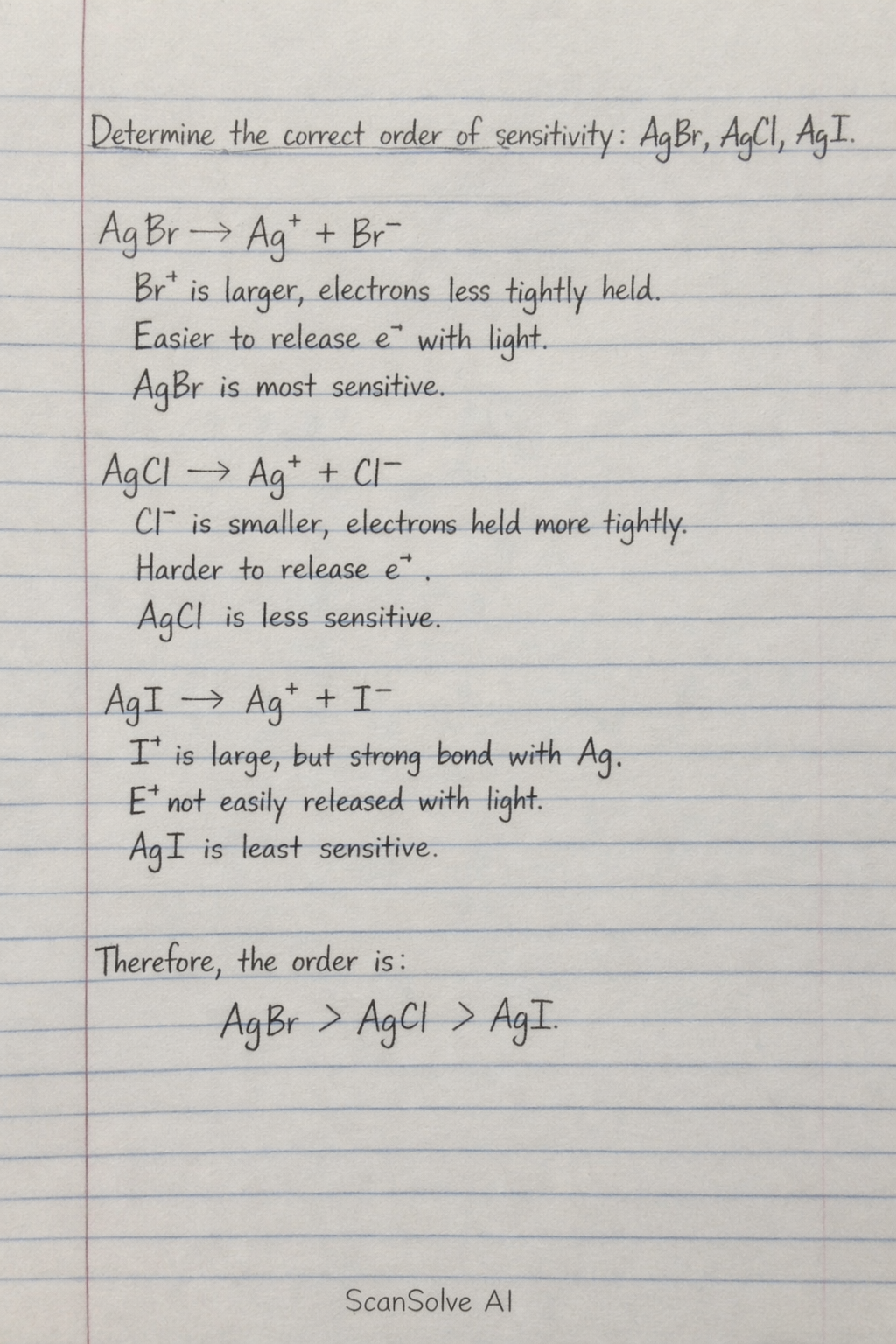
Welcome back — missed you this week. ✅ Correct. Your explanation accurately describes the light sensitivity of silver halides. The order of sensitivity is determined by how easily the halide ion can release an electron when exposed to light, leading to the formation of silver metal. AgBr is the most sensitive because the bromide ion is larger than chloride, making its valence electrons less tightly held and easier to release upon light absorption. This is why it's widely used in photography. AgCl is less sensitive than AgBr because the chloride ion is smaller, holding its electrons more strongly. AgI is the least sensitive. Although iodide is the largest, its strong covalent character with silver makes it less prone to releasing electrons compared to AgBr under typical photographic light conditions. Therefore, the correct order of light sensitivity is AgBr > AgCl > AgI. Send me the next one 📸