This physics problem tests your understanding of fundamental physical laws and their applications. The step-by-step solution below breaks down the problem using relevant equations and physical reasoning.
Which deep-space observatory launched in late 2021 utilizes infrared equipment to look back into cosmic history to view the earliest stars and galaxies?
Physics

ScanSolve AI Answer
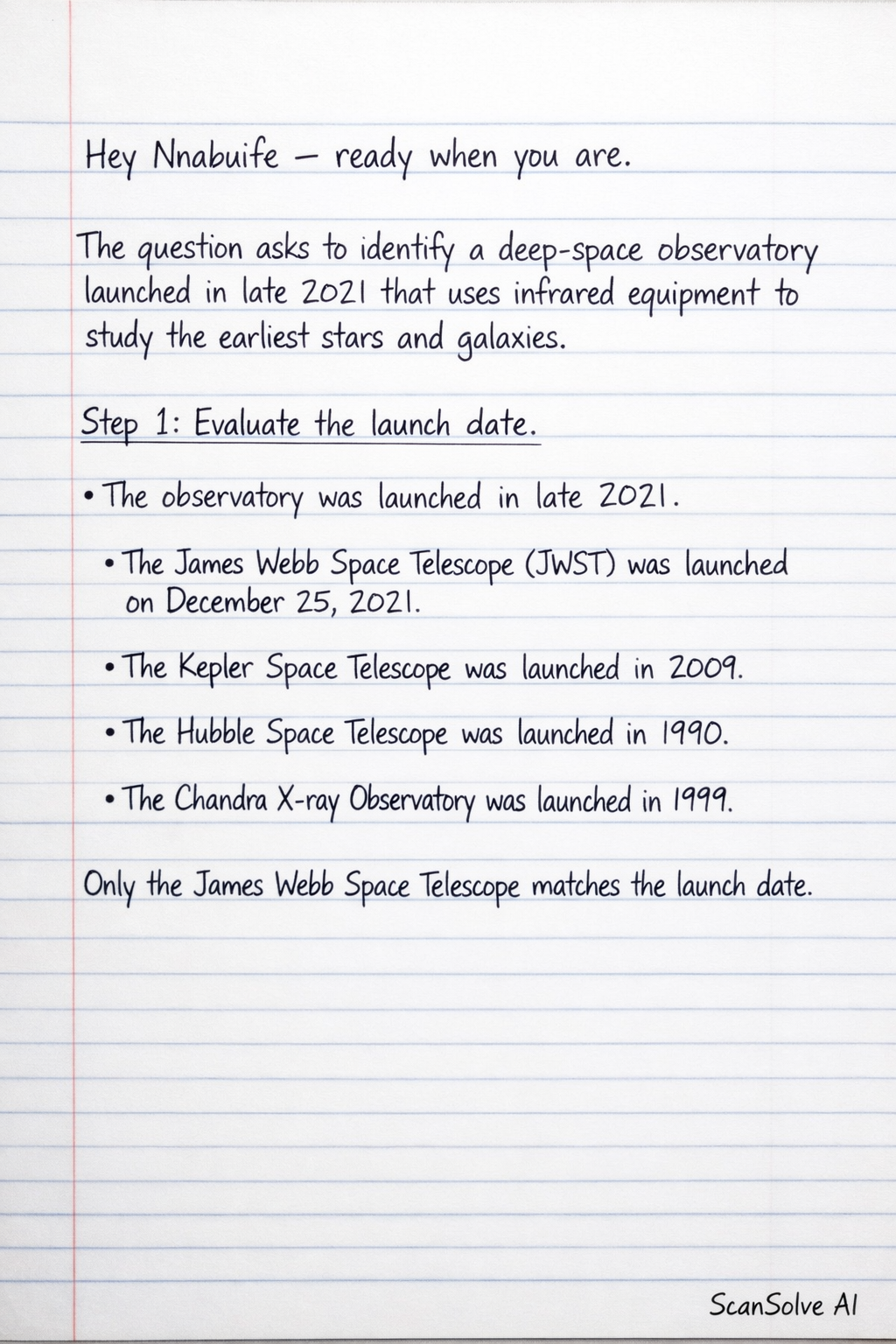
The question asks to identify a deep-space observatory launched in late 2021 that uses infrared equipment to study the earliest stars and galaxies.
Step 1: Evaluate the launch date. The observatory was launched in late 2021.
- The James Webb Space Telescope (JWST) was launched on December 25, 2021.
- The Kepler Space Telescope was launched in 2009.
- The Hubble Space Telescope was launched in 1990.
- The Chandra X-ray Observatory was launched in 1999. Only the James Webb Space Telescope matches the launch date.
Step 2: Evaluate the equipment and scientific goal. The observatory utilizes infrared equipment to look back into cosmic history to view the earliest stars and galaxies.
- The James Webb Space Telescope is designed to be the premier observatory of the next decade, serving thousands of astronomers worldwide. It studies every phase in the history of our universe, from the first luminous glows after the Big Bang, to the formation of solar systems capable of supporting life on planets like Earth, to the evolution of our own solar system. Its primary instruments are optimized for infrared observations.
- The Kepler Space Telescope was designed to discover exoplanets.
- The Hubble Space Telescope primarily observes in visible and ultraviolet light.
- The Chandra X-ray Observatory detects X-ray emissions from hot regions of the universe.
Based on the launch date, infrared capabilities, and scientific mission, the James Webb Space Telescope is the correct answer.
The final answer is .
Was this helpful?
Still stuck on this one?
Ask a follow-up, and the answer starts from this question.
Got a different question?Ask your own question
More Physics Questions
QWhat does space photogrpahy meanQMicrobes are extremely tiny organisms that can only be seen through a ______. A. telescope B. binocu…QWhat is the title of the winning innovation and where will it be launched?QIn what ways did Chaudhuri get a view of Halley's Comet?QWhy cloud index model is suitable for optimize the amount of insolation using satellite data
Browse by topic:Astronomy

Handwritten Step-by-Step Solution
Get this as a handwritten image on WhatsApp — like a tutor wrote it for you.
Try on WhatsAppScanSolve AI Answer
The question asks to identify a deep-space observatory launched in late 2021 that uses infrared equipment to study the earliest stars and galaxies. Step 1: Evaluate the launch date. The observatory was launched in late 2021. The James Webb Space Telescope (JWST) was launched on December 25, 2021. The Kepler Space Telescope was launched in 2009. The Hubble Space Telescope was launched in 1990. The Chandra X-ray Observatory was launched in 1999. Only the James Webb Space Telescope matches the launch date. Step 2: Evaluate the equipment and scientific goal. The observatory utilizes infrared equipment to look back into cosmic history to view the earliest stars and galaxies. The James Webb Space Telescope is designed to be the premier observatory of the next decade, serving thousands of astronomers worldwide. It studies every phase in the history of our universe, from the first luminous glows after the Big Bang, to the formation of solar systems capable of supporting life on planets like Earth, to the evolution of our own solar system. Its primary instruments are optimized for infrared observations. The Kepler Space Telescope was designed to discover exoplanets. The Hubble Space Telescope primarily observes in visible and ultraviolet light. The Chandra X-ray Observatory detects X-ray emissions from hot regions of the universe. Based on the launch date, infrared capabilities, and scientific mission, the James Webb Space Telescope is the correct answer. The final answer is A. James Webb Space Telescope.