
We read your photo as:
Design an experiment to determine the specific heat capacity of an unknown metal.
Physics
ScanSolve AI Answer
Here's a breakdown of the experiment and tasks:
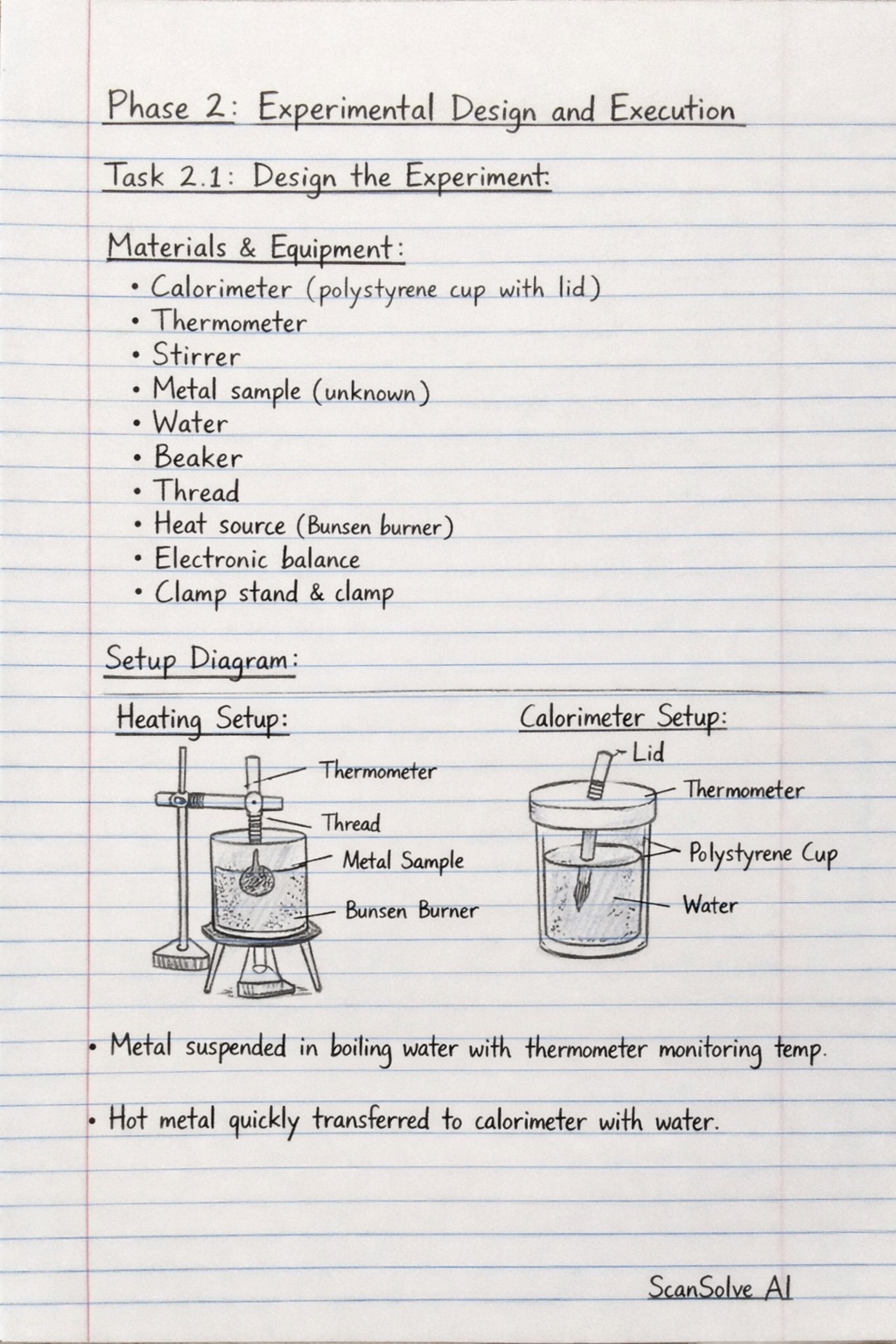
Phase 2: Experimental Design and Execution
Task 2.1: Design your experiment by:
-
Listing all materials and equipment:
- Calorimeter (e.g., polystyrene cup with lid)
- Thermometer (digital or mercury-in-glass)
- Stirrer
- Unknown metal sample (e.g., metal block or pellets)
- Water
- Beaker (for heating water and metal)
- Thread (to suspend metal)
- Heat source (e.g., Bunsen burner, hot plate)
- Electronic balance (for measuring mass)
- Clamp stand and clamp (to hold thermometer or metal)
-
Drawing a labelled diagram of the setup:
- Description: The setup involves two main parts. First, a beaker on a heat source containing water, with the metal sample suspended by a thread in the boiling water, and a thermometer to confirm the water's temperature. Second, a calorimeter (e.g., a polystyrene cup with a lid) containing a known mass of water, a stirrer, and a thermometer. The hot metal is quickly transferred from the boiling water to the calorimeter.
-
Identifying sources of error and ways to minimize them:
- Sources of Error:
- Heat loss to surroundings: The calorimeter is not perfectly insulated, leading to heat exchange with the environment.
- Incomplete heat transfer: The metal might not reach the exact boiling point of water, or it might lose heat during transfer to the calorimeter.
- Temperature measurement inaccuracies: Errors in reading the thermometer or thermometer calibration issues.
- Mass measurement inaccuracies: Errors in using the balance.
- Specific heat capacity of calorimeter: The assumed value for might not be perfectly accurate.
- Inadequate stirring: Leads to non-uniform temperature distribution in the water.
- Ways to Minimize Errors:
- Heat loss: Use a well-insulated calorimeter (e.g., double-walled polystyrene cup with a lid). Minimize the time taken to transfer the hot metal.
- Incomplete heat transfer: Ensure the metal is immersed in boiling water for a sufficient duration (e.g., 10-15 minutes) to reach thermal equilibrium. Transfer the metal quickly.
- Temperature measurement: Use a precise thermometer and read at eye level. Stir continuously for uniform temperature.
- Mass measurement: Use a precise digital balance and zero it correctly.
- Calorimeter specific heat capacity: Use a calorimeter made of a known material or determine its specific heat capacity experimentally.
- Stirring: Stir the water gently but continuously.
- Sources of Error:
Task 2.2: Conduct the experiment:
- Record all measurements in a data table:
- A data table should include: mass of calorimeter (), mass of water (), initial temperature of water and calorimeter (), mass of metal (), initial temperature of metal (, typically boiling point of water), and final equilibrium temperature ().
- Conduct at least two trials for reliability: Repeat the entire experiment at least twice to check for consistency and calculate an average.
- Ensure accurate measurements with proper units: All measurements should be taken carefully and recorded with their correct SI units (e.g., kg for mass, or K for temperature).
Phase 3: Data Analysis and Calculation
Task 3.1: Calculate the specific heat capacity using the formula:
The formula provided is:
Where:
- : specific heat capacity of metal (to be calculated)
- : mass of water (in kg)
- : specific heat capacity of water ()
- : mass of calorimeter (in kg)
- : specific heat capacity of calorimeter (in , depends on material, e.g., copper is , polystyrene is )
- : final equilibrium temperature (in or K)
- : initial temperature of water and calorimeter (in or K)
- : mass of metal (in kg)
- : initial temperature of metal (in or K, typically )
To calculate , substitute all measured and known values into the formula and solve.
Task 3.2:
- Calculate average specific heat capacity from your 2 trials:
- If you obtain and from two trials, the average specific heat capacity is:
- Compare with known specific heat capacity value of the metal:
- Once the metal is identified, find its accepted specific heat capacity value from a reliable source. Compare your calculated average value to this accepted value.
- Calculate percentage error:
- Percentage Error
Phase 4: Analysis and Interpretation
Task 4.1: Analyze results:
- Was the calculated value close to the known value? Explain.
- Based on your percentage error, determine if the experimental value is acceptably close to the known value. A small percentage error (e.g., less
Was this helpful?
Still stuck on this one?
Ask a follow-up, and the answer starts from this question.
Got a different question?Ask your own question
More Physics Questions
QDefine specific heat capacity and describe an experiment to determine the specific heat capacity of…QDefine specific heat capacity, explain why metals are good conductors of heat, and describe the…QCalculate the specific heat capacity of the metal given the following information: Initial…QDesign an experiment to compare the reactivity of two metals (A and B) with hydrochloric acid by…QCalculate the specific heat capacities of Zinc and Brass using the principle of calorimetry and the…
Browse by topic:Thermodynamics
Handwritten Step-by-Step Solution
Get this as a handwritten image on WhatsApp — like a tutor wrote it for you.
Try on WhatsApp