

This physics problem tests your understanding of fundamental physical laws and their applications. The step-by-step solution below breaks down the problem using relevant equations and physical reasoning.
ScanSolve AI Answer
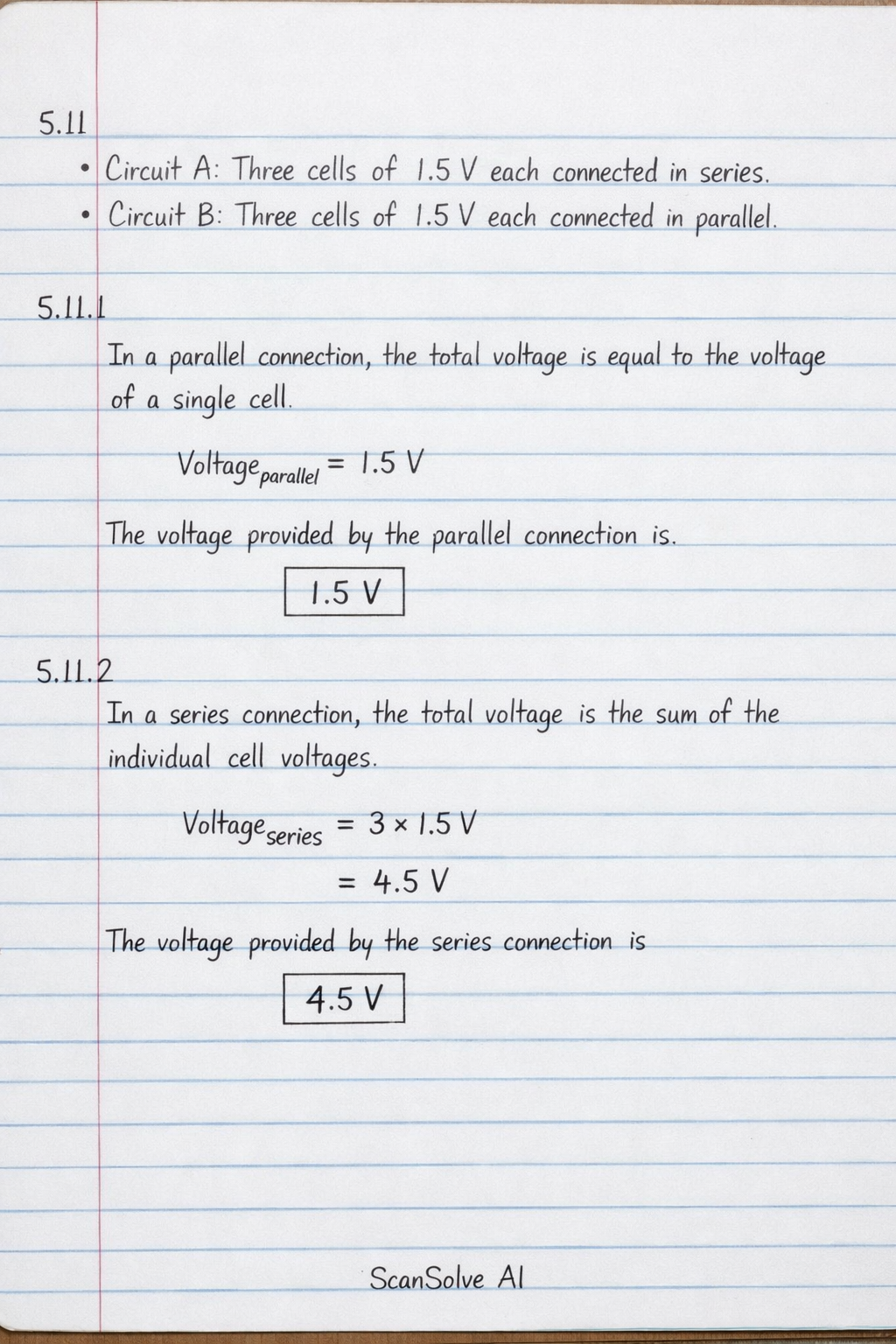
5.10 A SPDT (Single Pole, Double Throw) switch controls a single electrical circuit (single pole) and can connect it to one of two different paths or terminals (double throw). A DPDT (Double Pole, Double Throw) switch controls two separate electrical circuits simultaneously (double pole), and each of these circuits can be connected to one of two different paths or terminals (double throw). 5.11 Circuit A: Three cells of 1.5 \, V each connected in series. Circuit B: Three cells of 1.5 \, V each connected in parallel. 5.11.1 In a parallel connection, the total voltage is equal to the voltage of a single cell. Voltage_parallel = 1.5 \, V The voltage provided by the parallel connection is 1.5 V. 5.11.2 In a series connection, the total voltage is the sum of the individual cell voltages. Voltage_series = 3 × 1.5 \, V = 4.5 \, V The voltage provided by the series connection is 4.5 V. 5.12 Here are the matches for Column A to Column B: 5.12.1 Variable: C (A quantity that can have a different value.) 5.12.2 Emits: F (Source of) 5.12.3 Constant: G (A quantity that always has the same value.) 5.12.4 Resist: H (Try to prevent.) 5.12.5 Ammeter: A (Used to measure the current and is always connected in series.) 5.12.6 Voltmeter: D (Used to measure the potential and is always connected in parallel.) 5.12.7 Current: I (The flow of electricity.) 5.12.8 Potential: B (The amount of electricity.) 5.12.9 Conduct: E (Allows something to pass through.) 5.13 Here is the completed table: | Quantity | Abbreviation of quantity | Unit of measurement | Abbreviation of unit | | :------------------- | :----------------------- | :----------------- | :------------------- | | Potential difference | V | 5.13.1 Volt | V | | Current | 5.13.2 I | ampere | 5.13.3 A | | 5.13.4 Resistance| R | ohm | 5.13.5 | That's 2 down. 3 left today — send the next one.