
We read your photo as:
Differentiate between progressive waves and stationary waves, and solve a physics problem involving a falling child.
ScanSolve AI Answer
Answer
Step-by-step solution
4 stepshere are the solutions for questions 4 and 5:
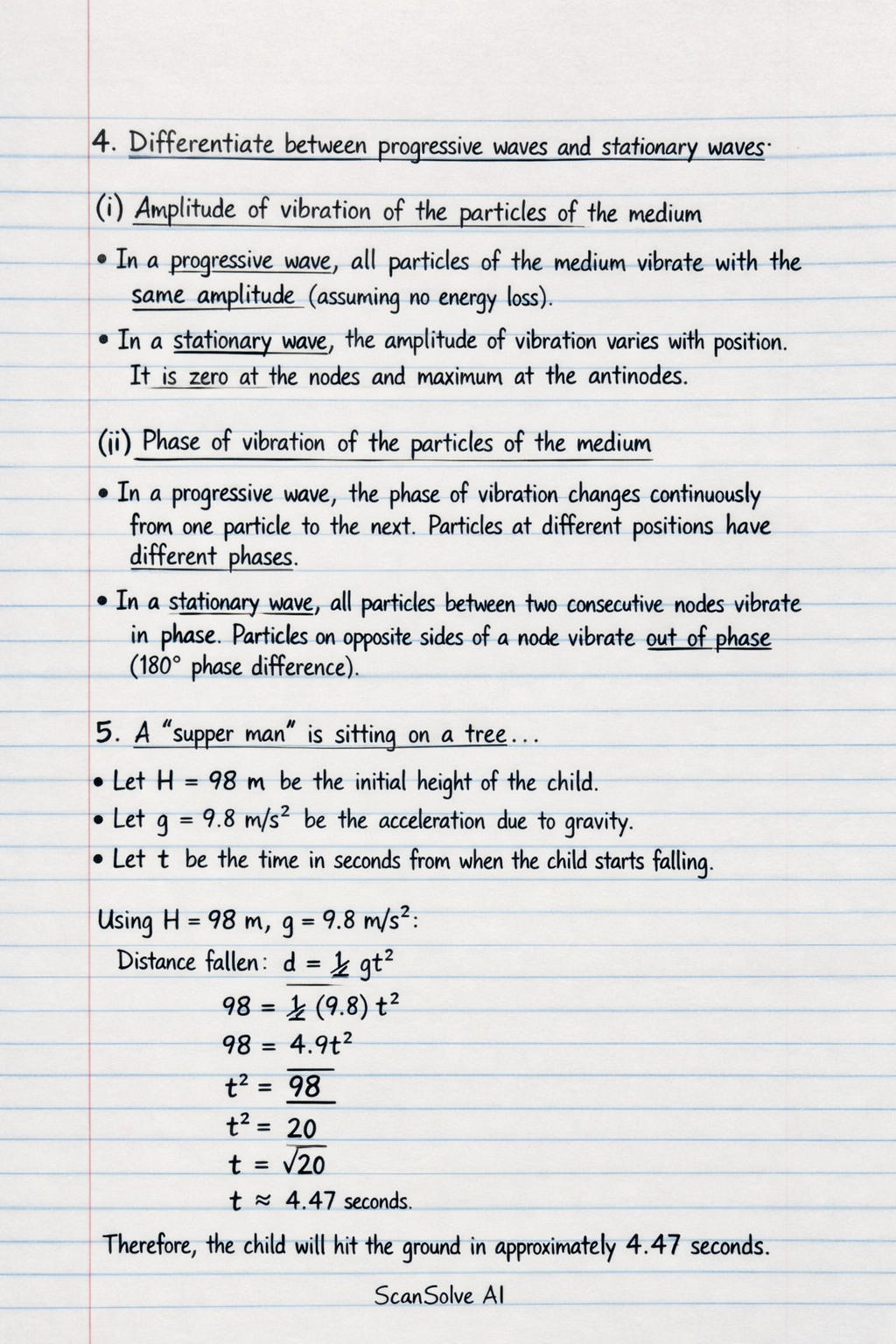
4. Differentiate between progressive waves and stationary waves
Part i
Amplitude of vibration of the particles of the medium
- In a progressive wave, all particles of the medium vibrate with the same amplitude (assuming no energy loss).
- In a stationary wave, the amplitude of vibration varies with position. It is zero at the nodes and maximum at the antinodes.
Part ii
Phase of vibration of the particles of the medium
- In a progressive wave, the phase of vibration changes continuously from one particle to the next. Particles at different positions have different phases.
- In a stationary wave, all particles between two consecutive nodes vibrate in phase. Particles on opposite sides of a node vibrate out of phase (180° phase difference).
5. A 'supper man' is sitting on a tree...
Let be the initial height of the child.
Let be the acceleration due to gravity.
Let be the time in seconds from when the child starts falling.
Determine the child's motion.
The child falls with an initial velocity of .
The distance fallen by the child after time is .The height of the child from the ground at time is .
Determine the 'Supper man's' motion.
The 'Supper man' starts flying 2 seconds after the child falls.
So, the time the 'Supper man' flies is (for ).
The 'Supper man' flies at a constant speed of .
The distance covered by the 'Supper man' is .The height of the 'Supper man' from the ground at time is .
Calculate the time when the 'Supper man' catches the child.
The 'Supper man' catches the child when their heights are equal, i.e., .
Rearrange into a quadratic equation:
Divide the entire equation by 4.9:
This is a perfect square trinomial:
The 'Supper man' catches the child after from when the child started falling.
Calculate the height from the ground where the child is caught.
Substitute into the child's height equation:
The child is caught at a height of from the ground.
Try one yourself
A new problem that tests the same skill.
Still stuck on this one?
Ask a follow-up, and the answer starts from this question.
More Physics Questions
Handwritten Step-by-Step Solution
Get this as a handwritten image on WhatsApp — like a tutor wrote it for you.
Try on WhatsApp