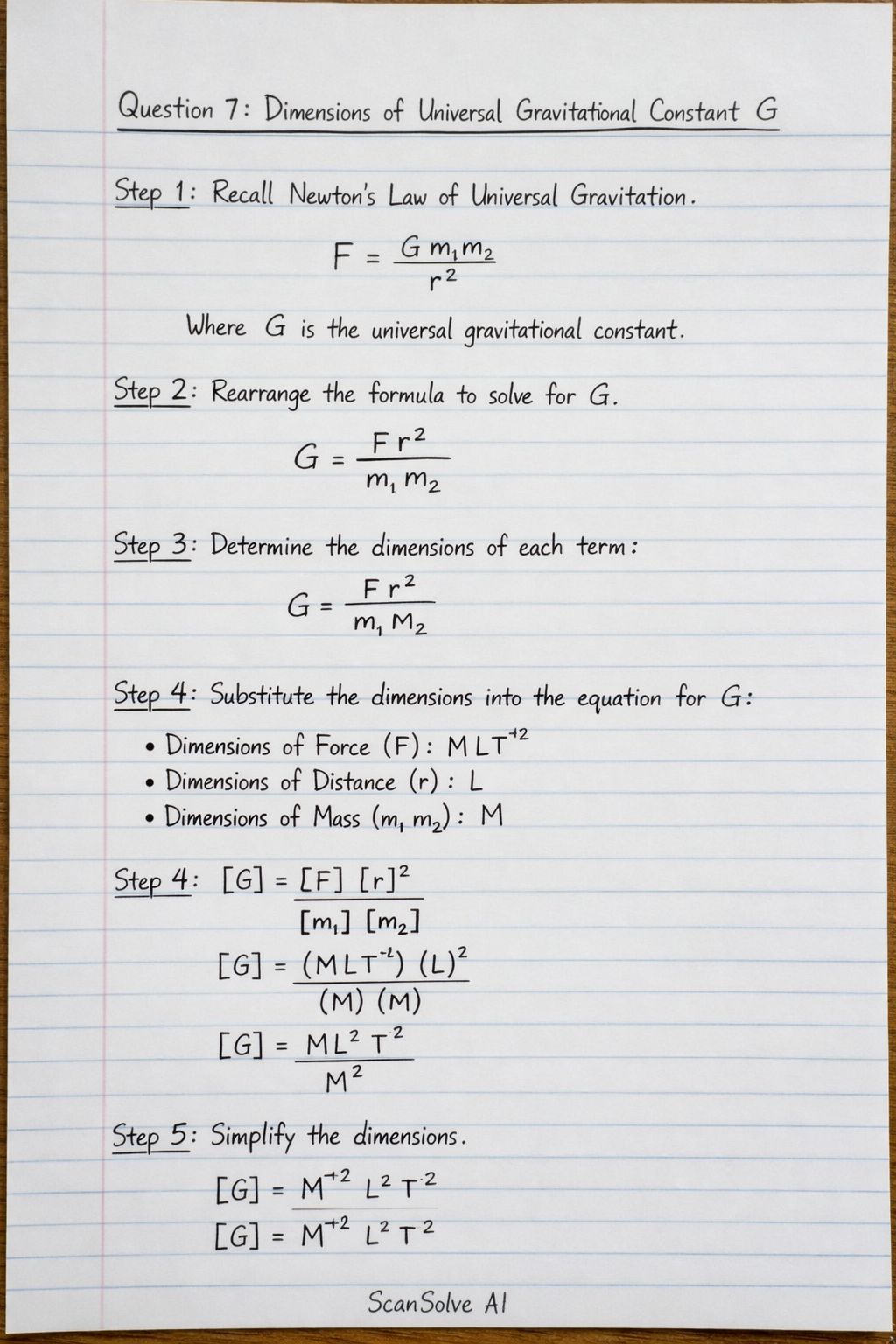
We read your photo as:

Determine the dimensions of the Universal Gravitational Constant G and Pressure.

Physics

ScanSolve AI Answer

Answers

2 parts
7

a) M−1L3T−2\text{a) M}^{-1}\text{L}^3\text{T}^{-2}

8

a) ML−1T−2\text{a) ML}^{-1}\text{T}^{-2}

Step-by-step solution

13 steps

Part 7· 5 steps

Dimensions of Universal Gravitational Constant G

  1. Recall Newton's Law of Universal Gravitation.

    The formula for the gravitational force (FF) between two masses (m1m_1, m2m_2) separated by a distance (rr) is:

    F=Gm1m2r2F = G \frac{m_1 m_2}{r^2}

    Where GG is the universal gravitational constant.

  2. Rearrange the formula to solve for G.

    G=Fr2m1m2G = \frac{F r^2}{m_1 m_2}
  3. Determine the dimensions of each term.

    • Dimensions of Force (FF): M L T−2\text{M L T}^{-2}
    • Dimensions of Distance (rr): L\text{L}
    • Dimensions of Mass (m1m_1, m2m_2): M\text{M}
  4. Substitute the dimensions into the equation for G.

    [G]=[F][r]2[m1][m2][G] = \frac{[\text{F}] [\text{r}]^2}{[\text{m}_1] [\text{m}_2]} [G]=(M L T−2)(L)2(M)(M)[G] = \frac{(\text{M L T}^{-2}) (\text{L})^2}{(\text{M}) (\text{M})} [G]=M L3 T−2M2[G] = \frac{\text{M L}^3 \text{ T}^{-2}}{\text{M}^2}
  5. Simplify the dimensions.

    [G]=M1−2 L3 T−2[G] = \text{M}^{1-2} \text{ L}^3 \text{ T}^{-2} [G]=M−1 L3 T−2[G] = \text{M}^{-1} \text{ L}^3 \text{ T}^{-2}

    The correct combination of dimensions for the Universal Gravitational Constant G is a) M−1L3T−2\boxed{\text{a) M}^{-1}\text{L}^3\text{T}^{-2}}.


Part 8

a) ML−1T−2\text{a) ML}^{-1}\text{T}^{-2}

Dimensions of Pressure

  1. Recall the definition of Pressure.

    Pressure (PP) is defined as force (FF) per unit area (AA):

    P=FAP = \frac{F}{A}
  2. Determine the dimensions of Force and Area.

    • Dimensions of Force (FF): M L T−2\text{M L T}^{-2}
    • Dimensions of Area (AA): L2\text{L}^2
  3. Substitute the dimensions into the equation for Pressure.

    [P]=[F][A][P] = \frac{[\text{F}]}{[\text{A}]} [P]=M L T−2L2[P] = \frac{\text{M L T}^{-2}}{\text{L}^2}
  4. Simplify the dimensions.

    [P]=M L1−2 T−2[P] = \text{M L}^{1-2} \text{ T}^{-2} [P]=M L−1 T−2[P] = \text{M L}^{-1} \text{ T}^{-2}

    The correct combination of dimensions for Pressure is a) ML−1T−2\boxed{\text{a) ML}^{-1}\text{T}^{-2}}.


Part 9· 4 steps

Original length of the pendulum

  1. Recall the formula for the period of a simple pendulum.

    The period (TT) of a simple pendulum is given by:

    T=2πLgT = 2\pi \sqrt{\frac{L}{g}}

    Where LL is the length of the pendulum and gg is the acceleration due to gravity.

  2. Set up equations for the initial and final states.

    Let T1T_1 be the initial period and L1L_1 be the original length.
    Let T2T_2 be the new period and L2L_2 be the new length.
    Given:

    • T1=7.0 sT_1 = 7.0 \text{ s}
    • The length is shortened by 1.5 m1.5 \text{ m}, so L2=L1−1.5 mL_2 = L_1 - 1.5 \text{ m}.
    • The new period is T2=8.5 sT_2 = 8.5 \text{ s}.

    The equations are:

    T1=2πL1g(1)T_1 = 2\pi \sqrt{\frac{L_1}{g}} \quad (1) T2=2πL2g(2)T_2 = 2\pi \sqrt{\frac{L_2}{g}} \quad (2)
  3. Form a ratio of the periods to eliminate constants.

    Divide equation (1) by equation (2):

    T1T2=2πL1g2πL2g\frac{T_1}{T_2} = \frac{2\pi \sqrt{\frac{L_1}{g}}}{2\pi \sqrt{\frac{L_2}{g}}} T1T2=L1L2\frac{T_1}{T_2} = \sqrt{\frac{L_1}{L_2}}
  4. Substitute the given values and solve for L1L_1.

    Square both sides:

    (T1T2)2=L1L2\left(\frac{T_1}{T_2}\right)^2 = \frac{L_1}{L_2}

    Substitute T1=7.0 sT_1 = 7.0 \text{ s}, T2=8.5 sT_2 = 8.5 \text{ s}, and L2=L1−1.5 mL_2 = L_1 - 1.5 \text{ m}:

    (7.0 s8.5 s)2=L1L1−1.5 m\left(\frac{7.0 \text{ s}}{8.5 \text{ s}}\right)^2 = \frac{L_1}{L_1 - 1.5 \text{ m}} (78.5)2=L1L1−1.5\left(\frac{7}{8.5}\right)^2 = \frac{L_1}{L_1 - 1.5} 4972.25=L1L1−1.5\frac{49}{72.25} = \frac{L_1}{L_1 - 1.5}

    Cross-multiply:

    49(L1−1.5)=72.25L149(L_1 - 1.5) = 72.25 L_1 49L1−49×1.5=72.25L149 L_1 - 49 \times 1.5 = 72.25 L_1 49L1−73.5=72.25L149 L_1 - 73.5 = 72.25 L_1

    Rearrange to solve for L1L_1:

    −73.5=72.25L1−49L1-73.5 = 72.25 L_1 - 49 L_1 −73.5=23.25L1-73.5 = 23.25 L_1 L1=−73.523.25L_1 = \frac{-73.5}{23.25} L1≈−3.16 mL_1 \approx -3.16 \text{ m}

    *Note: The calculated original length is negative, which is physically impossible for a pendulum. This indicates an inconsistency in the problem statement, as shortening the length of a pendulum should decrease its period, but here the period increased

Was this helpful?

Try one yourself

A new problem that tests the same skill.

Still stuck on this one?

Ask a follow-up, and the answer starts from this question.

Got a different question?Ask your own question
Handwritten step-by-step solution preview

Handwritten Step-by-Step Solution

Get this as a handwritten image on WhatsApp — like a tutor wrote it for you.

Try on WhatsApp