
We read your photo as:
What is dispersion of light? Determine the reading of an ammeter in figure 4 below. A ray of light is incident on a glass oil interface as shown in figure 5 below. Determine the value of r (Take refra
ScanSolve AI Answer
-
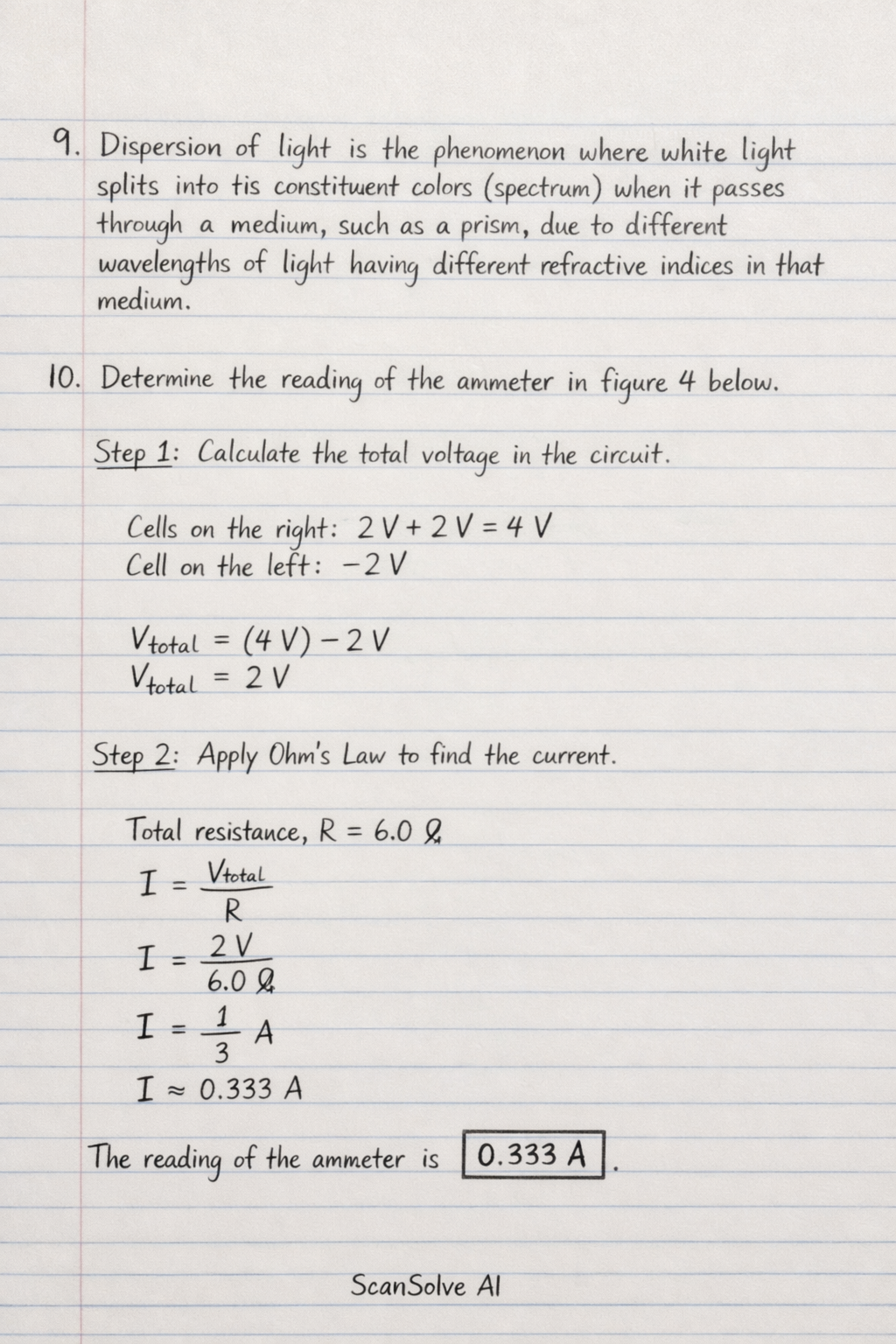
What is dispersion of light? Dispersion of light is the phenomenon where white light splits into its constituent colors (spectrum) when it passes through a medium, such as a prism, due to different wavelengths of light having different refractive indices in that medium.
-
Determine the reading of an ammeter in figure 4 below.
Step 1: Calculate the total voltage in the circuit.
The two cells on the right are in series aiding, providing .
The cell on the left is in series opposing the other two, providing .
The net voltage .
Step 2: Apply Ohm's Law to find the current.
The total resistance in the circuit is .
The current is given by .
The reading of the ammeter is .
- A ray of light is incident on a glass oil interface as shown in figure 5 below. Determine the value of r (Take refractive index of glass and oil as 3/2 and 5/3 respectively).
Step 1: Identify the given values.
Refractive index of glass
Refractive index of oil
Angle of incidence (from glass)
Angle of refraction (into oil)
Step 2: Apply Snell's Law, .
Here, and .
Step 3: Substitute and solve for .
The value of r is .
- a) State two factors that affect the capacitance of a parallel plate capacitors. The capacitance of a parallel plate capacitor is affected by:
- The area of overlap of the plates.
- The distance between the plates.
- The type of dielectric material between the plates (its permittivity).
b) i) State Ohm's law.
Ohm's Law states that the current flowing through a conductor between two points is directly proportional to the voltage across the two points, and inversely proportional to the resistance between them, provided the temperature and other physical conditions remain constant.
ii) In the spaces below, draw the circuit that can be used using the apparatus above to verify Ohm's Law.
The circuit diagram to verify Ohm's Law using the given apparatus is:
\begin{circuitikz} \draw
(0,0) to[battery] (0,2)
to[switch] (2,2)
to[ammeter] (4,2)
to[R, l_=$R_{fixed}$] (6,2) node[above]{}
(6,2) to[voltmeter, v_=$V$] (6,0)
(6,0) to[variable resistor, l_=$R_{variable}$] (4,0)
(4,0) -- (0,0);
\end{circuitikz}
(Note: The diagram shows two cells in series as the power source, a switch, an ammeter in series, a fixed resistor, a voltmeter in parallel across the fixed resistor, and a variable resistor in series.)
- The question is incomplete as the context for the observations and line XY is missing from the provided image.
Still stuck on this one?
Ask a follow-up, and the answer starts from this question.
More Physics Questions
Handwritten Step-by-Step Solution
Get this as a handwritten image on WhatsApp — like a tutor wrote it for you.
Try on WhatsApp