
We read your photo as:
Determine the displacement vector d.
Physics
ScanSolve AI Answer
Answer
Step-by-step solution
2 stepsDetermine the displacement vector .
The initial position is and the final position is .
The displacement vector is given by .Calculate the work done .
The force vector is N.
The work done by a constant force is the dot product of the force vector and the displacement vector: .The work done on the body is .
Was this helpful?
Try one yourself
A new problem that tests the same skill.
Still stuck on this one?
Ask a follow-up, and the answer starts from this question.
Got a different question?Ask your own question
More Physics Questions
QIdentify the individual displacement vectors.QDefine the displacement vectors in component form.QIdentify the components of the displacement.QResolve the first displacement into components.QIn the given figure, find the values of d and e.
Browse by topic:Mechanics
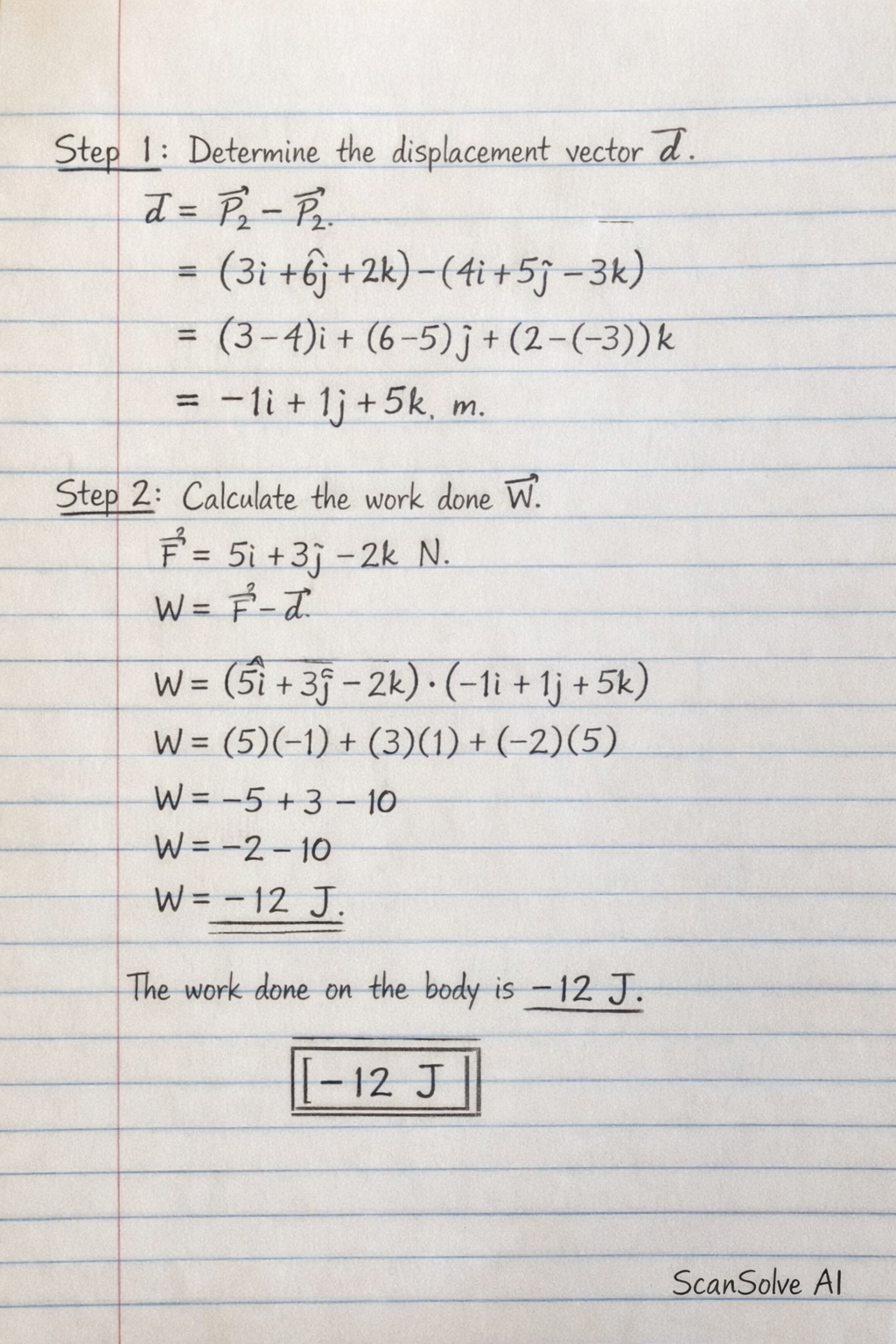
Handwritten Step-by-Step Solution
Get this as a handwritten image on WhatsApp — like a tutor wrote it for you.
Try on WhatsApp