
We read your photo as:
Distinguish between longitudinal and transverse waves.
ScanSolve AI Answer
7. (a) Distinguish between longitudinal and transverse waves.
-
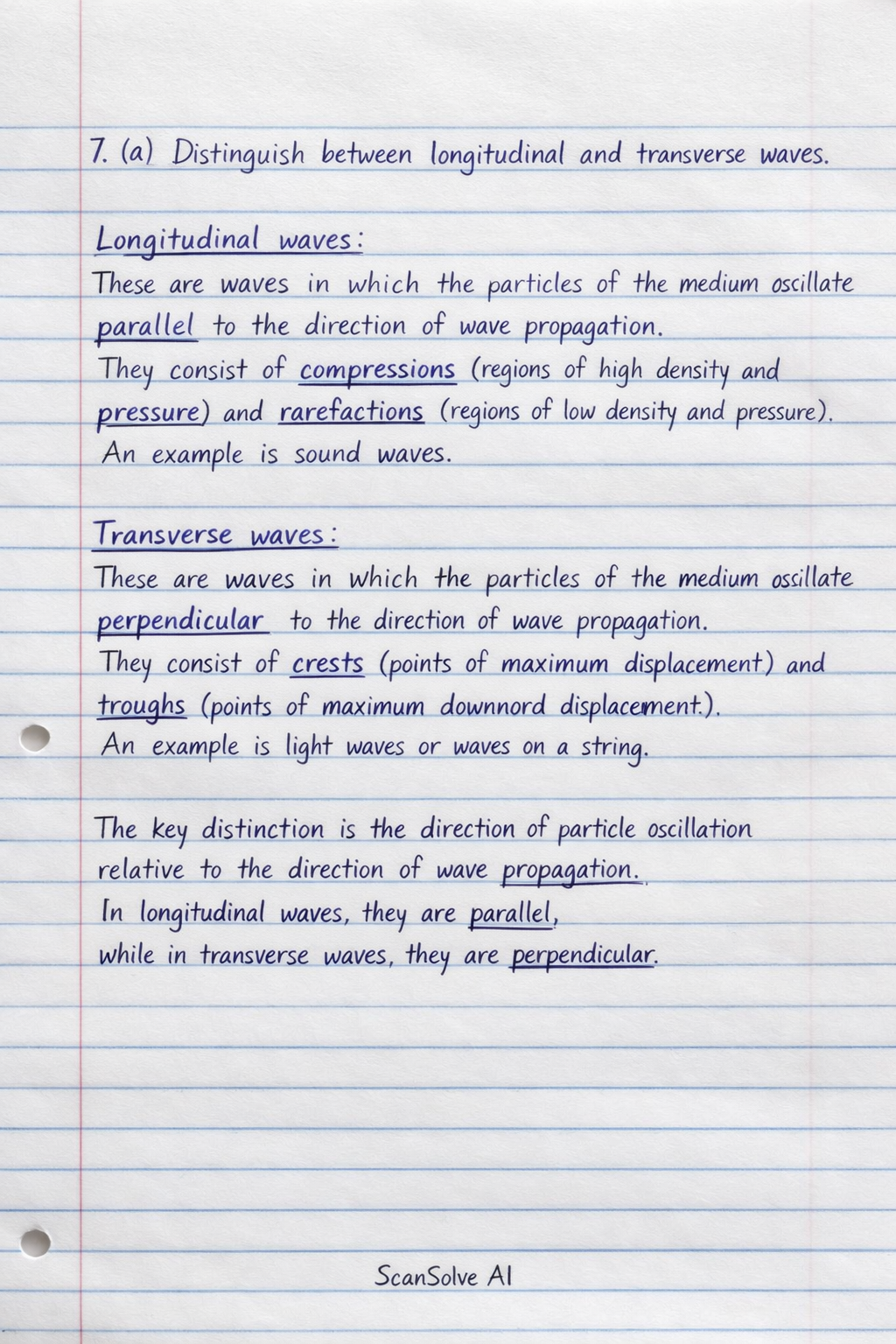
Longitudinal waves: These are waves in which the particles of the medium oscillate parallel to the direction of wave propagation. They consist of compressions (regions of high density and pressure) and rarefactions (regions of low density and pressure). An example is sound waves.
-
Transverse waves: These are waves in which the particles of the medium oscillate perpendicular to the direction of wave propagation. They consist of crests (points of maximum upward displacement) and troughs (points of maximum downward displacement). An example is light waves or waves on a string.
The key distinction is the direction of particle oscillation relative to the direction of wave propagation. In longitudinal waves, they are parallel, while in transverse waves, they are perpendicular.
Still stuck on this one?
Ask a follow-up, and the answer starts from this question.
More Physics Questions
Handwritten Step-by-Step Solution
Get this as a handwritten image on WhatsApp — like a tutor wrote it for you.
Try on WhatsApp