

This physics problem tests your understanding of fundamental physical laws and their applications. The step-by-step solution below breaks down the problem using relevant equations and physical reasoning.
ScanSolve AI Answer
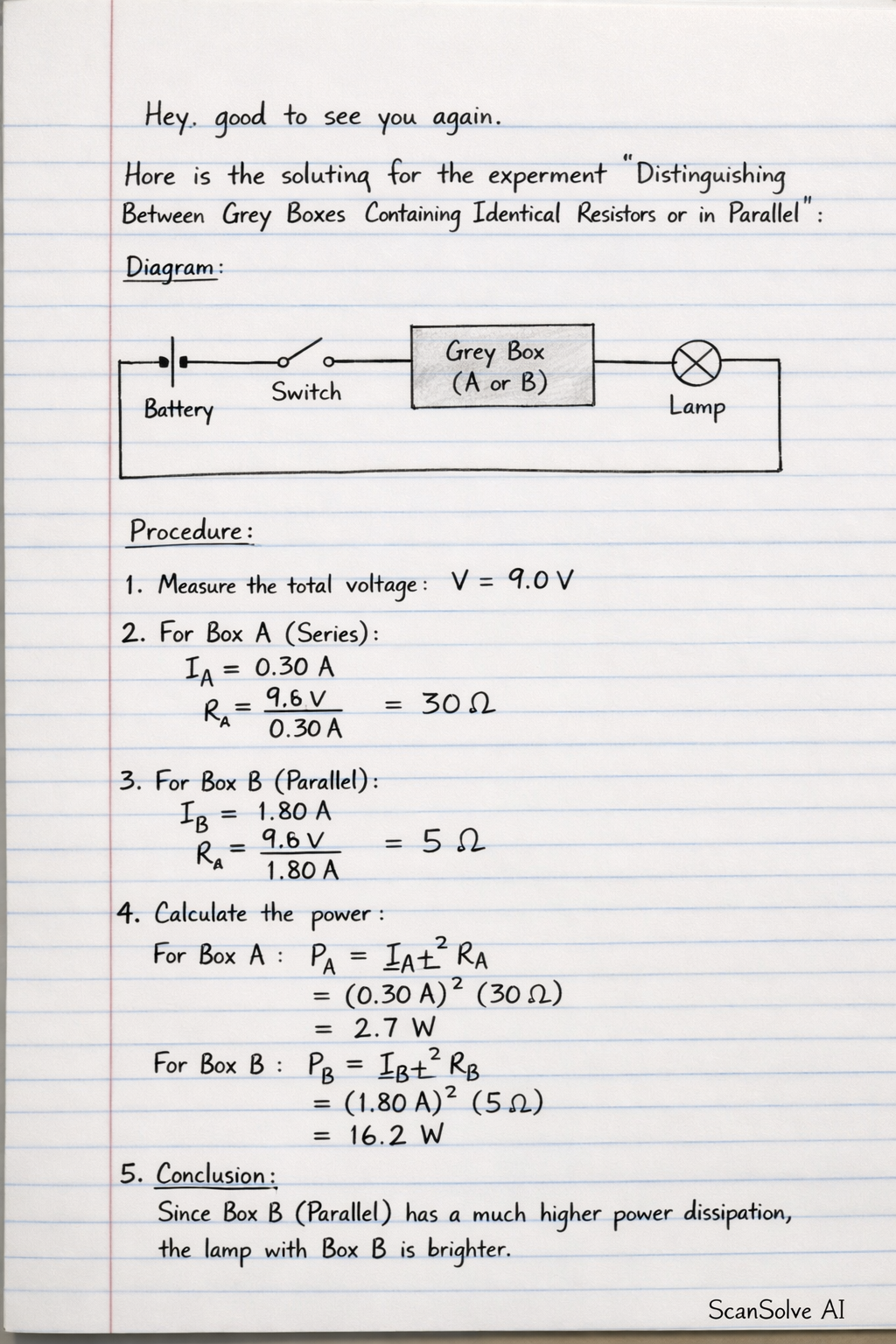
Hey, good to see you again. Here is the solution for the experiment "Distinguishing Between Grey Boxes Containing Identical Resistors Connected either in Series or in Parallel": Diagram [scale=1.0] % Battery (0,0) to (0,0.5); [thick] (0,0.5) to (0,1); (0,1) to (0,1.5); [thick] (0,1.5) to (0,2); at (0.5,1) Battery; % Switch (0,2) -- (1,2); (1,2) -- (1.5,2.5); (1.5,2) -- (2,2); at (1.5,2.7) Switch; % Grey Box (2,2) -- (3,2); (3,2) rectangle (5,0); at (4,1) Grey Box (A or B); (5,0) -- (5,0); % Lamp (5,0) -- (5,-1); (5,-1) circle (0.5); (5,-1.5) -- (5,-2); at (5.5,-1) Lamp; % Connecting wires (0,0) -- (5,-2); (5,-2) -- (0,0); (0,0) -- (0,0); (0,2) -- (0,2); Procedure 1. Set up a series circuit consisting of the battery, a switch, the 2.5 V lamp, and one of the grey boxes (e.g., Box A). Ensure all connections are secure. 2. Close the switch and observe the brightness of the lamp. Note whether it is bright or dim. 3. Open the switch and disconnect Box A from the circuit. 4. Replace Box A with the other grey box (Box B) in the same series circuit. 5. Close the switch and observe the brightness of the lamp. Note whether it is bright or dim, and compare its brightness to when Box A was in the circuit. 6. Open the switch and disconnect the circuit. Observations/Results When Grey Box A is connected, the lamp glows brightly*. When Grey Box B is connected, the lamp glows dimly*. Inference The brightness of the lamp is inversely proportional to the total resistance in the circuit. A brighter lamp indicates lower total resistance, while a dimmer lamp indicates higher total resistance. Resistors connected in parallel have a lower equivalent resistance than the individual resistors. For two identical resistors (R) in parallel, the equivalent resistance is (R)/(2). Resistors connected in series have a higher equivalent resistance than the individual resistors. For two identical resistors (R) in series, the equivalent resistance is 2R. Since Box A makes the lamp glow brighter, it has a lower equivalent resistance. Therefore, the resistors in Box A are connected in parallel*. Since Box B makes the lamp glow dimmer, it has a higher equivalent resistance. Therefore, the resistors in Box B are connected in series*. Conclusion Grey Box A contains two identical resistors connected in parallel, and Grey Box B contains two identical resistors connected in series. Precautions Ensure all connecting leads are properly insulated and have good contact to prevent short circuits or inaccurate readings. Use a battery with sufficient voltage to light the lamp but not so high as to burn it out. Do not leave the circuit connected for extended periods, especially with the dimmer lamp, to prevent the battery from draining quickly or components from overheating. Ensure the lamp used is suitable for the battery voltage to avoid damage. Make sure the grey boxes are handled carefully to avoid disturbing the internal resistor arrangements.