
We read your photo as:
Describe the Doppler Effect and calculate the period and frequency of a detected wave from a given graph.
ScanSolve AI Answer
Answers
3 partsStep-by-step solution
8 stepsHere are the solutions to Question 3.
Part 3.1
State the Doppler Effect in words.
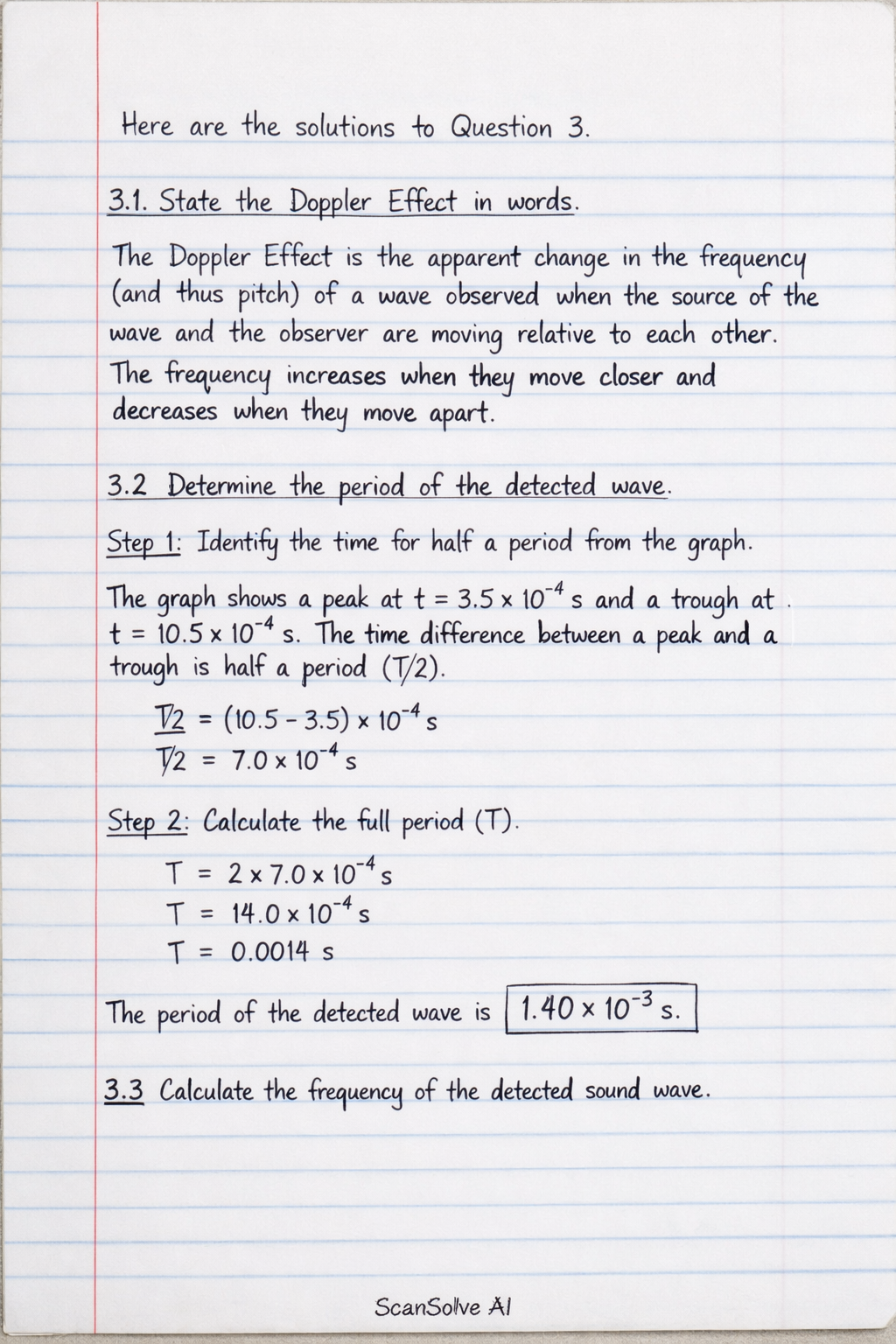
The Doppler Effect is the apparent change in the frequency (and thus pitch) of a wave observed when the source of the wave and the observer are moving relative to each other. The frequency increases when they move closer and decreases when they move apart.
Part 3.2
Determine the period of the detected wave.
Identify the time for half a period from the graph.
The graph shows a peak at s and a trough at s. The time difference between a peak and a trough is half a period ().
Calculate the full period ().
The period of the detected wave is .
Part 3.3
Calculate the frequency of the detected sound wave.
Use the relationship between frequency () and period ().
Substitute the period calculated in 3.2.
The frequency of the detected sound wave is .
Part 3.4
Calculate the speed of the moving car.
Identify the given values.
Source frequency, Hz
Speed of sound in air, m/s
Detected frequency, Hz (using the more precise fraction Hz for calculation)Determine the appropriate Doppler Effect formula.
Since the detected frequency ( Hz) is higher than the source frequency ( Hz), the car (source) must be moving towards the stationary listener. The formula for a moving source and stationary listener approaching each other is:
where is the speed of the source (car).
Rearrange the formula to solve for .
Substitute the values and calculate .
The speed of the moving car is .
Try one yourself
A new problem that tests the same skill.
Still stuck on this one?
Ask a follow-up, and the answer starts from this question.
More Physics Questions
Handwritten Step-by-Step Solution
Get this as a handwritten image on WhatsApp — like a tutor wrote it for you.
Try on WhatsApp