
We read your photo as:
Draw a circuit diagram for a simple circuit containing a battery, a switch, a resistor, an ammeter, and a voltmeter. Calculate the resistance if the ammeter reads 5A and the voltmeter reads 15V. Ident
ScanSolve AI Answer
Answers
2 partsStep-by-step solution
6 stepsHere are the answers to questions (c) and (d).
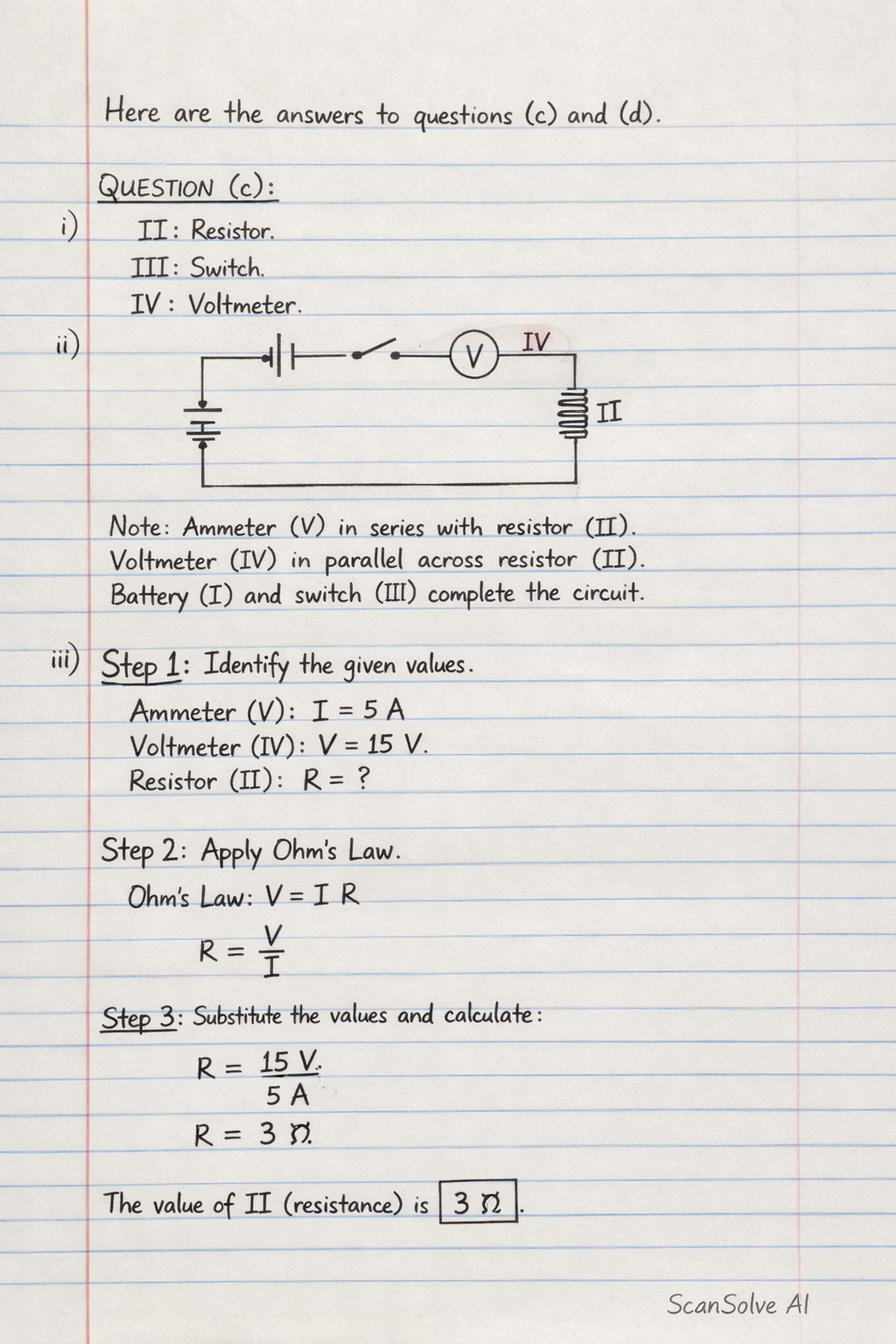
Part c(i)
- II: Resistor
- III: Switch
- IV: Voltmeter
Part c(ii)
\begin{circuitikz} \draw
  (0,0) to[battery] (0,2)
  to[switch] (2,2)
  to[ammeter] (4,2) node[right]{V}
  to[R, l_=$II$] (6,2)
  (6,2) to[short] (6,0)
  (6,0) to[short] (0,0)
  (6,2) to[voltmeter, v_=$IV$] (6,0);
\end{circuitikz}
(Note: The ammeter (V) should be in series with the resistor (II), and the voltmeter (IV) should be in parallel across the resistor (II). The battery (I) and switch (III) complete the circuit.)
Part c(iii)
Identify the given values.
The ammeter (V) reads current .
The voltmeter (IV) reads potential difference .
The component II is a resistor, .Apply Ohm's Law.
Ohm's Law states that . To find the resistance , we rearrange the formula:
Substitute the values and calculate.
The value of II (resistance) is .
Part d(i)
- () 7: C (NaCl is a neutral salt)
- () 14: E (NaOH is a strong base)
Part d(ii)
- () strong acid: A (HCl)
- () neutral: C (NaCl)
- () weak base: D (NH₃)
Part d(iii)1
Identify the solution and its concentration.
Solution A is HCl. HCl is a strong acid.
Determine the hydrogen ion concentration.
For a strong acid, the concentration of hydrogen ions is equal to the concentration of the acid.
Calculate the pH.
The pH is calculated using the formula .
The pH value of solution A is .
Part d(iv)
Two solutions that will react to form salt and water (acid-base neutralization)
- A (HCl) and E (NaOH)
- B (CH₃COOH) and D (NH₃) (Any two pairs of an acid and a base from the table are acceptable.)
Part d(v)
What would be the colour of solution C upon addition of drops of universal indicator.
Solution C is NaCl. Sodium chloride (NaCl) is a salt formed from a strong acid (HCl) and a strong base (NaOH), making its solution neutral. A neutral solution (pH = 7) typically turns green with universal indicator.
Try one yourself
A new problem that tests the same skill.
Still stuck on this one?
Ask a follow-up, and the answer starts from this question.
More Physics Questions
Handwritten Step-by-Step Solution
Get this as a handwritten image on WhatsApp — like a tutor wrote it for you.
Try on WhatsApp