
We read your photo as:
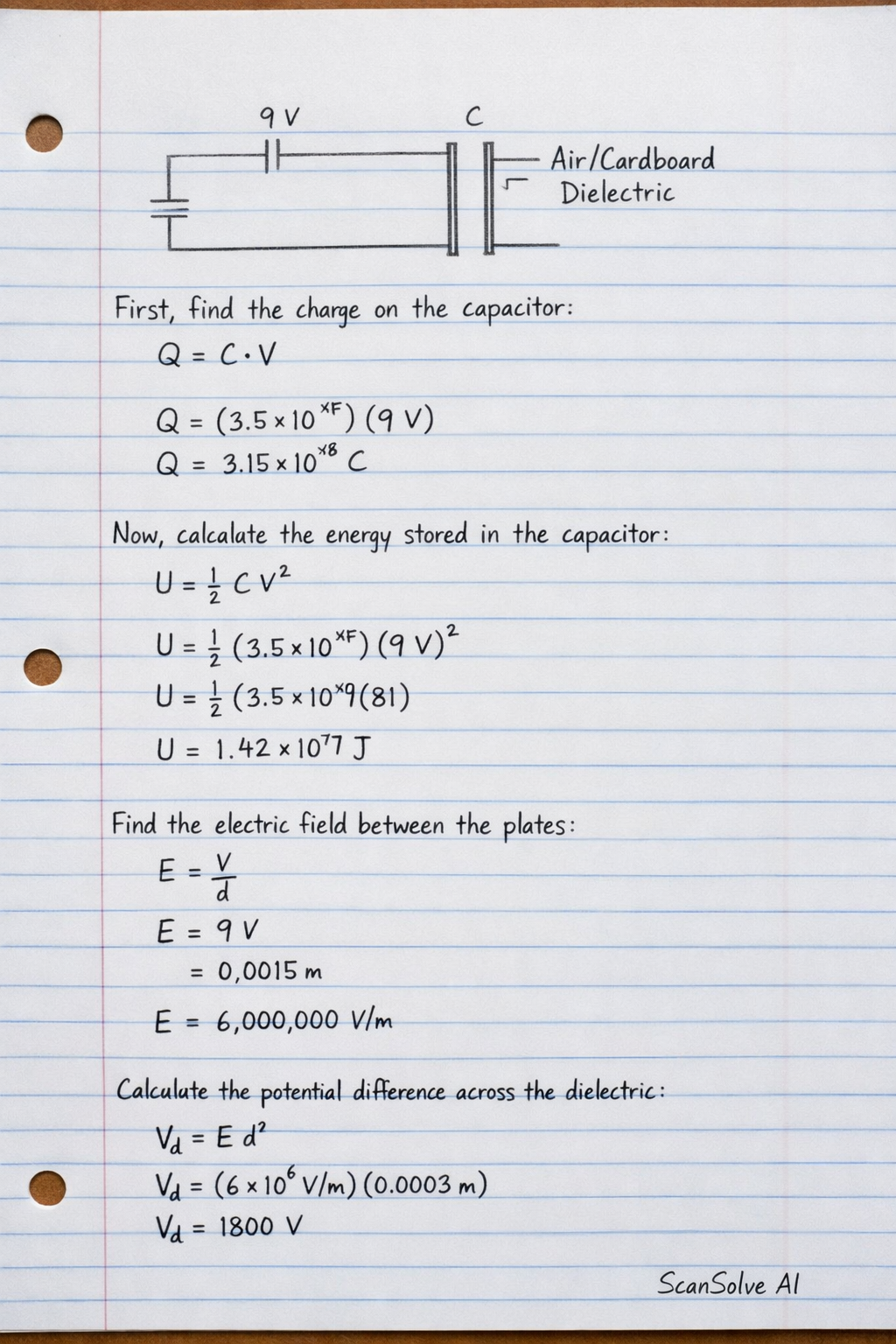
Draw a circuit diagram to show a parallel-plate capacitor being charged by a battery and describe observations.
ScanSolve AI Answer
Circuit diagram:
\begin{tikzpicture}[
    capacitor/.style={
        thick,
        draw,
        fill=white,
        rectangle,
        minimum width=0.8cm,
        minimum height=1.2cm,
        label={[font=\tiny]above:C}
    },
    battery/.style={
        thick,
        draw,
        fill=white,
        rectangle,
        minimum width=0.8cm,
        minimum height=1.2cm,
        label={[font=\tiny]above:V}
    },
    wire/.style={thick, draw},
    dot/.style={fill,circle,inner sep=1.5pt}
]
    % Battery
    \draw (0,0) to[battery, l_=$9\text{ V}$] (0,2);
    \draw (0,2) -- (1,2);
    \draw (0,0) -- (1,0);

    % Capacitor plates
    \draw (2,2) -- (2,0); % Left plate
    \draw (2.2,2) -- (2.2,0); % Right plate
    \node at (2.1, 1) [label={[font=\tiny]right:Air/Cardboard Dielectric}] {};

    % Wires connecting battery to capacitor
    \draw (1,2) -- (2,2);
    \draw (1,0) -- (2.2,0);

    % Labels for terminals
    \node at (0.5, 2.2) {$+$};
    \node at (0.5, -0.2) {$-$};
\end{tikzpicture}
This diagram shows the capacitor being charged by the 9V battery. The two parallel lines represent the aluminum foil plates, separated by the cardboard dielectric.
Observations / Measurements:
- When the battery is connected to the aluminum foil plates, no immediate visible change occurs.
- After 5 minutes of charging, when the battery is disconnected and a small bulb is connected across the plates, the bulb flashes brightly for a brief moment and then goes out.
- If a multimeter is connected across the plates immediately after disconnecting the battery, it will show a voltage reading close to 9 V.
- After the bulb flashes, if the multimeter is reconnected, it will show a voltage reading close to 0 V.
Inference / Conclusion:
This experiment demonstrates that a simple capacitor can be constructed using aluminum foil as conductors and cardboard as a dielectric. The capacitor stores electrical energy when connected to a battery (charging) and releases this stored energy when connected to a load like a bulb (discharging), causing the bulb to flash. The voltage across the capacitor drops to zero after discharge, confirming the release of stored charge.
Precaution(s):
- Ensure the aluminum foil on one cardboard sheet does not touch the foil on the other sheet to prevent a short circuit.
- Maintain a consistent and small separation (approximately 2 mm) between the foil surfaces to ensure effective capacitance.
- Avoid touching the aluminum foil surfaces directly with bare hands after charging, as this could cause an accidental discharge through the body or introduce unwanted resistance/leakage.
- Ensure good electrical contact between the connecting wires and the aluminum foil.
- Use a low-power bulb to clearly observe the brief flash during discharge.
Still stuck on this one?
Ask a follow-up, and the answer starts from this question.
More Physics Questions
Handwritten Step-by-Step Solution
Get this as a handwritten image on WhatsApp — like a tutor wrote it for you.
Try on WhatsApp