

This physics problem tests your understanding of fundamental physical laws and their applications. The step-by-step solution below breaks down the problem using relevant equations and physical reasoning.
ScanSolve AI Answer
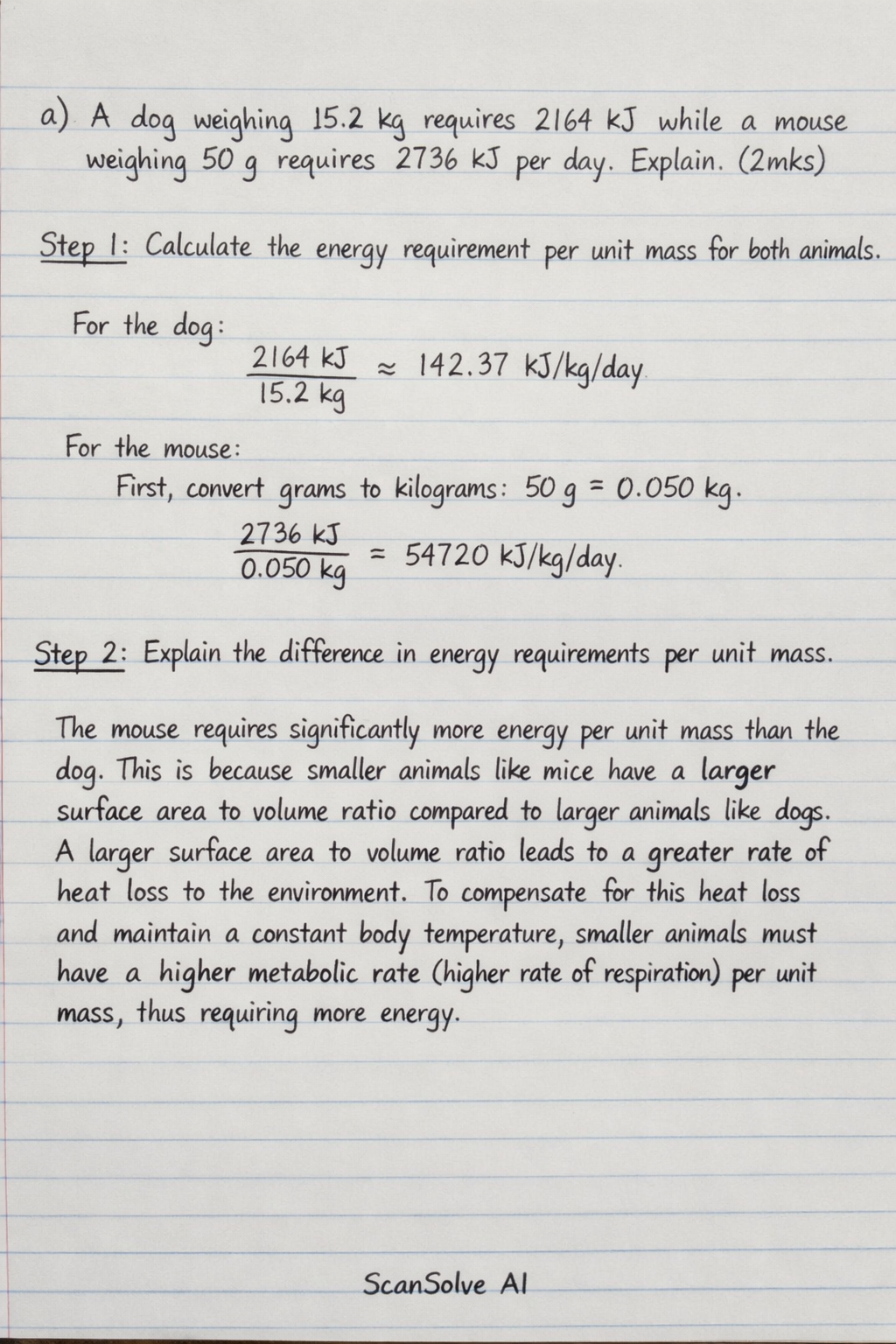
a) A dog weighing 15.2 kg requires 2164 kJ while a mouse weighing 50 g requires 2736 kJ per day. Explain. (2mks) Step 1: Calculate the energy requirement per unit mass for both animals. For the dog: 2164 kJ15.2 kg ≈ 142.37 kJ/kg/day For the mouse: First, convert grams to kilograms: 50 g = 0.050 kg. 2736 kJ0.050 kg = 54720 kJ/kg/day Step 2: Explain the difference in energy requirements per unit mass. The mouse requires significantly more energy per unit mass than the dog. This is because smaller animals like mice have a larger surface area to volume ratio compared to larger animals like dogs. A larger surface area to volume ratio leads to a greater rate of heat loss to the environment. To compensate for this heat loss and maintain a constant body temperature, smaller animals must have a higher metabolic rate (higher rate of respiration) per unit mass, thus requiring more energy. b) Explain why a baby uses more heat per unit weight than an adult when they are at the same environmental conditions? (1mk) Babies have a larger surface area to volume ratio compared to adults. This means they lose heat to the environment more rapidly. To maintain their body temperature, they must generate more heat per unit weight through metabolic processes. Additionally, babies have less insulating fat and less developed thermoregulatory systems than adults. That's 2 down. 3 left today — send the next one.