We read your photo as:

Calculate the equivalent capacitance of the circuit shown in Figure 3, given C = 2 ext extmu F and V = 20 ext V.

Physics

ScanSolve AI Answer

Step-by-step solution

3 steps

The image shows a circuit diagram (Figure 3) with several capacitors and a voltage source. Assuming the question asks for the equivalent capacitance of the circuit, we will calculate it step-by-step. All capacitors are given as C=2μFC = 2 \mu\text{F} and the voltage source is V=20 VV = 20 \text{ V}.

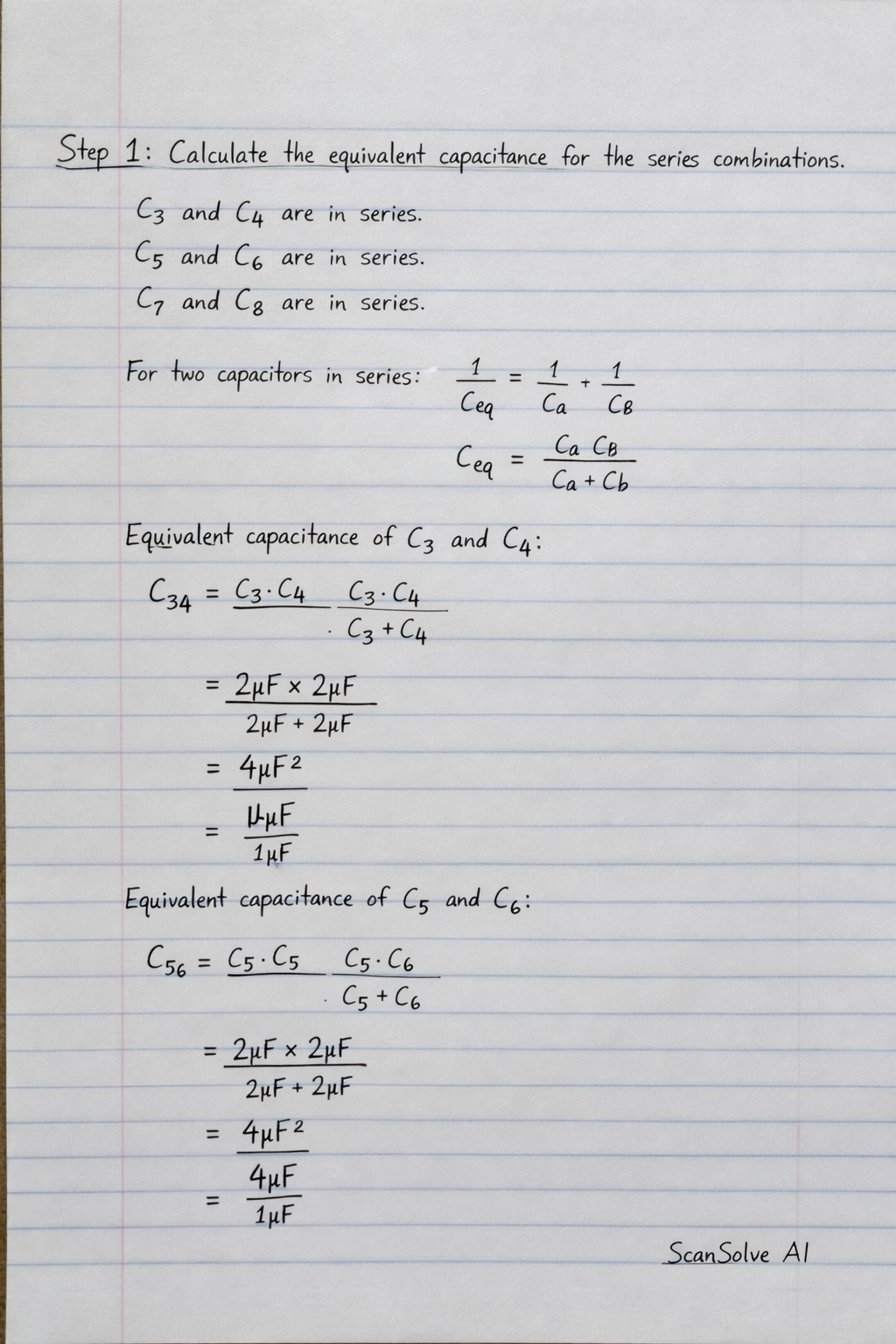
  1. Calculate the equivalent capacitance for the series combinations.

    Capacitors C3C_3 and C4C_4 are in series.
    Capacitors C5C_5 and C6C_6 are in series.
    Capacitors C7C_7 and C8C_8 are in series.
    For two capacitors in series, the equivalent capacitance CeqC_{eq} is given by 1Ceq=1Ca+1Cb\frac{1}{C_{eq}} = \frac{1}{C_a} + \frac{1}{C_b} or Ceq=CaCbCa+CbC_{eq} = \frac{C_a C_b}{C_a + C_b}.

    • Equivalent capacitance of C3C_3 and C4C_4:

      C34=C3×C4C3+C4=2μF×2μF2μF+2μF=4(μF)24μF=1μFC_{34} = \frac{C_3 \times C_4}{C_3 + C_4} = \frac{2 \mu\text{F} \times 2 \mu\text{F}}{2 \mu\text{F} + 2 \mu\text{F}} = \frac{4 (\mu\text{F})^2}{4 \mu\text{F}} = 1 \mu\text{F}
    • Equivalent capacitance of C5C_5 and C6C_6:

      C56=C5×C6C5+C6=2μF×2μF2μF+2μF=1μFC_{56} = \frac{C_5 \times C_6}{C_5 + C_6} = \frac{2 \mu\text{F} \times 2 \mu\text{F}}{2 \mu\text{F} + 2 \mu\text{F}} = 1 \mu\text{F}
    • Equivalent capacitance of C7C_7 and C8C_8:

      C78=C7×C8C7+C8=2μF×2μF2μF+2μF=1μFC_{78} = \frac{C_7 \times C_8}{C_7 + C_8} = \frac{2 \mu\text{F} \times 2 \mu\text{F}}{2 \mu\text{F} + 2 \mu\text{F}} = 1 \mu\text{F}
  2. Calculate the equivalent capacitance for the parallel combination.

    The three equivalent capacitances C34C_{34}, C56C_{56}, and C78C_{78} are in parallel.
    For capacitors in parallel, the equivalent capacitance CeqC_{eq} is given by Ceq=Ca+Cb+CcC_{eq} = C_a + C_b + C_c.

    • Equivalent capacitance of the parallel section: Cparallel=C34+C56+C78=1μF+1μF+1μF=3μFC_{parallel} = C_{34} + C_{56} + C_{78} = 1 \mu\text{F} + 1 \mu\text{F} + 1 \mu\text{F} = 3 \mu\text{F}
  3. Calculate the total equivalent capacitance of the circuit.

    The capacitor C1C_1, the parallel combination CparallelC_{parallel}, and the capacitor C2C_2 are all in series.
    For capacitors in series, the equivalent capacitance CtotalC_{total} is given by 1Ctotal=1C1+1Cparallel+1C2\frac{1}{C_{total}} = \frac{1}{C_1} + \frac{1}{C_{parallel}} + \frac{1}{C_2}.

    • Total equivalent capacitance: 1Ctotal=12μF+13μF+12μF\frac{1}{C_{total}} = \frac{1}{2 \mu\text{F}} + \frac{1}{3 \mu\text{F}} + \frac{1}{2 \mu\text{F}} 1Ctotal=36μF+26μF+36μF\frac{1}{C_{total}} = \frac{3}{6 \mu\text{F}} + \frac{2}{6 \mu\text{F}} + \frac{3}{6 \mu\text{F}} 1Ctotal=3+2+36μF=86μF=43μF\frac{1}{C_{total}} = \frac{3 + 2 + 3}{6 \mu\text{F}} = \frac{8}{6 \mu\text{F}} = \frac{4}{3 \mu\text{F}} Ctotal=34μF=0.75μFC_{total} = \frac{3}{4} \mu\text{F} = 0.75 \mu\text{F}

    The equivalent capacitance of the circuit is 0.75 \muF\boxed{\text{0.75 \mu F}}.

    If the question also implies finding the total charge stored in the circuit:
    The total charge QQ stored in the circuit is given by Q=Ctotal×VQ = C_{total} \times V.

    Q=0.75μF×20 VQ = 0.75 \mu\text{F} \times 20 \text{ V} Q=(0.75×10⁻⁶ F)×20 VQ = (0.75 \times 10^{-6} \text{ F}) \times 20 \text{ V} Q=15×10−6 C=15μCQ = 15 \times 10^{-6} \text{ C} = 15 \mu\text{C}

    The total charge stored in the circuit is 15 \muC\boxed{\text{15 \mu C}}.

Was this helpful?

Still stuck on this one?

Ask a follow-up, and the answer starts from this question.

Got a different question?Ask your own question
Handwritten step-by-step solution preview

Handwritten Step-by-Step Solution

Get this as a handwritten image on WhatsApp — like a tutor wrote it for you.

Try on WhatsApp