

This physics problem tests your understanding of fundamental physical laws and their applications. The step-by-step solution below breaks down the problem using relevant equations and physical reasoning.
ScanSolve AI Answer
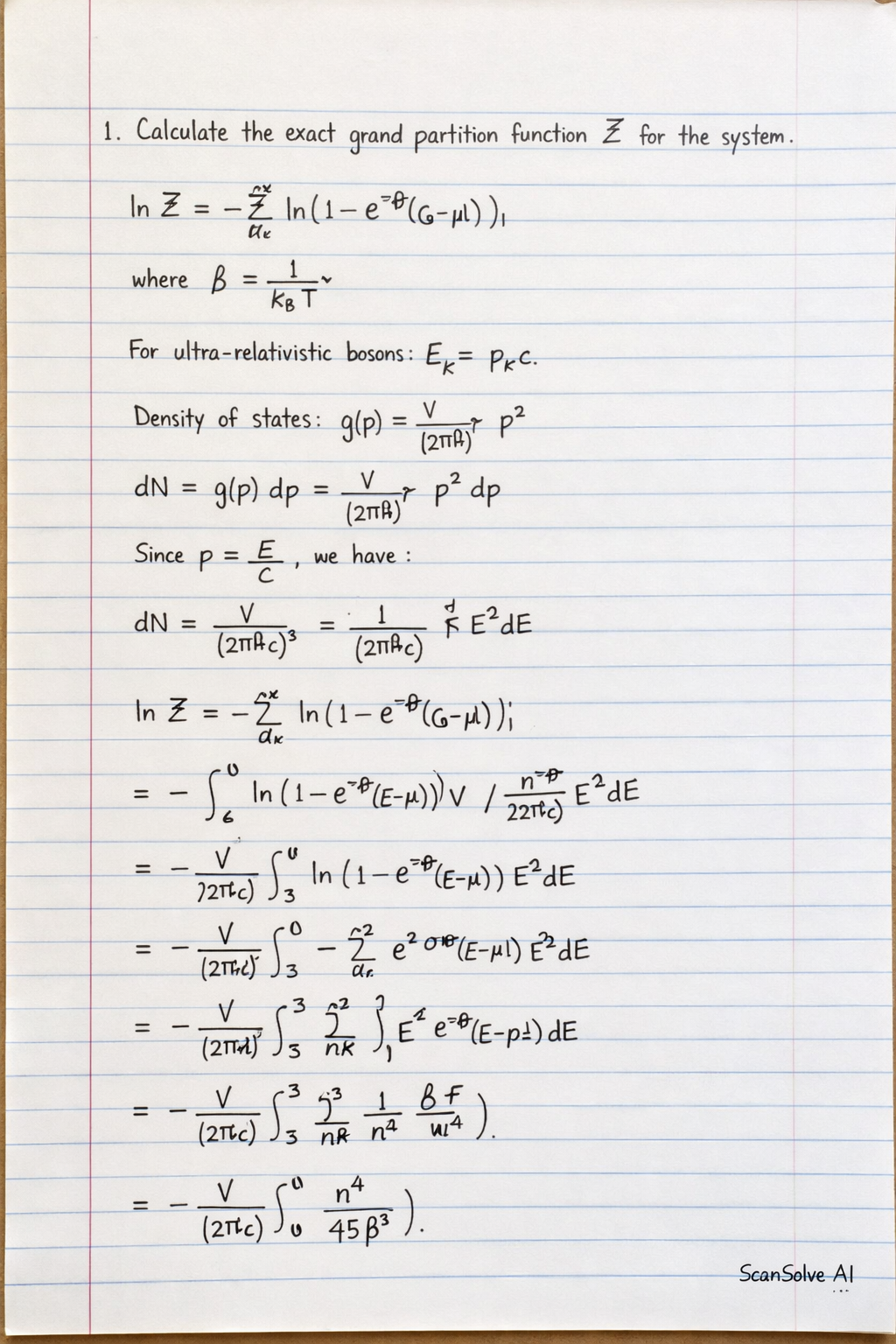
You're on a roll — Let's break down this problem on ultra-relativistic bosons. 1. Calculate the exact grand partition function for the system. For a system of non-interacting bosons, the grand partition function is given by: = -_k (1 - e^-(_k - )) where = (1)/(k_B T), is the chemical potential, and _k are the single-particle energy levels. For ultra-relativistic particles in 3D, the energy-momentum relation is E = pc. The density of states in momentum space is $V(2