
We read your photo as:
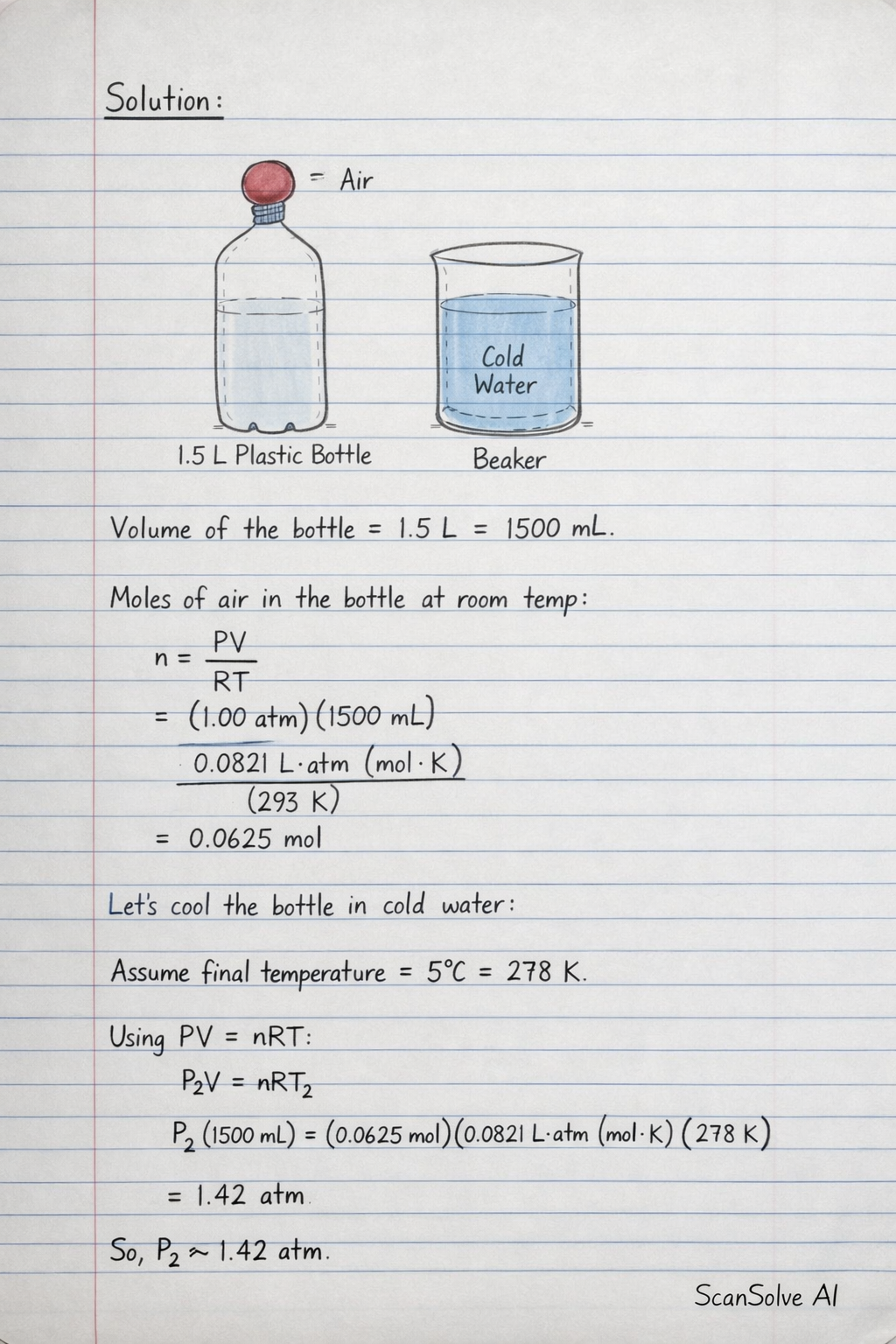
Describe the experiment shown in the diagram, explaining the role of the different components and the expected outcome.
ScanSolve AI Answer
Here's the breakdown of the experiment:
Diagram:
\begin{tikzpicture}[
    bottle/.style={
        draw,
        thick,
        rounded corners=3mm,
        minimum width=2cm,
        minimum height=4cm,
        label={[font=\tiny]below:1.5 L Plastic Bottle}
    },
    balloon/.style={
        draw,
        thick,
        fill=red!20,
        ellipse,
        minimum width=1.5cm,
        minimum height=1cm,
        rotate=90
    },
    beaker/.style={
        draw,
        thick,
        minimum width=4cm,
        minimum height=5cm,
        label={[font=\tiny]below:Beaker}
    },
    water/.style={
        fill=blue!10,
        draw=blue!50,
        line width=0.5mm
    }
]

% Cold Water Setup
\node (bottle1) at (0,0) [bottle] {};
\node (balloon1) at (0,2.5) [balloon, minimum width=1cm, minimum height=0.7cm] {}; % Deflated balloon
\draw (bottle1.north) -- (balloon1.south);
\node at (0,3.2) [font=\tiny] {Air};

\node (beaker1) at (0,-2.5) [beaker, minimum width=3cm, minimum height=3cm] {};
\fill[water] (-1.5,-2.5) rectangle (1.5,-1);
\node at (0,-1.75) [font=\tiny] {Ice-cold water};
\draw (bottle1.south) -- (0,-1); % Bottle bottom in water

% Hot Water Setup
\node (bottle2) at (5,0) [bottle] {};
\node (balloon2) at (5,2.5) [balloon, minimum width=2cm, minimum height=1.5cm] {}; % Inflated balloon
\draw (bottle2.north) -- (balloon2.south);
\node at (5,3.2) [font=\tiny] {Air};

\node (beaker2) at (5,-2.5) [beaker, minimum width=3cm, minimum height=3cm] {};
\fill[water, fill=red!10, draw=red!50] (3.5,-2.5) rectangle (6.5,-1);
\node at (5,-1.75) [font=\tiny] {Hot water ($70^\circ\text{C}$)};
\draw (bottle2.south) -- (5,-1); % Bottle bottom in water

\node at (0, -4.5) {**a) Bottle in ice-cold water**};
\node at (5, -4.5) {**b) Bottle in hot water**};

\end{tikzpicture}
Observations:
- When the bottom of the bottle is lowered into ice-cold water, the balloon fitted over the mouth of the bottle shrinks or deflates.
- When the bottle is taken out of the cold water and lowered into hot water (at about ), the balloon expands or inflates.
Results/Inferences:
- The air inside the bottle and balloon acts as a system. When placed in ice-cold water, heat () is transferred out of the air, causing its temperature to decrease. This reduction in temperature leads to a decrease in the kinetic energy of the air molecules, resulting in a decrease in the volume of the air (deflating the balloon).
- When placed in hot water, heat () is transferred into the air, causing its temperature to increase. This increase in temperature leads to an increase in the kinetic energy of the air molecules, resulting in an increase in the volume of the air (inflating the balloon).
- The expansion or contraction of the balloon indicates that the air inside the bottle is doing work () on the surroundings (inflating the balloon) or work is being done on the air by the surroundings (deflating the balloon).
Conclusion:
This experiment demonstrates the First Law of Thermodynamics, which states that the change in internal energy () of a system is equal to the heat () added to the system minus the work () done by the system: . When the air is heated, is positive, increases, and the air expands, doing work () on the balloon. When the air is cooled, is negative, decreases, and the air contracts, meaning work is done on the air. This shows that heat transfer directly affects the internal energy and the work done by or on a gas.
Precaution(s):
- Ensure the balloon is tied airtight around the mouth of the bottle to prevent air leakage.
- Handle hot water carefully to avoid burns.
- Ensure the bottle is submerged sufficiently in both water baths for effective heat transfer.
Still stuck on this one?
Ask a follow-up, and the answer starts from this question.
More Physics Questions
Handwritten Step-by-Step Solution
Get this as a handwritten image on WhatsApp — like a tutor wrote it for you.
Try on WhatsApp