
Faraday contribution to modern chemistry
Physics
ScanSolve AI Answer
Answer
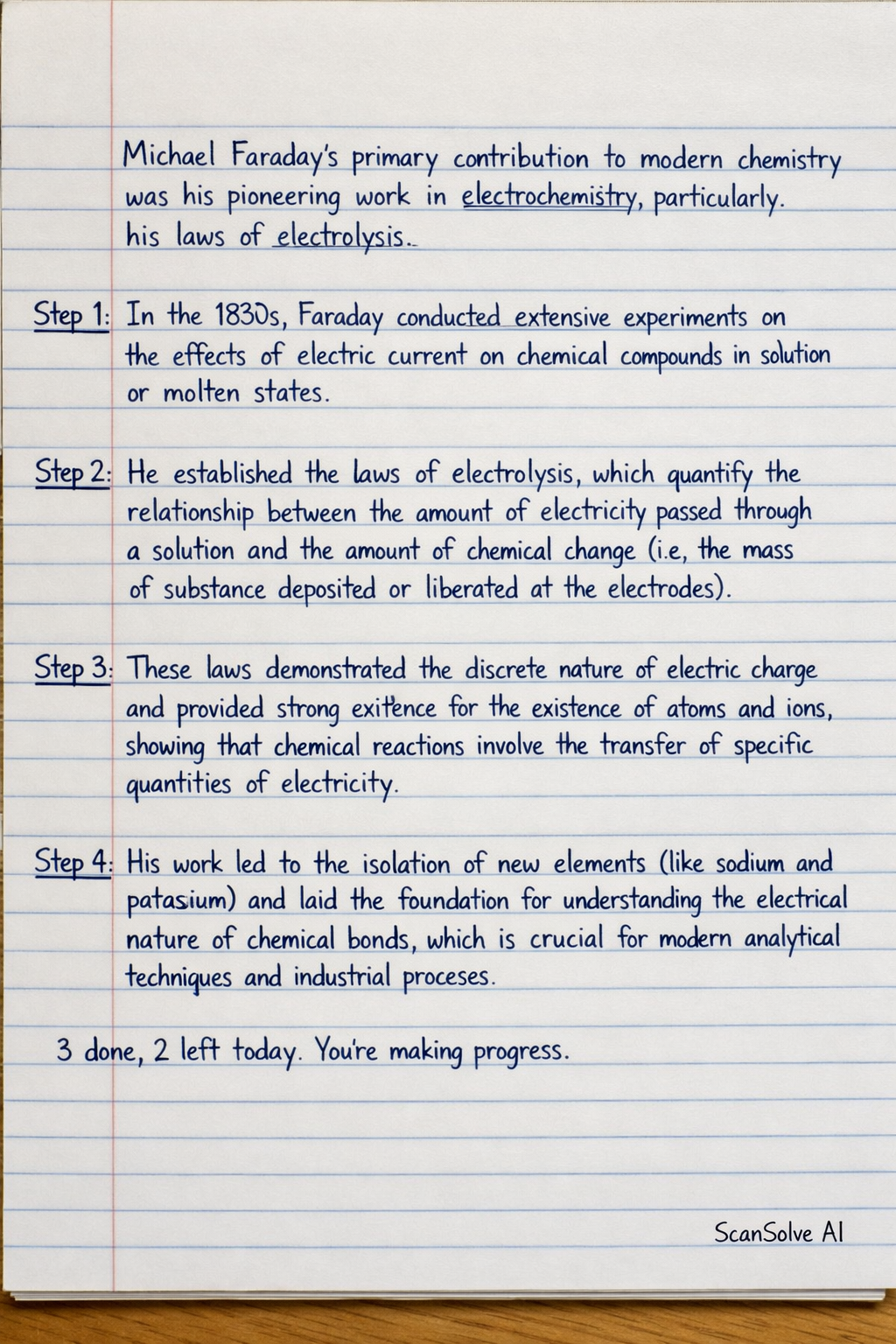
Michael Faraday's primary contribution to modern chemistry was his pioneering work in electrochemistry, particularly his laws of electrolysis.
Step-by-step solution
4 stepsIn the 1830s, Faraday conducted extensive experiments on the effects of electric current on chemical compounds in solution or molten states.
He established the laws of electrolysis, which quantify the relationship between the amount of electricity passed through a solution and the amount of chemical change (i.e., the mass of substance deposited or liberated at the electrodes).
These laws demonstrated the discrete nature of electric charge and provided strong evidence for the existence of atoms and ions, showing that chemical reactions involve the transfer of specific quantities of electricity.
His work led to the isolation of new elements (like sodium and potassium) and laid the foundation for understanding the electrical nature of chemical bonds, which is crucial for modern analytical techniques and industrial processes.
Was this helpful?
Still stuck on this one?
Ask a follow-up, and the answer starts from this question.
Got a different question?Ask your own question
More Physics Questions
QMilikan contribution to modern chemistryQMendeleev contribution to modern chemistryQCan I just say Micheal FaradayQFaraday's law of magnetismQDe Broglie contribution to modern chemistry
Browse by topic:Electromagnetism
Handwritten Step-by-Step Solution
Get this as a handwritten image on WhatsApp — like a tutor wrote it for you.
Try on WhatsApp