
We read your photo as:
Fill in the blanks and explain the reasoning for each statement concerning hydraulic systems.
ScanSolve AI Answer
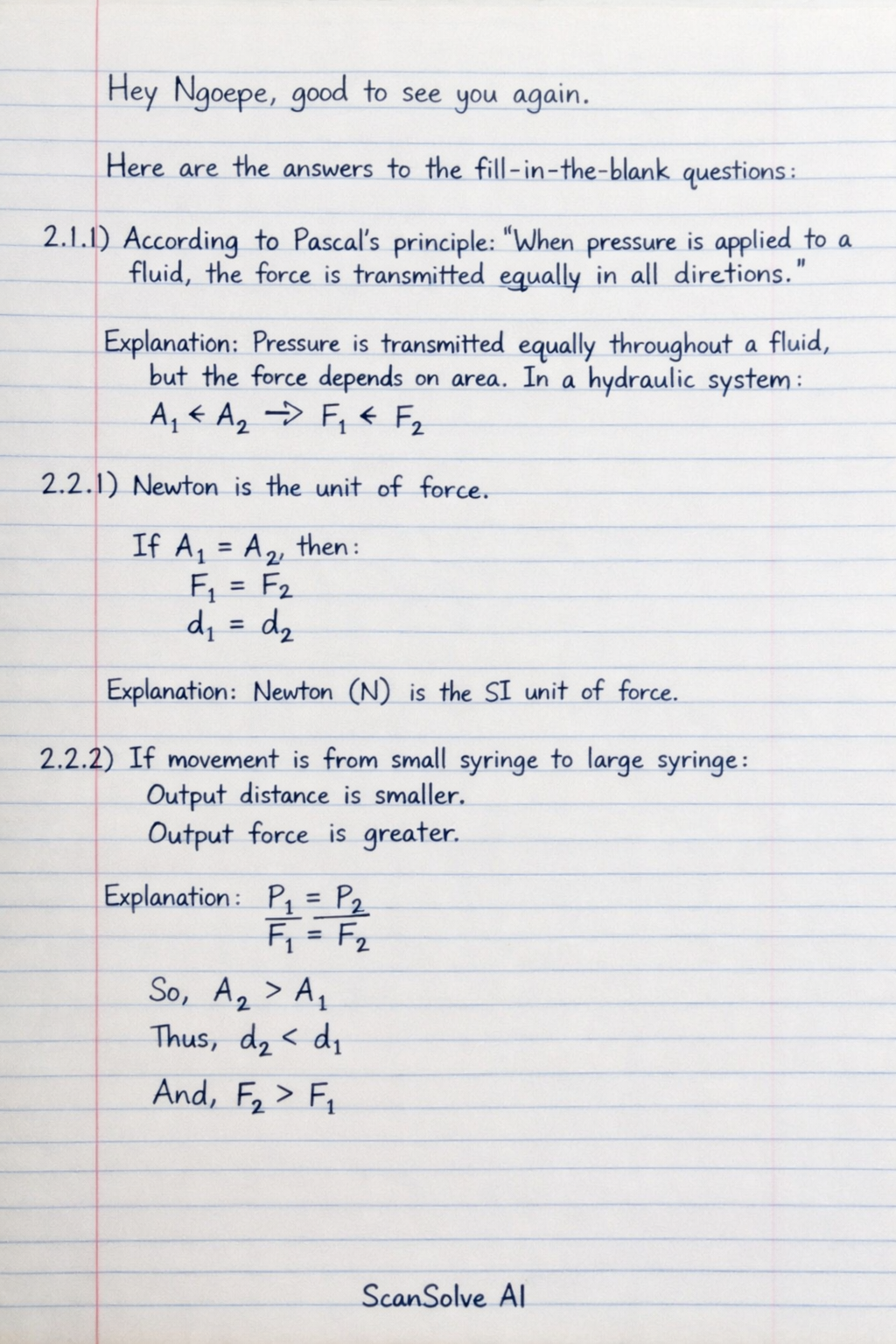
Here are the answers to the fill-in-the-blank questions:
-
2.1.1 According to Pascal's principle "when pressure is applied to a fluid, the force is transmitted (equally / unequally) in all directions". Explanation: While pressure is transmitted equally throughout a fluid, the force exerted depends on the area. In a hydraulic system, if the areas are different, the forces will be different (unequal).
-
2.2.1 Newton is the unit in which force is measured in a hydraulic system with two equal syringes, we get equal distance and equal force between the two syringes. Explanation: The Newton is the SI unit for force.
-
2.2.2 In a hydraulic system where movement is from a small syringe to a larger syringe, the output distance is smaller and the output force is greater. Explanation: To conserve volume, if the output piston has a larger area, it will move a smaller distance. Due to Pascal's principle (), a larger output area () results in a greater output force ().
-
2.2.3 When the output force is increased by the force transfer from the input force, we call this force multiplication (or mechanical advantage). Explanation: This process is known as force multiplication, which is the primary application of hydraulic systems.
Still stuck on this one?
Ask a follow-up, and the answer starts from this question.
More Physics Questions
Handwritten Step-by-Step Solution
Get this as a handwritten image on WhatsApp — like a tutor wrote it for you.
Try on WhatsApp